
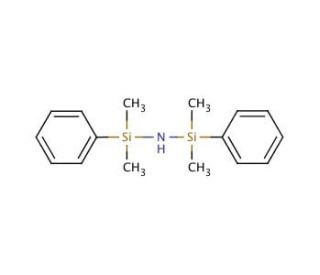

1,1,3,3-Tetramethyl-1,3-diphenyldisilazane 의 분자 구조, CAS 번호: 3449-26-1
1,1,3,3-Tetramethyl-1,3-diphenyldisilazane (CAS 3449-26-1)
대체 이름:
DPTMDS; 1,3-Diphenyltetramethyldisilazane
CAS 등록번호:
3449-26-1
분자량:
285.53
분자식:
C16H23NSi2
연구용으로만 사용가능합니다. 진단이나 치료용으로 사용불가합니다.
* Refer to Certificate of Analysis for lot specific data.
빠른 링크
주문정보
설명
기술정보
안전정보
SDS 및 분석 증명서
1,1,3,3-테트라메틸-1,3-디페닐디실라잔은 일반적으로 DMTD로 알려져 있으며 수십 년에 걸쳐 광범위한 과학적 용도를 가진 유기 실리콘 화합물이다. 안정적이고 무색의 액체이며, 비휘발성이며 물에 녹지 않지만 다양한 유기 용매에 쉽게 용해된다. 이 다용도 화합물은 유기 합성에서 가장 널리 사용되는 실리콘계 시약으로서 중요한 역할을 하며, 다양한 화합물의 생성에 크게 기여했다. 1,1,3,3,3-테트라메틸-1,3-디페닐디실라잔은 유기 합성 및 생화학과 같은 다양한 분야에서 귀중한 것으로 입증되었다. 이 촉매 특성은 수많은 화합물의 합성을 촉진하는 데 중요한 역할을 했다. 더욱이 시약으로서의 효능은 펩티드 및 기타 생체고분자를 포함한 다양한 유기 화합물의 생성에 중요한 역할을 했다. 1,1,3,3-테트라메틸-1,3-디페닐디실라잔은 친핵성 시약으로서 기능하여 미쓰노부 반응에서 그 응용을 발견한다. 이 과정에서 친핵성 시약이 방향족 아민의 친핵성 탄소 원자를 공격하여 중간 생성물이 생성되고, 이를 가수분해하여 원하는 최종 생성물이 생성된다. 이 고도로 선택적인 반응은 매우 정확한 다양한 화합물 배열을 합성하는 강력한 도구임이 입증되었다.
1,1,3,3-Tetramethyl-1,3-diphenyldisilazane (CAS 3449-26-1) 참고자료
- 아이슬란드로 헤엄쳐 온 영양실조 북극곰(우르수스 마리티무스)의 지질 종류와 지방산을 질량 분석하는 박층 크로마토그래피와 기체 크로마토그래피를 결합했습니다. | Eibler, D., et al. 2017. J Chromatogr B Analyt Technol Biomed Life Sci. 1046: 138-146. PMID: 28183043
- 실라잔과 MCl4 치환 및 재배열 반응 비교 | C. Lehnert, J. Wagler, E. Kroke & G. Roewer. 2006. Chemistry of Heterocyclic Compounds. 42: 1574–1584.
- R3Si-NH-SiR3형 디실라잔에 대한 검토: 합성에서 응용까지 | Krzysztof Kuciński, Hanna Stachowiak, Dariusz Lewandowski, Marcin Gruszczyński, Paulina Lampasiak, Grzegorz Hreczycho. 2022. Journal of Organometallic Chemistry. 961.
주문정보
| 제품명 | 카탈로그 번호 | 단위 | 가격 | 수량 | 관심품목 | |
1,1,3,3-Tetramethyl-1,3-diphenyldisilazane, 1 g | sc-237650 | 1 g | $31.00 |