
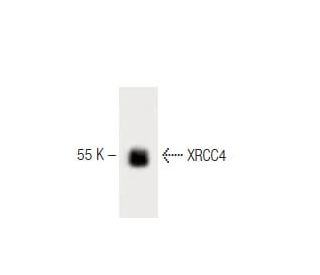


XRCC4 Antibody (4): sc-136124
- XRCC4 Antibody (4) is a mouse monoclonal IgG2b provided at 50 µg/0.5 ml
- raised against amino acids 53-168 of XRCC4 of human origin
- recommended for detection of XRCC4 of human origin by WB, IP and IF
- At present, we have not yet completed the identification of the preferred secondary detection reagent(s) for XRCC4 Antibody (4). This work is in progress.

QUICK LINKS
XRCC4 Antibody (4) is a mouse monoclonal IgG2b antibody that detects XRCC4 in human samples through applications such as western blotting (WB), immunoprecipitation (IP), and immunofluorescence (IF). XRCC4 plays a crucial role in the DNA double-strand break repair (DSBR) pathway, which is essential for maintaining genomic stability and preventing chromosomal aberrations that can lead to cancer. XRCC4 is primarily located in the nucleus, where XRCC4 interacts with other key repair proteins to facilitate the repair of DNA breaks. XRCC4′s nuclear localization enables quick responses to DNA damage, ensuring repair processes are initiated promptly to maintain cellular integrity. XRCC4 forms a complex with DNA ligase IV, which is vital for the final steps of the non-homologous end joining repair mechanism. Understanding XRCC4′s function and localization helps researchers better appreciate XRCC4′s role in cellular responses to DNA damage and implications in cancer biology, making anti-XRCC4 antibody (4) an invaluable tool for studying DNA repair mechanisms in human cells.
Alexa Fluor® is a trademark of Molecular Probes Inc., OR., USA
LI-COR® and Odyssey® are registered trademarks of LI-COR Biosciences
XRCC4 Antibody (4) References:
- The role of XRCC4 in carcinogenesis and anticancer drug discovery. | Wu, CN., et al. 2008. Recent Pat Anticancer Drug Discov. 3: 209-19. PMID: 18991789
- XRCC4 and XLF form long helical protein filaments suitable for DNA end protection and alignment to facilitate DNA double strand break repair. | Mahaney, BL., et al. 2013. Biochem Cell Biol. 91: 31-41. PMID: 23442139
- Mutations in XRCC4 cause primordial dwarfism without causing immunodeficiency. | Saito, S., et al. 2016. J Hum Genet. 61: 679-85. PMID: 27169690
- Prognostic significance of XRCC4 expression in hepatocellular carcinoma. | Lu, J., et al. 2017. Oncotarget. 8: 87955-87970. PMID: 29152133
- Silencing of XRCC4 increases radiosensitivity of triple-negative breast cancer cells. | Wen, Y., et al. 2019. Biosci Rep. 39: PMID: 30842344
- Reciprocal regulation of RIG-I and XRCC4 connects DNA repair with RIG-I immune signaling. | Guo, G., et al. 2021. Nat Commun. 12: 2187. PMID: 33846346
- Role of Paralogue of XRCC4 and XLF in DNA Damage Repair and Cancer Development. | Tang, J., et al. 2022. Front Immunol. 13: 852453. PMID: 35309348
- Systematic analysis identifies XRCC4 as a potential immunological and prognostic biomarker associated with pan-cancer. | Yu, Y., et al. 2023. BMC Bioinformatics. 24: 44. PMID: 36765282
- Androgen signaling stabilizes genomes to counteract senescence by promoting XRCC4 transcription. | Chen, Y., et al. 2023. EMBO Rep. 24: e56984. PMID: 37955230
- SMYD3 promotes endometrial cancer through epigenetic regulation of LIG4/XRCC4/XLF complex in non-homologous end joining repair. | Huang, Y., et al. 2024. Oncogenesis. 13: 3. PMID: 38191478
Ordering Information
| Product Name | Catalog # | UNIT | Price | Qty | FAVORITES | |
XRCC4 Antibody (4) | sc-136124 | 50 µg/0.5 ml | $322.00 |