
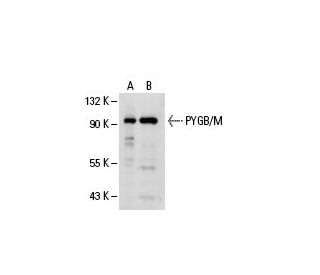
PYGB/M Anticuerpo (3G1): sc-51925
- PYGB/M Anticuerpo 3G1 es un monoclonal de ratón IgG1 PYGB/M Anticuerpo proporcionado como 100 µg/ml
- planteado contra human glicógeno fosforilasa cerebral
- recomendado para detectar PYGB and PYGM de human origen, mediante WB y IP
- Actualmente, aún no hemos completado la identificación de los reactivos de detección secundaria preferidos para PYGB/M Anticuerpo (3G1). Este trabajo está en progreso.

ENLACES RÁPIDOS
VER TAMBIÉN ....
El anticuerpo PYGB/M (3G1) es un anticuerpo monoclonal de ratón IgG1 que detecta la proteína PYGB/M de origen humano mediante WB e IP. Este anticuerpo está disponible como anticuerpo anti-PYGB/M no conjugado. La glicólisis es una serie evolutivamente conservada de diez reacciones químicas que utiliza once enzimas para generar simultáneamente piruvato y ATP a partir de glucosa. La fosfofructoquinasa-2/fructosa 2,6-bifosfatasa (PFK-2) estimula la síntesis y degradación de fructosa 2,6-bifosfato. La fosforilasa de glucógeno (también conocida como GP) es una enzima alostérica importante en el metabolismo de carbohidratos. Su actividad está regulada ya sea mediante la unión no covalente de metabolitos o mediante modificación covalente. La fosforilasa de glucógeno cataliza la fosforilación de glucógeno a Glc-1-P. Hay tres genes que codifican las formas cerebral, hepática y muscular de la fosforilasa de glucógeno, PYGB, PYGL y PYGM. Debido a su papel fundamental en el metabolismo del glucógeno, la fosforilasa de glucógeno ha sido un objetivo para el diseño de compuestos inhibidores, que podrían ser valiosos en el tratamiento terapéutico de la diabetes mellitus tipo 2.
Alexa Fluor® es una marca registrada de Molecular Probes Inc., OR., USA
REIVEW LI-COR® y Odyssey® son marcas registradas de LI-COR Biosciences.
PYGB/M Anticuerpo (3G1) Referencias:
- Comparación de marcadores bioquímicos para la detección de lesiones miocárdicas mínimas: sensibilidad superior de la troponina cardiaca--T ELISA. | Lang, K., et al. 2000. J Intern Med. 247: 119-23. PMID: 10672139
- La glucógeno fosforilasa BB en los síndromes coronarios agudos. | Peetz, D., et al. 2005. Clin Chem Lab Med. 43: 1351-8. PMID: 16309372
- Efecto de la proteína RecF en las reacciones catalizadas por la proteína RecA. | Madiraju, MV. and Clark, AJ. 1991. Nucleic Acids Res. 19: 6295-300. PMID: 1835535
- Genes rec y proteínas de recombinación homóloga en Escherichia coli. | Clark, AJ. 1991. Biochimie. 73: 523-32. PMID: 1911953
- Nueva variante en el gen PYGM que causa miopatía de cinturas de extremidades de aparición tardía, ptosis y camptocormia. | Chéraud, C., et al. 2018. Muscle Nerve. 57: 157-160. PMID: 28120463
- El análisis proteómico diferencial del líquido endometrial sugiere un aumento de la inflamación y una alteración del metabolismo de la glucosa en los ciclos de FIV no implantatorios y señala a la PYGB como un posible marcador de implantación. | Azkargorta, M., et al. 2018. Hum Reprod. 33: 1898-1906. PMID: 30169642
- Los cánceres de mama utilizan las reservas hipóxicas de glucógeno a través de PYGB, la isoforma cerebral de la glucógeno fosforilasa, para promover fenotipos metastásicos. | Altemus, MA., et al. 2019. PLoS One. 14: e0220973. PMID: 31536495
- La PYGB dirigida por el receptor de andrógenos contribuye a la progresión tumoral y a la reprogramación metabólica en el carcinoma escamoso esofágico. | Miao, H., et al. 2024. Cell Signal. 124: 111481. PMID: 39442902
- ¿Pueden la clonidina, la enoximona y el enalaprilato ayudar a proteger el miocardio frente a la isquemia en la cirugía cardiaca? | Boldt, J., et al. 1996. Heart. 76: 207-13. PMID: 8868976
- La isoenzima BB de la glucógeno fosforilasa en el diagnóstico de la lesión isquémica miocárdica y el infarto. | Krause, EG., et al. 1996. Mol Cell Biochem. 160-161: 289-95. PMID: 8901485
- Avances en la detección del daño miocárdico: nuevos marcadores bioquímicos para los clínicos. | Mair, J. 1997. Crit Rev Clin Lab Sci. 34: 1-66. PMID: 9055056
- Glucógeno fosforilasa isoenzima BB en el diagnóstico del daño miocárdico isquémico. | Mair, J. 1998. Clin Chim Acta. 272: 79-86. PMID: 9581859
Información sobre pedidos
| Nombre del producto | Número de catálogo | UNIDAD | Precio | CANTIDAD | Favoritos | |
PYGB/M Anticuerpo (3G1) | sc-51925 | 100 µg/ml | $322.00 |