
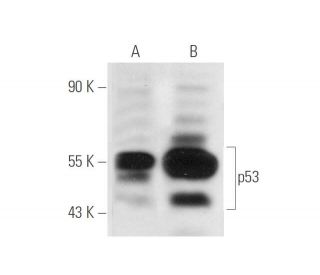
p53 Antibody (B-P3): sc-65334
- p53 Antibody (B-P3) is a mouse monoclonal IgG2a κ, cited in 13 publications, provided at 200 µg/ml
- raised against recombinant p53 of human origin
- recommended for detection of all forms of p53 of mouse, rat and human origin by WB, IP, IF, IHC(P) and ELISA
- See p53 (DO-1): sc-126 for p53 antibody conjugates, including AC, HRP, FITC, PE, Alexa Fluor® 488, 594, 647, 680 and 790.
- m-IgG Fc BP-HRP is the preferred secondary detection reagent for p53 Antibody (B-P3) for WB and IHC(P) applications. This reagent is now offered in a bundle with p53 Antibody (B-P3) (see ordering information below).

QUICK LINKS
SEE ALSO...
p53 Antibody (B-P3) is an IgG2a kappa light chain mouse monoclonal antibody that is highly specific for detecting p53 in mouse, rat, and human species. p53 monoclonal antibody (B-P3) is raised against a recombinant protein corresponding to amino acids 16-25 of p53 of human origin. The p53 protein is a critical tumor suppressor protein involved in maintaining genomic stability. p53 mouse monoclonal antibody (B-P3) is a valuable tool for studying p53 expression and function across different experimental molecular biology assays. p53, encoded by the TP53 gene, plays a key role in regulating DNA repair, cell cycle arrest, apoptosis, and senescence in response to cellular stress or DNA damage. It inhibits further progression of the cell cycle to allow for repair or triggers apoptosis when damage is beyond repair, thus preventing tumor formation. Post-translational modifications such as phosphorylation and acetylation enhance p53’s stability and functionality. By studying p53 with the anti-p53 antibody (B-P3), scientist can gain a deeper understanding into how mutations in this protein disrupts its tumor-suppressing function. p53 research is critical for developing cancer therapies aimed at restoring p53 activity or compensating for its loss in tumor cells. Applying this antibody provides deeper insights into the molecular pathways influenced by p53 and how its dysfunction drives cancer progression, paving the way for advancements in cancer diagnostics.
Alexa Fluor® is a trademark of Molecular Probes Inc., OR., USA
LI-COR® and Odyssey® are registered trademarks of LI-COR Biosciences
p53 Antibody (B-P3) References:
- Cellular and molecular advances in elucidating p53 function. | Shay, JW., et al. 1992. Mutat Res. 277: 163-71. PMID: 1378532
- Functional analysis of p53 tumor suppressor in yeast. | Smardová, J., et al. 2005. Differentiation. 73: 261-77. PMID: 16138827
- Gain of function of p53 cancer mutants in disrupting critical DNA damage response pathways. | Song, H. and Xu, Y. 2007. Cell Cycle. 6: 1570-3. PMID: 17598983
- Molecular dynamics simulation of S100B protein to explore ligand blockage of the interaction with p53 protein. | Zhou, Z. and Li, Y. 2009. J Comput Aided Mol Des. 23: 705-14. PMID: 19597941
- Recent discoveries in the cycling, growing and aging of the p53 field. | McCubrey, JA. and Demidenko, ZN. 2012. Aging (Albany NY). 4: 887-93. PMID: 23425920
- Mechanisms of mutant p53 stabilization in cancer. | Frum, RA. and Grossman, SR. 2014. Subcell Biochem. 85: 187-97. PMID: 25201195
- Tumor suppressor p53 mutations and breast cancer: a critical analysis. | Ozbun, MA. and Butel, JS. 1995. Adv Cancer Res. 66: 71-141. PMID: 7793321
- Tumor cell-specific loss of p53 protein in a unique in vitro model of human breast tumor progression. | Liu, XL., et al. 1994. Carcinogenesis. 15: 1969-73. PMID: 7923592
- Wild-type alternatively spliced p53: binding to DNA and interaction with the major p53 protein in vitro and in cells. | Wu, Y., et al. 1994. EMBO J. 13: 4823-30. PMID: 7957051
- Expression and stability of p53 protein in normal human mammary epithelial cells. | Delmolino, L., et al. 1993. Carcinogenesis. 14: 827-32. PMID: 8504474
Ordering Information
| Product Name | Catalog # | UNIT | Price | Qty | FAVORITES | |
p53 Antibody (B-P3) | sc-65334 | 200 µg/ml | $322.00 | |||
p53 Antibody (B-P3): m-IgG Fc BP-HRP Bundle | sc-539171 | 200 µg Ab; 10 µg BP | $361.00 |