
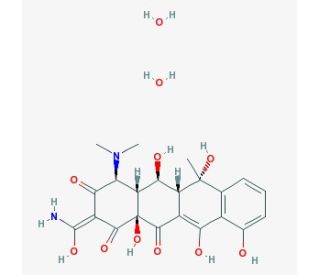

Oxytetracycline Dihydrate (CAS 6153-64-6)
QUICK LINKS
Oxytetracycline Dihydrate, registered under CAS number 6153-64-6, is a dihydrate form of oxytetracycline, a broad-spectrum antibiotic belonging to the tetracycline class, primarily used in research to study bacterial protein synthesis and gene expression. The core mechanism of action of Oxytetracycline Dihydrate involves the inhibition of protein synthesis by binding to the 30S ribosomal subunit of bacteria. This binding interferes with the attachment of aminoacyl-tRNA to the mRNA-ribosome complex at the acceptor (A) site, effectively blocking the addition of new amino acids to the growing polypeptide chain during translation. This interruption in protein synthesis ultimately inhibits bacterial growth and proliferation. In research settings, Oxytetracycline Dihydrate has been extensively used to explore the dynamics of bacterial response to ribosomal inhibition, particularly in understanding how bacteria adapt and potentially develop resistance to such mechanisms. These studies often focus on the genetic mutations that confer resistance, the environmental conditions that favor such adaptations, and the overall impact on bacterial fitness. The compound′s ability to affect a wide range of bacteria makes it an ideal candidate for studies aimed at deciphering complex bacterial behaviors and interactions under controlled laboratory conditions, contributing significantly to our understanding of microbial ecology and molecular biology.
Oxytetracycline Dihydrate (CAS 6153-64-6) References
- Long-acting antibiotic formulations in the treatment of calf pneumonia: a comparative study of tilmicosin and oxytetracycline. | Laven, R. and Andrews, AH. 1991. Vet Rec. 129: 109-11. PMID: 1926728
- Oxytetracycline does not cause growth promotion in finfish. | Trushenski, JT., et al. 2018. J Anim Sci. 96: 1667-1677. PMID: 29608688
- Evaluation of oxidative stress in caprine anaplasmosis and effect of vitamin E-selenium in monitoring oxidative stress. | Dhanasree, G., et al. 2020. Trop Anim Health Prod. 52: 2695-2698. PMID: 31838717
- Leptospira Interrogans Serogroup Sejroe Serovar Hardjo in Aborting Cows: Two Herd Cases in Sicily (Italy). | Grippi, F., et al. 2020. J Vet Res. 64: 73-78. PMID: 32258802
- Assessing safety, efficacy and residue depletion in golden mahseer, Tor putitora (Hamilton, 1822): biochemical and physiological responses to graded concentrations of oxytetracycline dietary supplementation. | Mallik, SK., et al. 2024. Vet Res Commun. 48: 1573-1593. PMID: 38409399
- Pharmacokinetics and renal clearance of oxytetracycline after intravenous and intramuscular administration to dairy cows. | Nouws, JF., et al. 1985. Vet Q. 7: 296-305. PMID: 4071950
- Oxytetracycline tablet formulations: the influence of excipients and the method of granulation. | Chalmers, AA. and Elworthy, PH. 1976. J Pharm Pharmacol. 28: 234-8. PMID: 6698
- Oxytetracycline tablet formulations: the effect of wet mixing time, particle size and batch variation on granule and tablet properties. | Chalmers, AA. and Elworthy, PG. 1976. J Pharm Pharmacol. 28: 239-43. PMID: 6699
- Bioavailability of oxytetracycline dihydrate tablets in dogs. | Cooke, RG., et al. 1981. J Vet Pharmacol Ther. 4: 11-3. PMID: 7349318
Ordering Information
| Product Name | Catalog # | UNIT | Price | Qty | FAVORITES | |
Oxytetracycline Dihydrate, 1 g | sc-212492 | 1 g | $320.00 |