
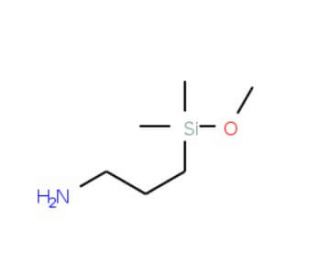

(3-Aminopropyl)dimethylmethoxysilane (CAS 31024-26-7)
QUICK LINKS
(3-Aminopropyl)dimethylmethoxysilane (APDMS) is a versatile organosilicon compound extensively utilized in scientific research and various industrial applications. It presents itself as a white, water-soluble liquid with a low vapor pressure and minimal volatility. Its low melting point and miscibility in most organic solvents further enhance its applicability. (3-Aminopropyl)dimethylmethoxysilane serves multiple roles, finding use as a surfactant, coupling agent, emulsifier, and catalyst. This broadens its applications across different fields. In scientific research, it functions as a surfactant during the synthesis of both organic and inorganic compounds, while also acting as a coupling agent in the preparation of thin films and nanostructures.The key to its effectiveness lies in its ability to form hydrogen bonds with other molecules. This unique characteristic enables (3-Aminopropyl)dimethylmethoxysilane to serve as a surfactant, coupling agent, and promoter of nanostructure formation. Additionally, it acts as a catalyst, facilitating the reaction of various organic and inorganic compounds, thereby amplifying its impact on chemical processes.
(3-Aminopropyl)dimethylmethoxysilane (CAS 31024-26-7) References
- Biosensing using lipid bilayers suspended on porous silicon. | Worsfold, O., et al. 2006. Langmuir. 22: 7078-83. PMID: 16863263
- Catalyzed oxidative corrosion of porous silicon used as an optical transducer for ligand-receptor interactions. | Voelcker, NH., et al. 2008. Chembiochem. 9: 1776-86. PMID: 18576449
- Kinetics and computational studies of an aminosilane reaction with a silsesquioxane silanol. | Frei, R., et al. 2009. J Phys Chem A. 113: 6612-9. PMID: 19514783
- A fluorescence based method for the quantification of surface functional groups in closed micro- and nanofluidic channels. | Wang, Y., et al. 2013. Biomicrofluidics. 7: 26503. PMID: 24404019
- Quantification of variable functional-group densities of mixed-silane monolayers on surfaces via a dual-mode fluorescence and XPS label. | Fischer, T., et al. 2015. Anal Chem. 87: 2685-92. PMID: 25621905
- Novel Nanocomposites of Poly(lauryl methacrylate)-Grafted Al2O3 Nanoparticles in LDPE. | Cobo Sánchez, C., et al. 2015. ACS Appl Mater Interfaces. 7: 25669-78. PMID: 26468765
- Enhanced Performance of a Molecular Photoacoustic Imaging Agent by Encapsulation in Mesoporous Silicon Nanoparticles. | Kang, J., et al. 2018. Adv Mater. 30: e1800512. PMID: 29782671
- Loading of PNA and Other Molecular Payloads on Inorganic Nanostructures for Theranostics. | Bertucci, A., et al. 2018. Methods Mol Biol. 1811: 65-77. PMID: 29926446
Ordering Information
| Product Name | Catalog # | UNIT | Price | Qty | FAVORITES | |
(3-Aminopropyl)dimethylmethoxysilane, 5 g | sc-281662 | 5 g | $142.00 |