
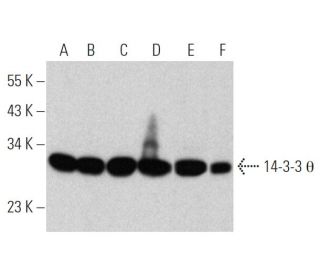
14-3-3 θ抗体(5J20): sc-69720
- 14-3-3 theta抗体 5J20はマウスモノクローナルIgG114-3-3 θ 抗体 です。200 µg/mlで提供
- アミノ酸に対して調製された human 由来の全長 14-3-3 θ
- mouse, rat と human 由来の14-3-3 θ WB, IP, IF, IHC(P), FCM と ELISAでの検出にはお勧めします; 以下追加動物種との反応性もあります: bovine; 14-3-3 ζにも抗体が反応する事がありません。
- 現在、14-3-3 θ Antibody (5J20)に適した二次検出試薬の同定はまだ完了していません。この研究は進めています。

14-3-3 θ 抗体 (5J20) はマウスモノクローナル IgG1 κ軽鎖抗体で、マウス、ラット、ヒト由来の 14-3-3 θ タンパク質をウェスタンブロッティング (WB)、免疫沈降 (IP)、免疫蛍光 (IF)、パラフィン包埋切片を用いた免疫組織化学 (IHCP)、フローサイトメトリー (FCM)、酵素結合免疫吸着測定法 (ELISA) により検出します。抗 14-3-3 θ 抗体 (5J20) はノンコンジュゲートで入手可能です。14-3-3θタンパク質は、様々な細胞プロセスの制御、特に癌生物学において重要な役割を果たしており、14-3-3θタンパク質はアポトーシス、分裂促進シグナル伝達、細胞周期チェックポイントに関与している。14-3-3θタンパク質は主に細胞質に存在し、そこで14-3-3θタンパク質は様々なパートナータンパク質と相互作用し、適切な機能と局在を促進している。細胞質における14-3-3シータタンパク質の存在は、細胞の生存と増殖に不可欠なシグナル伝達経路の制御を可能にする。14-3-3シータタンパク質は、細胞質に標的タンパク質を隔離することにより、分解を防ぎ、活性を調節し、ストレスや成長シグナルに対する重要な細胞応答に影響を与える。14-3-3タンパク質による二量体形成は、コンセンサス結合モチーフを共有するリガンドとの結合部位を作り、細胞の恒常性維持における重要性を強調している。14-3-3シータタンパク質の発現低下や機能不全は、これらの経路の調節不全を引き起こし、癌を含む様々な病態の一因となる。
Alexa Fluor® はMolecular Probes Inc., OR., USAの商標です。
LI-COR® and Odyssey® はLI-COR Biosciencesの登録商標です。
14-3-3 θ抗体(5J20) 参考文献:
- DAL-1/プロテイン4.1B腫瘍抑制因子の4.1/ezrin/radixin/moesinドメインは14-3-3タンパク質と相互作用する。 | Yu, T., et al. 2002. Biochem J. 365: 783-9. PMID: 11996670
- 骨髄性白血病因子1の14-3-3結合部位のリン酸化を仲介する新規アダプタータンパク質MADM。 | Lim, R., et al. 2002. J Biol Chem. 277: 40997-1008. PMID: 12176995
- 14-3-3の癌との関係 | Hermeking, H. 2003. Nat Rev Cancer. 3: 931-43. PMID: 14737123
- シロイヌナズナにおける14-3-3タンパク質のアイソフォーム特異的細胞内局在は, クライアントとの相互作用によって駆動されているようだ。 | Paul, AL., et al. 2005. Mol Biol Cell. 16: 1735-43. PMID: 15659648
- 14-3-3θの過剰発現は、乳がんの転移を促進し、予後不良を示す。 | Li, N., et al. 2014. Oncotarget. 5: 249-57. PMID: 24371149
- MiR-27aは14-3-3θ, RUNX1, AF4, MLL-AF4をダウンレギュレートし, t(4;11)白血病細胞における芽球転化の重要なドライバーとなる。 | Fioretti, T., et al. 2022. Cell Biochem Funct. 40: 706-717. PMID: 35981137
- シノメニンは, 14-3-3θタンパク質を促進し, NF-κBシグナルを阻害することにより, デキストラン硫酸ナトリウム誘発炎症反応を抑制した。 | Zhou, Y., et al. 2023. J Ethnopharmacol. 303: 116037. PMID: 36526094
- 14-3-3θのリン酸化はα-シヌクレインの凝集と毒性作用を増悪させる。 | Wang, B., et al. 2025. Neurobiol Dis. 206: 106801. PMID: 39805369
- 14-3-3:シグナル伝達タンパク質のモジュレーター? | Morrison, D. 1994. Science. 266: 56-7. PMID: 7939645
- ヒト14-3-3エタ鎖遺伝子(YWHAH)の構造構成と染色体上の位置。 | Muratake, T., et al. 1996. Genomics. 36: 63-9. PMID: 8812417
- 14-3-3:リン酸化ペプチド結合特異性の構造的基盤。 | Yaffe, MB., et al. 1997. Cell. 91: 961-71. PMID: 9428519
- 新規スフィンゴシン依存性プロテインキナーゼ(SDK1)は, 14-3-3タンパク質の特定のアイソフォームを特異的にリン酸化する。 | Megidish, T., et al. 1998. J Biol Chem. 273: 21834-45. PMID: 9705322
注文情報
| 製品名 | カタログ # | 単位 | 価格 | 数量 | お気に入り | |
14-3-3 θ 抗体 (5J20) | sc-69720 | 200 µg/ml | $322.00 | |||
14-3-3 θ (5J20): m-IgG Fc BP-HRP Bundle | sc-551866 | 200 µg Ab; 10 µg BP | $361.00 |