

translin Double Nickase Plasmid (h): sc-407354-NIC
- Target species: human
- 20 µg of transfection-ready, purified plasmid DNA; Suitable for up to 20 transfections
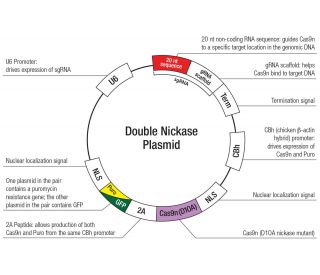
- translin Double Nickase Plasmid (h) consists of a pair of plasmids each encoding a D10A mutated Cas9 nuclease and a target-specific 20 nt guide RNA (gRNA) designed to knockout gene expression with greater specificity than its CRISPR/Cas9 KO counterpart
- Paired gRNA sequences are offset by approximately 20 bp to allow for specific Cas9-mediated double nicking of the genomic DNA, which mimics a DSB
- One plasmid in the pair contains a puromycin-resistance gene for selection; the other plasmid in the pair contains a GFP marker to visually confirm transfection
- translin Double Nickase Plasmid (h) and translin Double Nickase Plasmid (h2) encode distinct paired gRNA designs targeting TSN. One or both designs may be available
- Following transfection, gene knockout efficiency can be assayed by WB, IF or IHC using antibody: translin Antibody (C-2): sc-390472

Ordering Information
| Product Name | Catalog # | UNIT | Price | Qty | FAVORITES | |
translin Double Nickase Plasmid (h) | sc-407354-NIC | 20 µg | $410.00 | |||
translin Double Nickase Plasmid (h2) | sc-407354-NIC-2 | 20 µg | $410.00 |
TSN encodes translin, a conserved nucleic acid–binding protein that forms a complex with trax and contributes to RNA metabolism, including regulation of mRNA stability, transport, and small RNA pathways. Translin has been linked to post-transcriptional gene control in the cytoplasm and nucleus and is implicated in processes such as stress responses and neuronal function through modulation of RNA fate. Altered TSN/translin activity has been associated in the literature with dysregulated gene expression programs observed in cancer biology and neurodevelopmental or neuropsychiatric phenotypes. These features make TSN a useful node for studying RNA-centric regulation of cellular state and pathway plasticity.
translin Double Nickase Plasmid (h) consists of a matched pair of plasmids engineered for high-specificity editing of the TSN locus in human cell lines. Each plasmid expresses a Cas9 D10A nickase and a distinct sgRNA targeting opposite DNA strands within TSN. When directed to adjacent sites on opposite DNA strands, the two nickases generate offset single-strand nicks that together produce a staggered double-strand break, requiring coordinated on-target activity from both guides. The resulting DNA break is resolved by endogenous cellular repair pathways, most commonly through non-homologous end joining (NHEJ), leading to insertions or deletions that disrupt TSN function. By requiring dual sgRNA engagement at the target locus, the double nicking approach enhances editing specificity and provides a complementary CRISPR strategy for applications where additional control over targeting precision is desired.
To support efficient identification of edited cells, one plasmid encodes GFP for fluorescent visualization of transfected populations, while the companion plasmid carries a puromycin resistance gene for antibiotic selection. Together, these features support efficient enrichment of co-transfected populations and simplify the validation of TSN-disrupted clones.
For Research Use Only. Not Intended for Diagnostic or Therapeutic Use.