
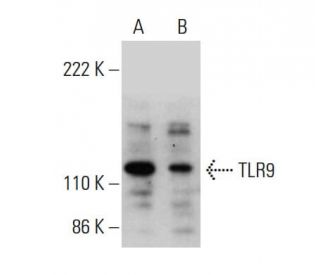


TLR9 Antibody (F-3): sc-515921
- TLR9 Antibody (F-3) is a mouse monoclonal IgM κ TLR9 antibody, cited in 1 publications, provided at 200 µg/ml
- specific for an epitope mapping between amino acids 1007-1032 at the C-terminus of TLR9 of human origin
- recommended for detection of TLR9 of mouse, rat and human origin by WB, IP, IF and ELISA
- m-IgGκ BP-HRP is the preferred secondary detection reagent for TLR9 Antibody (F-3) for WB applications. This reagent is now offered in a bundle with TLR9 Antibody (F-3) (see ordering information below). For additional m-IgGκ BP conjugates see our complete list of Mouse IgG Binding Proteins.

TLR9 Antibody (F-3) is a mouse monoclonal IgM kappa antibody that detects TLR9 protein of mouse, rat, and human origin by western blotting (WB), immunoprecipitation (IP), immunofluorescence (IF), and enzyme-linked immunosorbent assay (ELISA). Anti-TLR9 antibody (F-3) is available as the non-conjugated format. TLR9 protein plays a crucial role in the innate immune system by recognizing unmethylated CpG motifs commonly found in bacterial and viral DNA, which is essential for initiating an immune response. Upon activation, TLR9 triggers signaling pathways that lead to the production of pro-inflammatory cytokines and type I interferons, thereby enhancing the host′s ability to combat infections. This function is particularly important in pathogen recognition and subsequent activation of adaptive immunity, making TLR9 a key player in the body′s defense mechanisms. TLR family, including TLR9, is characterized by a highly conserved Toll homology domain vital for signal transduction, and TLR9 is predominantly expressed in immune-related tissues such as spleen, lymph nodes, and bone marrow, underscoring its significance in immune surveillance and response.
Alexa Fluor® is a trademark of Molecular Probes Inc., OR., USA
LI-COR® and Odyssey® are registered trademarks of LI-COR Biosciences
TLR9 Antibody (F-3) References:
- Understanding TLR9 action in Epstein-Barr virus infection. | Zauner, L. and Nadal, D. 2012. Front Biosci (Landmark Ed). 17: 1219-31. PMID: 22201799
- Oxidized Mitochondrial DNA Engages TLR9 to Activate the NLRP3 Inflammasome in Myelodysplastic Syndromes. | Ward, GA., et al. 2023. Int J Mol Sci. 24: PMID: 36835307
- Targeted TLR9 Agonist Elicits Effective Antitumor Immunity against Spontaneously Arising Breast Tumors. | Miller, CL., et al. 2023. J Immunol. 211: 295-305. PMID: 37256255
- Rewiring innate and adaptive immunity with TLR9 agonist to treat osteosarcoma. | Cascini, C., et al. 2023. J Exp Clin Cancer Res. 42: 154. PMID: 37365634
- TLR9 Monotherapy in Immune-Competent Mice Suppresses Orthotopic Prostate Tumor Development. | Miles, MA., et al. 2024. Cells. 13: PMID: 38201300
- TLR9 Knockdown Alleviates Sepsis via Disruption of MyD88/NF-κB Pathway Activation. | Li, L., et al. 2024. Crit Rev Immunol. 44: 15-24. PMID: 38305333
- Damage sensing through TLR9 Regulates Inflammatory and Antiviral Responses During Influenza Infection. | Kim, J., et al. 2024. bioRxiv.. PMID: 38496452
- Dendritic Cell - Fibroblast Crosstalk via TLR9 and AHR Signaling Drives Lung Fibrogenesis. | Carter, H., et al. 2024. bioRxiv.. PMID: 38559175
- TLR9 mediates IgA production in the porcine small intestine during PEDV infection. | Wang, C., et al. 2024. Vet Microbiol. 293: 110096. PMID: 38636174
- Characterization of the TLR9-Activating Potential of LNA-Modified Antisense Oligonucleotides. | Riera-Tur, I., et al. 2024. Nucleic Acid Ther. 34: 257-271. PMID: 39018509
Ordering Information
| Product Name | Catalog # | UNIT | Price | Qty | FAVORITES | |
TLR9 Antibody (F-3) | sc-515921 | 200 µg/ml | $322.00 | |||
TLR9 Antibody (F-3): m-IgGκ BP-HRP Bundle | sc-552763 | 200 µg Ab; 40 µg BP | $361.00 |