
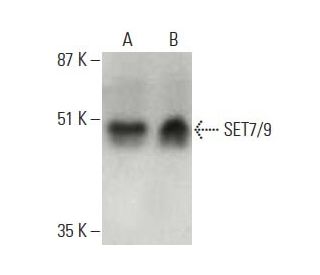
Datos CRISPR no: la imagen ilustra la calidad de los anticuerpos para visualizar los resultados de los experimentos CRISPR.
Datos CRISPR no: la imagen ilustra la calidad de los anticuerpos para visualizar los resultados de los experimentos CRISPR.
SET7/9 Plásmido CRISPR/Cas9 KO (r): sc-437354
- Especies Diana: rat
- 20 µg de plásmido de ADN purificado listo para la trasfección; suficiente para 20 transfecciones máximo
- SET7/9 El plásmido CRISPR/Cas9 Knockout (KO) (r) es un conjunto de plásmidos, cada uno de los cuales codifica la nucleasa Cas9 y un ARN guía (gRNA) de 20 nt específico para el objetivo, diseñado para lograr la máxima eficiencia de knockout utilizando secuencias derivadas de la biblioteca GeCKO v2
- Las secuencias de gRNA dirigen a Cas9 para que induzca roturas de doble cadena (DSB) específicas en el locus genómico SET7/9, lo que da lugar a la inactivación del gen mediante unión de extremos no homólogos (NHEJ)
- Los genes de resistencia a la puromicina y RFP están flanqueados por sitios LoxP, lo que permite la eliminación de los marcadores de selección mediante la recombinasa Cre (Vector Cre: sc-418923) tras el establecimiento de líneas celulares knockout estables
- Tras la transfección, la eficacia del knockout puede comprobarse mediante WB, IF ó IHC utilzando el anticuerpo: SET7/9 Anticuerpo (C-11): sc-390823

Información sobre pedidos
| Nombre del producto | Número de catálogo | UNIDAD | Precio | CANTIDAD | Favoritos | |
SET7/9 Plásmido CRISPR/Cas9 KO (r) | sc-437354 | 20 µg | $397.00 |
Descripción general
SET7/9 (también conocida como SETD7) es una metiltransferasa de lisina que cataliza predominantemente la monometilación de la histona H3 en la lisina 4 (H3K4me1) y también puede modificar sustratos no histónicos, modulando los resultados transcripcionales y la estabilidad de las proteínas. En células de rata, la actividad de SET7/9 se integra con la remodelación de la cromatina para regular el control del ciclo celular, los programas de diferenciación y la expresión génica sensible al estrés. Mediante una comunicación cruzada dependiente de la metilación con vías vinculadas a la señalización de p53 y a la transcripción inflamatoria asociada a NF-κB, SET7/9 influye en el mantenimiento del genoma y en la dinámica transcripcional inducida por estímulos. La disfunción de SET7/9 se ha asociado con alteraciones epigenéticas relevantes para la biología del cáncer, fenotipos metabólicos y cardiovasculares, y modelos de enfermedades inflamatorias, lo que respalda su uso como nodo mecanístico en la investigación en epigenética.
El plásmido CRISPR/Cas9 KO SET7/9 (r) es un conjunto de plásmidos diseñado para la interrupción dirigida del gen en líneas celulares rat. Cada plásmido coexpresa un ARN guía único (sgRNA) dirigido a un sitio distinto dentro del junto con la nucleasa Cas9 de Streptococcus pyogenes. Los plásmidos también codifican GFP, lo que permite la identificación fluorescente y el enriquecimiento de las células transfectadas con éxito mediante microscopía de fluorescencia o citometría de flujo.
El diseño multiguía aumenta la probabilidad de generar inserciones o deleciones (indeles) que interrumpan el marco de lectura abierto de tras la formación de roturas de doble cadena mediadas por Cas9. Las roturas de ADN introducidas por el sistema CRISPR/Cas9 se reparan a través de vías endógenas de unión de extremos no homólogos (NHEJ), lo que con frecuencia da lugar a mutaciones de desplazamiento del marco de lectura que anulan la expresión de la proteína SET7/9.
Este sistema de knockout CRISPR permite la generación eficiente de modelos celulares deficientes en para la investigación de la señalización de SET7/9, estudios de genómica funcional, investigación en biología del cáncer y evaluación de respuestas terapéuticas en líneas celulares humanas.
Características principales
- sgRNA dirigidos a los exones de críticos para la función de SET7/9
Coexpresión de SpCas9 y sgRNA a partir de un único plásmido para simplificar la administración
Reportero GFP para la identificación de células transfectadas
Conjunto de plásmidos dirigidos a múltiples sitios genómicos de para mejorar la eficiencia del knockout
Compatible con la administración mediante transfección
Variantes de diseño
CRISPRs +/- HDRs
- Los gRNA codificados por el plásmido SET7/9 CRISPR/Cas9 KO (r) y el plásmido SET7/9 CRISPR/Cas9 KO (r2) se dirigen a sitios distintos dentro del locus . Puede estar disponible uno o ambos diseños de orientación. Consulte «Productos relacionados» para conocer la disponibilidad.
Las construcciones donantes HDR codificadas por el plásmido HDR SET7/9 (r) y el plásmido HDR SET7/9 (r2) contienen un casete de resistencia a la puromicina y un reportero RFP flanqueado por brazos de homología para facilitar la reparación dirigida por homología en sitios diana definidos que se corresponden con los diseños de KO de CRISPR/Cas9. La disponibilidad de los donantes HDR puede variar. Consulte «Productos relacionados» para conocer la disponibilidad.
Sólo para uso en investigación. No destinado a uso diagnóstico o terapéutico.