
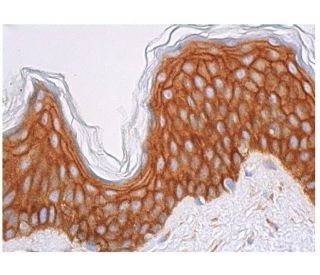
Phosphotyrosine Antibody (PY99): sc-7020
- Phosphotyrosine Antibody (PY99) is a mouse monoclonal IgG2b κ, cited in 2,689 publications, provided at 200 µg/ml
- raised against p-Tyr
- Phosphotyrosine Antibody (PY99) is recommended for detection of phosphotyrosine-containing proteins by WB, IP, IF and IHC(P); non cross-reactive with phosphoserine or phosphothreonine
- Anti-Phosphotyrosine Antibody (PY99) is available conjugated to agarose for IP; HRP for WB, IHC(P) and ELISA; and to either phycoerythrin or FITC for IF, IHC(P) and FCM
- also available conjugated to Alexa Fluor® 488, Alexa Fluor® 546, Alexa Fluor® 594 or Alexa Fluor® 647 for WB (RGB), IF, IHC(P) and FCM, and for use with RGB fluorescent imaging systems, such as iBright™ FL1000, FluorChem™, Typhoon, Azure and other comparable systems
- also available conjugated to Alexa Fluor® 680 or Alexa Fluor® 790 for WB (NIR), IF and FCM; for use with Near-Infrared (NIR) detection systems, such as LI-COR®Odyssey®, iBright™ FL1000, FluorChem™, Typhoon, Azure and other comparable systems
- available conjugated to biotin for WB, IHC(P) and ELISA; and to Alexa Fluor® 405 for IF, IHC(P) and FCM
- m-IgG Fc BP-HRP is the preferred secondary detection reagent for Phosphotyrosine Antibody (PY99) for WB and IHC(P) applications. This reagent is now offered in a bundle with Phosphotyrosine Antibody (PY99) (see ordering information below).

QUICK LINKS
SEE ALSO...
p-Tyr Antibody (PY99) is a mouse monoclonal IgG2b kappa light chain antibody that detects phosphorylated tyrosine protein across broad species through western blotting (WB), immunoprecipitation (IP), immunofluorescence (IF), and immunohistochemistry. p-Tyr (PY99) antibody comes in non-conjugated forms and various conjugates, including agarose, horseradish peroxidase (HRP), phycoerythrin (PE), fluorescein isothiocyanate (FITC), and multiple Alexa Fluor® options, offering flexibility for diverse experimental needs. Protein tyrosine phosphorylation plays a crucial role in cellular signaling pathways, serving as a key regulatory mechanism in numerous biological processes, including cell growth, differentiation, and metabolism. Phosphorylation of tyrosine residues occurs primarily through protein tyrosine kinases, which include receptor tyrosine kinases and non-receptor tyrosine kinases, with the Src family representing a classic example of the latter. These kinases typically localize to the plasma membrane′s inner surface, where they interact with surface receptors to transmit signals within cells. When receptor tyrosine kinases bind to ligands, they undergo dimerization and autophosphorylation, creating specific phosphotyrosine sites that dock downstream signaling molecules. This complex network highlights the significance of studying phosphotyrosine modifications, making anti-p-Tyr antibody (PY99) essential for researchers studying and purifying proteins containing phosphotyrosyl residues, ultimately advancing cellular signaling research.
Alexa Fluor® is a trademark of Molecular Probes Inc., OR., USA
LI-COR® and Odyssey® are registered trademarks of LI-COR Biosciences
Phosphotyrosine Antibody (PY99) References:
- Purification of the platelet-derived growth factor receptor by using an anti-phosphotyrosine antibody. | Daniel, TO., et al. 1985. Proc Natl Acad Sci U S A. 82: 2684-7. PMID: 2581254
- Purification and characterization of a protein-tyrosine kinase encoded by the Abelson murine leukemia virus. | Foulkes, JG., et al. 1985. J Biol Chem. 260: 8070-7. PMID: 2989275
- Phosphotyrosine profiling of human cerebrospinal fluid. | Sathe, G., et al. 2018. Clin Proteomics. 15: 29. PMID: 30220890
- Blockade of phosphotyrosine pathways suggesting SH2 superbinder as a novel therapy for pulmonary fibrosis. | Wang, M., et al. 2022. Theranostics. 12: 4513-4535. PMID: 35832075
- Tumor promoters block tyrosine-specific phosphorylation of the epidermal growth factor receptor. | Friedman, B., et al. 1984. Proc Natl Acad Sci U S A. 81: 3034-8. PMID: 6328489
- Signalling by receptor tyrosine kinases. | Fantl, WJ., et al. 1993. Annu Rev Biochem. 62: 453-81. PMID: 7688944
- Regulation of signal transduction and signal diversity by receptor oligomerization. | Lemmon, MA. and Schlessinger, J. 1994. Trends Biochem Sci. 19: 459-63. PMID: 7855887
- Incorporation of leucocyte GPI-anchored proteins and protein tyrosine kinases into lipid-rich membrane domains of COS-7 cells. | Cebecauer, M., et al. 1998. Biochem Biophys Res Commun. 243: 706-10. PMID: 9500981
- T cell receptor signalling results in rapid tyrosine phosphorylation of the linker protein LAT present in detergent-resistant membrane microdomains. | Brdiĉka, T., et al. 1998. Biochem Biophys Res Commun. 248: 356-60. PMID: 9675140
Ordering Information
| Product Name | Catalog # | UNIT | Price | Qty | FAVORITES | |
Phosphotyrosine Antibody (PY99) | sc-7020 | 200 µg/ml | $322.00 | |||
Phosphotyrosine Antibody (PY99): m-IgG Fc BP-HRP Bundle | sc-552878 | 200 µg Ab; 10 µg BP | $361.00 | |||
Phosphotyrosine Antibody (PY99) AC | sc-7020 AC | 500 µg/ml, 25% agarose | $424.00 | |||
Phosphotyrosine Antibody (PY99) HRP | sc-7020 HRP | 200 µg/ml | $322.00 | |||
Phosphotyrosine Antibody (PY99) FITC | sc-7020 FITC | 200 µg/ml | $336.00 | |||
Phosphotyrosine Antibody (PY99) PE | sc-7020 PE | 200 µg/ml | $349.00 | |||
Phosphotyrosine Antibody (PY99) Alexa Fluor® 488 | sc-7020 AF488 | 200 µg/ml | $364.00 | |||
Phosphotyrosine Antibody (PY99) Alexa Fluor® 546 | sc-7020 AF546 | 200 µg/ml | $364.00 | |||
Phosphotyrosine Antibody (PY99) Alexa Fluor® 594 | sc-7020 AF594 | 200 µg/ml | $364.00 | |||
Phosphotyrosine Antibody (PY99) Alexa Fluor® 647 | sc-7020 AF647 | 200 µg/ml | $364.00 | |||
Phosphotyrosine Antibody (PY99) Alexa Fluor® 680 | sc-7020 AF680 | 200 µg/ml | $364.00 | |||
Phosphotyrosine Antibody (PY99) Alexa Fluor® 790 | sc-7020 AF790 | 200 µg/ml | $364.00 | |||
Phosphotyrosine Antibody (PY99) B | sc-7020 B | 200 µg/ml | $326.00 | |||
Phosphotyrosine Antibody (PY99) AP | sc-7020 AP | 200 µg/ml |