
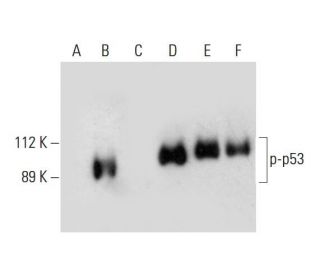


p-p53 Antibody (D-9): sc-377567
- p-p53 Antibody (D-9) is a mouse monoclonal IgM κ, cited in 21 publications, provided at 200 µg/ml
- specific for an epitope mapping between amino acids Thr 155 Thr 155 of p53 of human origin
- recommended for detection of Thr 155 phosphorylated p53 of human origin by WB, IP, IF, IHC(P) and ELISA
- m-IgGκ BP-HRP is the preferred secondary detection reagent for p-p53 Antibody (D-9) for WB and IHC(P) applications. This reagent is now offered in a bundle with p-p53 Antibody (D-9) (see ordering information below). For additional m-IgGκ BP conjugates see our complete list of Mouse IgG Binding Proteins.

QUICK LINKS
SEE ALSO...
p-p53 Antibody (D-9) is a mouse monoclonal IgM kappa light chain antibody that detects Thr 155 phosphorylated p53 of human origin by western blotting (WB), immunoprecipitation (IP), immunofluorescence (IF), immunohistochemistry with paraffin-embedded sections (IHCP), and enzyme-linked immunosorbent assay (ELISA). anti-p-p53 antibody (D-9) is available as the non-conjugated form. p53 plays a critical role as a tumor suppressor by regulating the cell cycle and promoting apoptosis in response to cellular stress, thereby preventing the proliferation of potentially cancerous cells. p53 function is vital for maintaining genomic stability, as p53 activates a network of genes involved in growth arrest and apoptosis, which are essential for cellular homeostasis. p53 is primarily located in the nucleus, where p53 binds to DNA to exert regulatory effects; however, p53 can be sequestered in the cytoplasm by the E3 ubiquitin ligase MDM2, which is a negative regulator that targets p53 for proteasomal degradation. This dynamic localization allows for a rapid response to cellular stress signals, ensuring that p53 is available to activate target genes when needed. The phosphorylation of p53 at Thr 155, mediated by the COP9 signalosome, is a key post-translational modification that influences stability and activity, highlighting the intricate regulatory mechanisms that control p53 function and implications in cancer biology. p-p53 monoclonal antibody (D-9) serves as an essential tool for investigating the regulatory pathways and functional dynamics of p53 in cellular stress responses and cancer biology.
Alexa Fluor® is a trademark of Molecular Probes Inc., OR., USA
LI-COR® and Odyssey® are registered trademarks of LI-COR Biosciences
p-p53 Antibody (D-9) References:
- p53 website and analysis of p53 gene mutations in human cancer: forging a link between epidemiology and carcinogenesis. | Soussi, T., et al. 2000. Hum Mutat. 15: 105-13. PMID: 10612830
- Regulation of p53 stability. | Ashcroft, M. and Vousden, KH. 1999. Oncogene. 18: 7637-43. PMID: 10618703
- COP9 signalosome-specific phosphorylation targets p53 to degradation by the ubiquitin system. | Bech-Otschir, D., et al. 2001. EMBO J. 20: 1630-9. PMID: 11285227
- The role of tetramerization in p53 function. | Chène, P. 2001. Oncogene. 20: 2611-7. PMID: 11420672
- Distinct pattern of p53 phosphorylation in human tumors. | Minamoto, T., et al. 2001. Oncogene. 20: 3341-7. PMID: 11423984
- Regulation of the specific DNA binding function of p53. | Hupp, TR., et al. 1992. Cell. 71: 875-86. PMID: 1423635
- Arecoline-induced phosphorylated p53 and p21(WAF1) protein expression is dependent on ATM/ATR and phosphatidylinositol-3-kinase in clone-9 cells. | Chou, WW., et al. 2009. J Cell Biochem. 107: 408-17. PMID: 19343784
- Dimethylfumarate inhibits MIF-induced proliferation of keratinocytes by inhibiting MSK1 and RSK1 activation and by inducing nuclear p-c-Jun (S63) and p-p53 (S15) expression. | Gesser, B., et al. 2011. Inflamm Res. 60: 643-53. PMID: 21340650
- FBXW7-mutated colorectal cancer cells exhibit aberrant expression of phosphorylated-p53 at Serine-15. | Li, N., et al. 2015. Oncotarget. 6: 9240-56. PMID: 25860929
- p53, the cellular gatekeeper for growth and division. | Levine, AJ. 1997. Cell. 88: 323-31. PMID: 9039259
Ordering Information
| Product Name | Catalog # | UNIT | Price | Qty | FAVORITES | |
p-p53 Antibody (D-9) | sc-377567 | 200 µg/ml | $322.00 | |||
p-p53 Antibody (D-9): m-IgGκ BP-HRP Bundle | sc-552496 | 200 µg Ab; 40 µg BP | $361.00 | |||
p-p53 (D-9) Neutralizing Peptide | sc-377567 P | 100 µg/0.5 ml | $69.00 |