
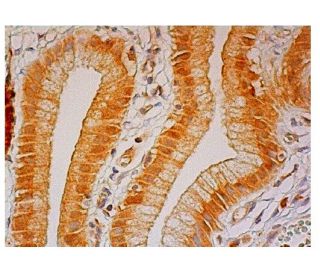
GID4 Antibody (B-6): sc-390887
- GID4 Antibody (B-6) is a mouse monoclonal IgG3 κ GID4 antibody provided at 200 µg/ml
- specific for an epitope mapping between amino acids 277-293 near the C-terminus of GID4 of human origin
- recommended for detection of GID4 of mouse, rat and human origin by WB, IP, IF, IHC(P) and ELISA
- m-IgG3 BP-HRP and m-IgGκ BP-HRP are the preferred secondary detection reagents for GID4 Antibody (B-6) for WB and IHC(P) applications. These reagents are now offered in bundles with GID4 Antibody (B-6) (see ordering information below).

QUICK LINKS
SEE ALSO...
GID4 Antibody (B-6) is a mouse monoclonal IgG3 kappa light chain antibody that detects GID4 protein of mouse, rat, and human origin by western blotting (WB), immunoprecipitation (IP), immunofluorescence (IF), immunohistochemistry with paraffin-embedded sections (IHCP), and enzyme-linked immunosorbent assay (ELISA). Anti-GID4 antibody (B-6) is available as non-conjugated format. GID4 plays a crucial role in regulating gene expression and is involved in cellular response to stress, particularly in tumor suppression. GID4 interacts with various proteins, including tumor suppressor p53, which is essential for maintaining genomic stability and preventing malignant transformation. GID4 interaction with p53 highlights GID4′s importance in cellular pathways governing cell fate decisions, such as apoptosis and DNA repair. Dysregulation of GID4 can lead to impaired cellular responses to stress, contributing to various cancers. Chromosome 17, where GID4 is located, harbors several key genes associated with tumor suppression and genetic disorders, underscoring GID4′s significance in cancer research and therapeutic development.
Alexa Fluor® is a trademark of Molecular Probes Inc., OR., USA
LI-COR® and Odyssey® are registered trademarks of LI-COR Biosciences
GID4 Antibody (B-6) References:
- Birt-Hogg-Dubé Syndrome. | Welsch, MJ., et al. 2005. Int J Dermatol. 44: 668-73. PMID: 16101870
- BLIMP1 regulates cell growth through repression of p53 transcription. | Yan, J., et al. 2007. Proc Natl Acad Sci U S A. 104: 1841-6. PMID: 17264218
- Neurofibromatosis 1, and Not TP53, seems to be the main target of chromosome 17 deletions in de novo acute myeloid leukemia. | Suela, J., et al. 2007. J Clin Oncol. 25: 1151-2; author reply 1152-3. PMID: 17369586
- Quantification of N-acetylaspartic acid in urine by LC-MS/MS for the diagnosis of Canavan disease. | Al-Dirbashi, OY., et al. 2007. J Inherit Metab Dis. 30: 612. PMID: 17632691
- Susceptibility to breast cancer: hereditary syndromes and low penetrance genes. | Nusbaum, R., et al. Breast Dis. 27: 21-50. PMID: 17917139
- Genetic causes of brain tumors: neurofibromatosis, tuberous sclerosis, von Hippel-Lindau, and other syndromes. | Farrell, CJ. and Plotkin, SR. 2007. Neurol Clin. 25: 925-46, viii. PMID: 17964021
- Breast cancer risk among male BRCA1 and BRCA2 mutation carriers. | Tai, YC., et al. 2007. J Natl Cancer Inst. 99: 1811-4. PMID: 18042939
- Novel deletion mutation in GFAP gene in an infantile form of Alexander disease. | Murakami, N., et al. 2008. Pediatr Neurol. 38: 50-2. PMID: 18054694
- Strategies for ovarian cancer prevention. | Dann, RB., et al. 2007. Obstet Gynecol Clin North Am. 34: 667-86, viii. PMID: 18061863
Ordering Information
| Product Name | Catalog # | UNIT | Price | Qty | FAVORITES | |
GID4 Antibody (B-6) | sc-390887 | 200 µg/ml | $322.00 | |||
GID4 Antibody (B-6): m-IgG3 BP-HRP Bundle | sc-550593 | 200 µg Ab; 40 µg BP | $361.00 | |||
GID4 Antibody (B-6): m-IgGκ BP-HRP Bundle | sc-551265 | 200 µg Ab; 40 µg BP | $361.00 | |||
GID4 (B-6) Neutralizing Peptide | sc-390887 P | 100 µg/0.5 ml | $69.00 |