
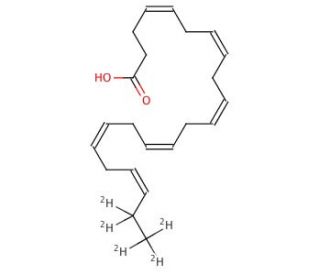

Molecular structure of Docosahexaenoic acid-d5, CAS Number: 1197205-71-2
Docosahexaenoic acid-d5 (CAS 1197205-71-2)
See product citations (3)
Alternate Names:
Cervonic Acid-d5; DHA-d5
Application:
Docosahexaenoic acid-d5 is a labeled omega-3 fatty acid supplied in ethanol
CAS Number:
1197205-71-2
Molecular Weight:
333.52
Molecular Formula:
C22H27D5O2
Supplemental Information:
This is classified as a Dangerous Good for transport and may be subject to additional shipping charges.
For Research Use Only. Not Intended for Diagnostic or Therapeutic Use.
* Refer to Certificate of Analysis for lot specific data.
QUICK LINKS
Ordering Information
Product Citations
Description
Technical Information
Safety Information
SDS & Certificate of Analysis
Docosahexaenoic Acid-d5 is a stable isotope of docosahexaenoic acid, a long-chain omega-3 fatty acid. In experimental applications, it is used to trace the metabolic fate and distribution of docosahexaenoic acid in biological systems. Its mechanism of action involves being incorporated into cellular membranes and lipid structures, where it can be metabolized and utilized in various cellular processes. As a labeled form of docosahexaenoic acid, it allows for the tracking and quantification of the movement and transformation of the parent compound within cells and tissues.
Docosahexaenoic acid-d5 (CAS 1197205-71-2) References
- South African pilchard oil. 6. The isolation and structure of a docosahexaenoic acid from South African pilchard oil. | WHITCUTT, JM. 1957. Biochem J. 67: 60-4. PMID: 13471511
- Effect of dietary docosahexaenoic acid on biosynthesis of docosahexaenoic acid from alpha-linolenic acid in young rats. | DeMar, JC., et al. 2008. J Lipid Res. 49: 1963-80. PMID: 18469302
- Novel liquid chromatography-mass spectrometry method shows that vitamin E deficiency depletes arachidonic and docosahexaenoic acids in zebrafish (Danio rerio) embryos. | Lebold, KM., et al. 2013. Redox Biol. 2: 105-13. PMID: 24416717
- Metabolic conversion of intra-amniotically-injected deuterium-labeled essential fatty acids by fetal rats following maternal n-3 fatty acid deficiency. | Yavin, E., et al. 2014. Biochim Biophys Acta. 1841: 1336-44. PMID: 24960100
- The validation & verification of an LC/MS method for the determination of total docosahexaenoic acid concentrations in canine blood serum. | Dillon, GP., et al. 2018. Regul Toxicol Pharmacol. 95: 198-203. PMID: 29577958
- Amyloid beta25-35 impairs docosahexaenoic acid efflux by down-regulating fatty acid transport protein 1 (FATP1/SLC27A1) protein expression in human brain capillary endothelial cells. | Ochiai, Y., et al. 2019. J Neurochem. 150: 385-401. PMID: 31091338
- A Lipidomic Analysis of Docosahexaenoic Acid (22:6, ω3) Mediated Attenuation of Western Diet Induced Nonalcoholic Steatohepatitis in Male Ldlr -/- Mice. | García-Jaramillo, M., et al. 2019. Metabolites. 9: PMID: 31661783
- The profile of urinary lipid metabolites in cats. | Kobayashi, Y., et al. 2020. J Vet Med Sci. 82: 1017-1020. PMID: 32507833
- Multiplex fatty acid imaging inside cells by Raman microscopy. | Uematsu, M., et al. 2020. FASEB J. 34: 10357-10372. PMID: 32592240
- Development and validation of a LC-MS/MS assay for quantifying the uptake of docosahexaenoic acid-d5 into mouse microglia. | Low, YL., et al. 2020. J Pharm Biomed Anal. 191: 113575. PMID: 32896811
- Profiling the expression of fatty acid-binding proteins and fatty acid transporters in mouse microglia and assessing their role in docosahexaenoic acid-d5 uptake. | Low, YL., et al. 2021. Prostaglandins Leukot Essent Fatty Acids. 171: 102303. PMID: 34098488
- The profile of urinary lipid metabolites in cats with bacterial cystitis. | Kobayashi, Y., et al. 2021. J Vet Med Sci. 83: 1977-1981. PMID: 34744098
- The profile of urinary lipid metabolites in healthy dogs. | Kida, T., et al. 2022. J Vet Med Sci. 84: 644-647. PMID: 35321995
- Review: pharmacological manipulation of docosahexaenoic-phospholipid biosynthesis in photoreceptor cells: implications in retinal degeneration. | Bazan, NG. and Rodriguez de Turco, EB. 1994. J Ocul Pharmacol. 10: 591-604. PMID: 7836869
- Is dietary docosahexaenoic acid essential for term infants? | Makrides, M., et al. 1996. Lipids. 31: 115-9. PMID: 8649228
Activator of:
ABCA4, and RXR.Ordering Information
| Product Name | Catalog # | UNIT | Price | Qty | FAVORITES | |
Docosahexaenoic acid-d5, 50 µg | sc-218259 | 50 µg | $139.00 | |||
Docosahexaenoic acid-d5, 100 µg | sc-218259A | 100 µg | $223.00 | |||
Docosahexaenoic acid-d5, 1 mg | sc-218259B | 1 mg | $889.00 |