
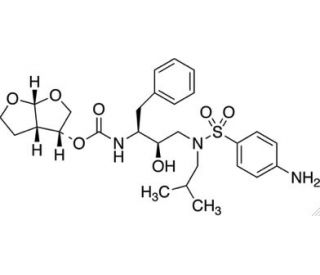

Darunavir (CAS 206361-99-1)
See product citations (4)
QUICK LINKS
Darunavir is a compound frequently utilized in biochemical and virology research due to its potent activity against certain enzymes essential for viral replication. It is of particular interest in studies focusing on enzyme inhibition and the mechanisms by which these proteins can be blocked. Darunavir is also used as a tool compound in the study of viral maturation and assembly, providing insights into the life cycle of viruses at a molecular level. Researchers employ this compound in structural biology to determine the three-dimensional conformation of enzyme-inhibitor complexes, which furthers the understanding of how such inhibitors bind and exert their effects. Additionally, darunavir is relevant in studies aimed at understanding resistance mechanisms, where it helps in elucidating how genetic mutations can affect enzyme structure and function, potentially leading to reduced inhibitor efficacy.
Darunavir (CAS 206361-99-1) References
- Visible light-driven water oxidation by a molecular ruthenium catalyst in homogeneous system. | Duan, L., et al. 2010. Inorg Chem. 49: 209-15. PMID: 19994841
- A molecular ruthenium catalyst with water-oxidation activity comparable to that of photosystem II. | Duan, L., et al. 2012. Nat Chem. 4: 418-23. PMID: 22522263
- Highly efficient and robust molecular ruthenium catalysts for water oxidation. | Duan, L., et al. 2012. Proc Natl Acad Sci U S A. 109: 15584-8. PMID: 22753518
- Insights into Ru-based molecular water oxidation catalysts: electronic and noncovalent-interaction effects on their catalytic activities. | Duan, L., et al. 2013. Inorg Chem. 52: 7844-52. PMID: 23808491
- 4,4'-Bis(trifluoromethyl)-2,2'-bipyridine--a multipurpose ligand scaffold for lanthanoid-based luminescence/19F NMR probes. | Güden-Silber, T., et al. 2013. Dalton Trans. 42: 13882-8. PMID: 23922033
- Specific chiral sensing of amino acids using induced circularly polarized luminescence of bis(diimine)dicarboxylic acid europium(III) complexes. | Okutani, K., et al. 2014. Inorg Chem. 53: 5527-37. PMID: 24819655
- Self-Assembled Amphiphilic Water Oxidation Catalysts: Control of O-O Bond Formation Pathways by Different Aggregation Patterns. | Yang, B., et al. 2016. Angew Chem Int Ed Engl. 55: 6229-34. PMID: 27071858
- A supramolecular ruthenium macrocycle with high catalytic activity for water oxidation that mechanistically mimics photosystem II. | Schulze, M., et al. 2016. Nat Chem. 8: 576-83. PMID: 27219702
- Tailored design of ruthenium molecular catalysts with 2,2'-bypyridine-6,6'-dicarboxylate and pyrazole based ligands for water oxidation. | Daniel, Q., et al. 2016. Dalton Trans. 45: 14689-96. PMID: 27241474
- Characterization of a trinuclear ruthenium species in catalytic water oxidation by Ru(bda)(pic)2 in neutral media. | Zhang, B., et al. 2016. Chem Commun (Camb). 52: 8619-22. PMID: 27332794
- Efficient Ytterbium Near-Infrared Luminophore Based on a Nondeuterated Ligand. | Kruck, C., et al. 2019. Inorg Chem. 58: 6959-6965. PMID: 31050288
- Copper-based metal-organic xerogels on paper for chemiluminescence detection of dopamine. | Zhang, L., et al. 2020. Anal Methods. 12: 4191-4198. PMID: 32780054
- Selection of HIV-1 for resistance to fifth-generation protease inhibitors reveals two independent pathways to high-level resistance. | Spielvogel, E., et al. 2023. Elife. 12: PMID: 36920025
Ordering Information
| Product Name | Catalog # | UNIT | Price | Qty | FAVORITES | |
Darunavir, 5 mg | sc-218079 | 5 mg | $311.00 |