
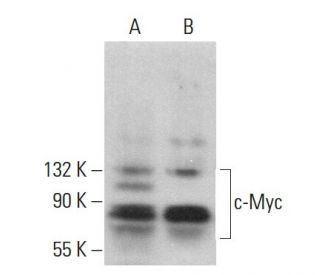
Anticorpo Myc (6A10): sc-53854
- Myc Antibody 6A10 è un monoclonale di ratto IgG2a, citato in 6 pubblicazioni, fornito in 200 µg/ml
- generato contro gli amminoacidi 1-262 di c-Myc di origine human
- raccomandato per il rilevamento di c-Myc di origine mouse, rat, human e monkey in WB, IP e IF
- Vedere Myc (9E10): sc-40 for Myc per anticorpi coniugati, tra cui AC, HRP, FITC, PE, Alexa Fluor® 488, 594, 647, 680 e 790.
- Al momento non abbiamo ancora completato l'identificazione dei reagenti secondari di rilevazione preferiti per Myc l'anticorpo (6A10). Questo lavoro è in corso.

Le proteine codificate da c-Myc, N-Myc e L-Myc funzionano nella proliferazione cellulare, nella differenziazione e nelle malattie neoplastiche. L'amplificazione del gene c-Myc è stata riscontrata in diversi tipi di tumori umani, tra cui i carcinomi del polmone, della mammella e del colon. La presenza di tre motivi di sequenza nella terminazione COOH di c-Myc, tra cui lo zipper di leucina, l'elica-loop-elica e una regione basica, ha fornito le prime prove di una funzione di legame sequenza-specifica. Una proteina con regione basica a elica-loop-elica con motivo zip di leucina (bHLH-Zip), designata Max, si associa specificamente alle proteine c-Myc, N-Myc e L-Myc. Il complesso Myc-Max si lega al DNA in maniera sequenza-specifica in condizioni in cui né Max né Myc presentano un legame apprezzabile. Max può anche formare eterodimeri con almeno altre due proteine bHLH-Zip, Mad 1 e Mxi1, ed è stato dimostrato che i dimeri Mad 1-Max reprimono la trascrizione attraverso l'interazione con mSin3.
Alexa Fluor® è un marchio registrato di Molecular Probes Inc., OR., USA
LI-COR® e Odyssey® sono marchi registrati di LI-COR Biosciences
Anticorpo Myc (6A10) Riferimenti:
- Il ruolo di c-myc nel controllo della crescita cellulare. | Schmidt, EV. 1999. Oncogene. 18: 2988-96. PMID: 10378694
- c-Myc regola il rilascio della pausa trascrizionale. | Rahl, PB., et al. 2010. Cell. 141: 432-45. PMID: 20434984
- c-MYC è un locus radiosensibile nelle cellule mammarie umane. | Wade, MA., et al. 2015. Oncogene. 34: 4985-94. PMID: 25531321
- Interazione funzionale tra c-Myc e Max nella differenziazione dei linfociti B. | Pérez-Olivares, M., et al. 2018. EMBO Rep. 19: PMID: 30126925
- SOX4 è attivato da C-MYC nel cancro alla prostata. | Dong, H., et al. 2019. Med Oncol. 36: 92. PMID: 31560094
- L'ipertermia inibisce la crescita del carcinoma nasofaringeo attraverso la degradazione di c-Myc. | Li, X., et al. 2022. Int J Hyperthermia. 39: 358-371. PMID: 35184661
- INSM1 promuove la carcinogenesi mammaria regolando C-MYC. | Guan, Y., et al. 2023. Am J Cancer Res. 13: 3500-3516. PMID: 37693125
- Sviluppo, sintesi e validazione di inibitori migliorati di c-Myc/Max. | Yıldırım, S., et al. 2024. J Cell Mol Med. 28: e18272. PMID: 38568057
- SOX2 reprime la trascrizione di c-MYC alterando il paesaggio dei co-attivatori delle regioni super-enhancer e promotore di c-MYC. | Ormsbee Golden, BD., et al. 2024. J Biol Chem. 300: 107642. PMID: 39122009
- Il ruolo di c-Myc nella crescita cellulare. | Evan, GI. and Littlewood, TD. 1993. Curr Opin Genet Dev. 3: 44-9. PMID: 8453273
Informazioni ordini
| Nome del prodotto | Codice del prodotto | UNITÀ | Prezzo | Quantità | Preferiti | |
Myc Anticorpo (6A10) | sc-53854 | 200 µg/ml | $322.00 |