
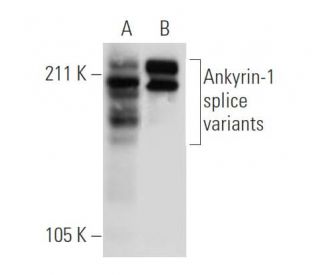


Anticorpo Ankyrin-1 (D-3): sc-374105
- Ankyrin-1 Antibody D-3 è un monoclonale di topo IgG1 κ, citato in 1 pubblicazioni, fornito in 200 µg/ml
- sollevato nei confronti degli amminoacidi 820-952 che mappano in una regione interna di Ankyrin-1 isoform 9 di origine human
- raccomandato per il rilevamento di Ankyrin-1 di origine mouse, rat e human in WB, IP, IF e ELISA
- m-IgG Fc BP-HRP, 1 BP-HRP">m-IgG1 BP-HRP e m-IgGκ BP-HRP sono i reagenti secondari preferiti per l'anticorpo Ankyrin-1 (D-3) per applicazioni WB. Questi reagenti sono ora offerti in bundle con l'anticorpo Ankyrin-1 (D-3)(vedere le informazioni per l'ordine sotto).

I membri della famiglia di proteine Ankyrin mediano il fissaggio delle proteine integrali di membrana al citoscheletro. I geni ANK1, ANK2 e ANK3 codificano rispettivamente per le proteine di questa famiglia, Ankyrin-1 (designata anche Ankyrin R), Ankyrin B e Ankyrin G. Le proteine sono strutturate in modo simile, ognuna composta da un dominio N-terminale con ripetizioni multiple di ankyrin, un dominio centrale altamente conservato per il legame con la spectrina e domini regolatori C-terminali che sono soggetti a maggiori variazioni. L'ankyrin-1 è una proteina di membrana che collega il citoscheletro alla membrana plasmatica negli eritrociti, nel muscolo cardiaco e scheletrico e nel cervello. È espressa in numerose isoforme, tra cui una proteina completa e diverse isoforme più corte. L'Ankyrin-1 è stato trovato difettoso anche nei pazienti affetti da sferocitosi ereditaria (HS), una comune anemia emolitica.
Alexa Fluor® è un marchio registrato di Molecular Probes Inc., OR., USA
LI-COR® e Odyssey® sono marchi registrati di LI-COR Biosciences
Anticorpo Ankyrin-1 (D-3) Riferimenti:
- Anchirina 1 del potenziale recettoriale transitorio: farmacologia emergente e indicazioni per la biologia cardiovascolare. | Bodkin, JV. and Brain, SD. 2011. Acta Physiol (Oxf). 203: 87-98. PMID: 20950342
- Canale dell'Ankirina 1 (TRPA1) a potenziale recettore transitorio e infiammazione neurogena nella patogenesi dell'asma. | Yang, H. and Li, S. 2016. Med Sci Monit. 22: 2917-23. PMID: 27539812
- Il recettore potenziale transitorio Ankyrin 1 (TRPA1) - un fattore indotto dall'infiammazione nei cheratinociti HaCaT umani. | Luostarinen, S., et al. 2021. Int J Mol Sci. 22: PMID: 33805042
- L'attivazione dei canali dell'anchirina 1 del potenziale recettoriale transitorio e del vanilloid 1 promuove la differenziazione odontogena delle cellule della polpa dentale umana. | Lou, Y., et al. 2021. J Endod. 47: 1409-1416. PMID: 34126160
- I canali ionici funzionali dell'anchirina 1 del potenziale recettoriale transitorio e del vanilloid 1 sono sovraespressi nel carcinoma orale a cellule squamose umano. | Kiss, F., et al. 2022. Int J Mol Sci. 23: PMID: 35163843
- Attivazione specie-specifica del potenziale recettore transitorio Ankyrin 1 da parte dei monoesteri dell'acido ftalico. | Mori, Y., et al. 2022. Biol Pharm Bull. 45: 1839-1846. PMID: 36223942
- Gli agonisti del recettore potenziale transitorio Ankyrin-1 (TRPA1) sopprimono la mielinizzazione e inducono la demielinizzazione in sezioni corticali organotipiche. | Giacco, V., et al. 2023. Glia. 71: 1402-1413. PMID: 36762504
- Il canale dell'Ankirina 1 (TRPA1) a potenziale recettore transitorio media la citotossicità dell'acroleina nelle cellule tumorali polmonari umane. | Sakamoto, A., et al. 2023. Int J Mol Sci. 24: PMID: 37511605
- Canale dell'Ankirina 1 a potenziale recettore transitorio umano: struttura, funzione e fisiologia. | Vlachova, V., et al. 2024. Subcell Biochem. 104: 207-244. PMID: 38963489
- Le mutazioni di Ankyrin-1 sono una delle principali cause di sferocitosi ereditaria dominante e recessiva. | Eber, SW., et al. 1996. Nat Genet. 13: 214-8. PMID: 8640229
Informazioni ordini
| Nome del prodotto | Codice del prodotto | UNITÀ | Prezzo | Quantità | Preferiti | |
Ankyrin-1 Anticorpo (D-3) | sc-374105 | 200 µg/ml | $322.00 | |||
Ankyrin-1 (D-3): m-IgG Fc BP-HRP Bundle | sc-537915 | 200 µg Ab; 10 µg BP | $361.00 | |||
Ankyrin-1 (D-3): m-IgGκ BP-HRP Bundle | sc-535386 | 200 µg Ab; 40 µg BP | $361.00 | |||
Ankyrin-1 (D-3): m-IgG1 BP-HRP Bundle | sc-545442 | 200 µg Ab; 20 µg BP | $361.00 |