
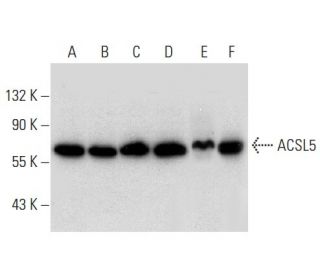
Anticorpo ACSL5 (A-2): sc-365478
- ACSL5 Antibody A-2 è un monoclonale di topo IgM (kappa light chain) ACSL5 antibody fornito in 200 µg/ml
- specifico per un epitopo mappato tra gli amminoacidi 661-683 al C-terminus di ACSL5 di origine human
- raccomandato per il rilevamento di short isoform and long isoform of ACSL5 di origine mouse, rat e human in WB, IP, IF e ELISA
- m-IgGκ BP-HRP è il reagente secondario di rilevazione preferito per l'anticorpo ACSL5 (A-2) per applicazioni WB. Questo reagente è ora offerto in combinazione con l'anticorpo ACSL5 (A-2)(vedere le informazioni per l'ordine sotto). Per ulteriori coniugati m-IgGκ BP, consultare l'elenco completo delle proteine leganti le IgG di topo.

LINK RAPIDI
L'anticorpo ACSL5 (A-2) è un anticorpo monoclonale di topo IgM κ ACSL5 che rileva la proteina ACSL5 di origine murina, ratta e umana mediante WB, IP, IF ed ELISA. L'anticorpo ACSL5 (A-2) è disponibile come anticorpo anti-ACSL5 non coniugato. Le sintetasi degli acil-CoA, note anche come sintetasi dei CoA acidi grassi a catena lunga (FACL) o palmitoil-CoA ligasi, comprendono le ACSL1-6, tutte proteine di membrana a singolo passaggio che si localizzano nel mitocondrio, nel microsoma o nel perossisoma. Le proteine ACSL sono importanti per la sintesi dei lipidi cellulari e per la degradazione della β-ossidazione. In particolare, le proteine ACSL catalizzano l'attivazione degli acidi grassi a lunga catena in acil-CoA, che possono essere metabolizzati per formare CO2, triacilglicerolo (TAG), fosfolipidi (PL) e esteri di colesterolo (CE). ACSL5 utilizza un'ampia gamma di acidi grassi saturi con una preferenza per gli acidi grassi insaturi C16-C18. È altamente espresso nell'utero e nella milza. Una diminuzione dell'espressione di ACSL5 è correlata alla tumorigenesi, compresi gli adenocarcinomi endometrioidi e i carcinomi colorettali. ACSL5 è utile anche come marcatore di differenziazione nel tratto gastrointestinale.
Alexa Fluor® è un marchio registrato di Molecular Probes Inc., OR., USA
LI-COR® e Odyssey® sono marchi registrati di LI-COR Biosciences
Anticorpo ACSL5 (A-2) Riferimenti:
- Gli acil-CoA sono canalizzati funzionalmente nel fegato: ruolo potenziale dell'acil-CoA sintetasi. | Muoio, DM., et al. 2000. Am J Physiol Endocrinol Metab. 279: E1366-73. PMID: 11093925
- Le acil-CoA sintetasi a catena lunga regolano l'ingresso degli acidi grassi nelle vie sintetiche rispetto a quelle degradative? | Coleman, RA., et al. 2002. J Nutr. 132: 2123-6. PMID: 12163649
- Espressione alterata dell'acil-CoA-sintetasi 5 nei tumori epiteliali dell'intestino tenue. | Gassler, N., et al. 2003. Hum Pathol. 34: 1048-52. PMID: 14608540
- Caratterizzazione degli epiteli metaplastici ed eterotopici del tratto gastrointestinale umano in base al modello di espressione dell'acil-CoA sintetasi 5. | Gassler, N., et al. 2005. Histol Histopathol. 20: 409-14. PMID: 15736044
- La celiachia è associata a un'alterata espressione dell'acil-CoA-sintetasi 5. | Obermüller, N., et al. 2006. Int J Colorectal Dis. 21: 130-4. PMID: 15809837
- Espressione alterata dell'acil-CoA sintetasi 5 negli adenocarcinomi sporadici del colon-retto. | Gassler, N., et al. 2005. J Pathol. 207: 295-300. PMID: 16110457
- Espressione dell'acil-CoA sintetasi 5 nell'endometrio umano e negli adenocarcinomi endometrioidi. | Gassler, N., et al. 2005. Histopathology. 47: 501-7. PMID: 16241998
- Una nuova acil-CoA sintetasi, ACS5, espressa in cellule epiteliali intestinali e preadipociti proliferanti. | Oikawa, E., et al. 1998. J Biochem. 124: 679-85. PMID: 9722683
Informazioni ordini
| Nome del prodotto | Codice del prodotto | UNITÀ | Prezzo | Quantità | Preferiti | |
ACSL5 Anticorpo (A-2) | sc-365478 | 200 µg/ml | $322.00 | |||
ACSL5 (A-2): m-IgGκ BP-HRP Bundle | sc-522253 | 200 µg Ab, 40 µg BP | $361.00 | |||
ACSL5 (A-2) peptide neutralizzante | sc-365478 P | 100 µg/0.5 ml | $69.00 |