


Plasmide Double Nickase (h) UXS1: sc-413346-NIC
- Espèces cibles: human
- 20 µg d'ADN plasmidique purifié et prêt à transfecter; Jusqu'à 20 transfections
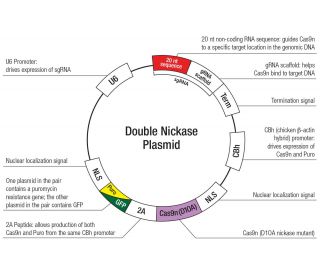
- Le Plasmide Double Nickase (h) UXS1 correspond à une paire de plasmides chacun codant la nucléase Cas9 mutante D10A et un ARN guide (gARN) cible de 20 nt specifique, élaboré pour le knockout optimal de l'expression d'un gène avec une plus grande spécificité que le plasmide KO CRISPR/Cas9 correspondant.
- Les séquences des paires d'ARNg sont décalées de 20 pb environ pour induire avec la Cas9 une double entaille spécifique de l'ADN génomique, qui imite un DSB
- L'un des plasmides de la paire contient un gène de résistance à la puromycine; l'autre plasmide de la paire contient un marqueur GFP pour confirmer visuellement la transfection
- Le plasmide UXS1 Double Nickase (h) et le plasmide UXS1 Double Nickase (h2) codent pour des paires distinctes de gRNA ciblant UXS1. Un ou les deux modèles peuvent être disponibles

Informations pour la commande
| Nom du produit | Ref. Catalogue | COND. | Prix HT | QTÉ | Favoris | |
Plasmide Double Nickase (h) UXS1 | sc-413346-NIC | 20 µg | $410.00 | |||
Plasmide Double Nickase (h2) UXS1 | sc-413346-NIC-2 | 20 µg | $410.00 |
Le gène humain UXS1 code l’UDP‑glucuronate décarboxylase 1, une enzyme cytosolique qui convertit l’acide UDP‑glucuronique en UDP‑xylose, un donneur de sucre essentiel à la biosynthèse des protéoglycanes et des glycosaminoglycanes. En fournissant l’UDP‑xylose, UXS1 favorise l’initiation et l’élongation des glycoconjugués de la matrice extracellulaire, influençant les interactions cellule–matrice, les profils de glycosylation issus de la voie sécrétoire et l’homéostasie tissulaire. Une perturbation de cette voie des sucres nucléotidiques peut modifier la composition des protéoglycanes ainsi que les environnements de signalisation en aval, qui façonnent les programmes d’adhérence, de migration et de différenciation cellulaires. La dérégulation d’UXS1 est donc pertinente pour les études mécanistiques de la biologie du tissu conjonctif et des troubles liés à une assemblage anormal des protéoglycanes.
UXS1 Le plasmide double nickase (h) se compose d'une paire de plasmides appariés, conçus pour une édition hautement spécifique du locus UXS1 dans les lignées cellulaires human. Chaque plasmide exprime une nickase Cas9 D10A et un sgRNA distinct ciblant des brins d'ADN opposés au sein de UXS1. Lorsqu'elles sont dirigées vers des sites adjacents sur des brins d'ADN opposés, les deux nickases génèrent des cassures simple brin décalées qui, ensemble, produisent une cassure double brin décalée, nécessitant une activité coordonnée sur la cible de la part des deux guides. La cassure d'ADN qui en résulte est résolue par les voies de réparation cellulaires endogènes, le plus souvent par jonction non homologue (NHEJ), ce qui conduit à des insertions ou des délétions qui perturbent la fonction de UXS1. En nécessitant l'engagement de deux ARNsg au locus cible, l'approche par double nick améliore la spécificité de l'édition et offre une stratégie CRISPR complémentaire pour les applications où un contrôle supplémentaire de la précision du ciblage est souhaité.
Afin de faciliter l'identification efficace des cellules éditées, un plasmide code pour la GFP permettant la visualisation par fluorescence des populations transfectées, tandis que le plasmide compagnon porte un gène de résistance à la puromycine pour la sélection antibiotique. Ensemble, ces caractéristiques favorisent l'enrichissement efficace des populations co-transfectées et simplifient la validation des clones présentant une perturbation de UXS1.
Réservé à la recherche. N'est pas destiné à un usage diagnostique ou thérapeutique.