
SLIRP CRISPR/Cas9 KO Plasmid (h): sc-418350
- Target species: human
- 20 µg of transfection-ready, purified plasmid DNA; Suitable for up to 20 transfections
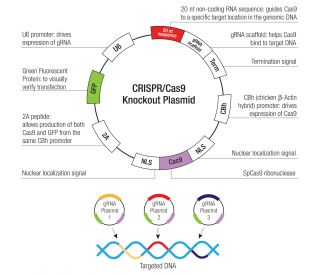
- SLIRP CRISPR/Cas9 Knockout (KO) Plasmid (h) is a pool of plasmids, each encoding Cas9 nuclease and a target-specific 20 nt guide RNA (gRNA) designed for maximum knockout efficiency using sequences derived from the GeCKO v2 library
- gRNA sequences direct Cas9 to induce site-specific double-strand breaks (DSBs) in the SLIRP genomic locus, resulting in gene knockout through non-homologous end joining (NHEJ)
- The puromycin resistance and RFP genes are flanked by LoxP sites, enabling removal of selection markers via Cre recombinase (Cre Vector: sc-418923) after establishing stable knockout cell lines

Ordering Information
| Product Name | Catalog # | UNIT | Price | Qty | FAVORITES | |
SLIRP CRISPR/Cas9 KO Plasmid (h) | sc-418350 | 20 µg | $397.00 |
Overview
SLIRP (SRA stem-loop interacting RNA binding protein) is a small mitochondrial RNA-binding factor that associates with LRPPRC to stabilize and coordinate the post-transcriptional handling of mitochondrially encoded mRNAs. By supporting mitochondrial transcript homeostasis, SLIRP contributes to oxidative phosphorylation (OXPHOS) capacity and respiratory chain function, influencing cellular energy metabolism and mitochondrial stress responses. Perturbation of SLIRP can disrupt mitochondrial gene expression programs and has been linked to mitochondrial dysfunction phenotypes relevant to neuromuscular and metabolic disease mechanisms. SLIRP is therefore studied in pathways connecting mitochondrial RNA regulation, proteostasis, and bioenergetic adaptation.
SLIRP CRISPR/Cas9 KO Plasmid (h) is a pool of plasmids designed for targeted disruption of the SLIRP gene in human cell lines. Each plasmid co-expresses a unique single guide RNA (sgRNA) targeting a distinct site within the SLIRP together with the Streptococcus pyogenes Cas9 nuclease. The plasmids also encode GFP, allowing fluorescent identification and enrichment of successfully transfected cells by fluorescence microscopy or flow cytometry.
The multi-guide design increases the likelihood of generating insertions or deletions (indels) that disrupt the SLIRP open reading frame following Cas9-mediated double-strand break formation. DNA breaks introduced by the CRISPR/Cas9 system are repaired through endogenous non-homologous end joining (NHEJ) pathways, frequently resulting in frameshift mutations that abolish SLIRP protein expression.
This CRISPR knockout system enables efficient generation of SLIRP-deficient cell models for investigation of SLIRP signaling, functional genomics studies, cancer biology research, and evaluation of therapeutic responses in human cell lines.
Key Features
- sgRNAs targeting SLIRP exon(s) critical for SLIRP function
- Co-expression of SpCas9 and sgRNA from a single plasmid for simplified delivery
- GFP reporter for identification of transfected cells
- Pool of plasmids targeting multiple SLIRP genomic sites to improve knockout efficiency
- Compatible with delivery by transfection
Design Variants
CRISPRs +/- HDRs
- gRNAs encoded by SLIRP CRISPR/Cas9 KO Plasmid (h) and SLIRP CRISPR/Cas9 KO Plasmid (h2) target distinct sites within the SLIRP locus. One or both targeting designs may be available. See Related Products for availability.
- HDR donor constructs encoded by SLIRP HDR Plasmid (h) and SLIRP HDR Plasmid (h2) contain a puromycin resistance cassette and an RFP reporter flanked by SLIRP homology arms to support homology-directed repair at defined SLIRP target sites corresponding to the CRISPR/Cas9 KO designs. HDR donor availability may vary. See Related Products for availability.
For Research Use Only. Not Intended for Diagnostic or Therapeutic Use.