
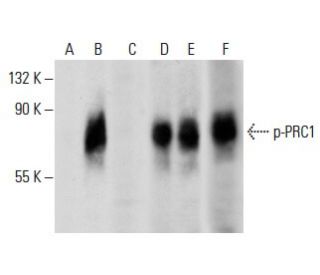

PRC1 Antibody (6G2): sc-56345
- PRC1 Antibody (6G2) is a mouse monoclonal IgG2b, cited in 4 publications, provided at 50 µg/0.5 ml
- raised against amino acids 1-150 of PRC1 of human origin
- recommended for detection of PRC1 of human origin by WB and IP
- At present, we have not yet completed the identification of the preferred secondary detection reagent(s) for PRC1 Antibody (6G2). This work is in progress.

QUICK LINKS
SEE ALSO...
PRC1 Antibody (6G2) is a mouse monoclonal IgG2b antibody that detects PRC1 in human samples through western blotting (WB) and immunoprecipitation (IP) applications. PRC1, or protein regulating cytokinesis 1, plays a crucial role in the regulation of the cell cycle by facilitating the proper separation of daughter cells during cytokinesis. PRC1 (6G2) antibody localizes to the midzone of mitotic spindles during anaphase and is essential for the formation of the cell midbody, which is critical for successful cellular cleavage. Studies show that PRC1 depletion can prevent cellular cleavage without affecting nuclear division, highlighting anti-PRC1 antibody (6G2) specific function in the later stages of mitosis. PRC1′s yeast homolog, Ase1, is vital for spindle assembly, elongation, and disassembly, and undergoes degradation mediated by the anaphase-promoting complex upon entry into the G1 phase, further emphasizing the regulatory mechanisms governing cell division. With specific reactivity and proven applications, PRC1 monoclonal antibody (6G2) serves as an invaluable tool for researchers studying cell cycle dynamics and cytokinesis in human cells.
Alexa Fluor® is a trademark of Molecular Probes Inc., OR., USA
LI-COR® and Odyssey® are registered trademarks of LI-COR Biosciences
PRC1 Antibody (6G2) References:
- PRC1 drives Polycomb-mediated gene repression by controlling transcription initiation and burst frequency. | Dobrinić, P., et al. 2021. Nat Struct Mol Biol. 28: 811-824. PMID: 34608337
- CDK16 promotes the progression and metastasis of triple-negative breast cancer by phosphorylating PRC1. | Li, X., et al. 2022. J Exp Clin Cancer Res. 41: 149. PMID: 35449080
- PCGF1-PRC1 links chromatin repression with DNA replication during hematopoietic cell lineage commitment. | Takano, J., et al. 2022. Nat Commun. 13: 7159. PMID: 36443290
- PRC2.1- and PRC2.2-specific accessory proteins drive recruitment of different forms of canonical PRC1. | Glancy, E., et al. 2023. Mol Cell. 83: 1393-1411.e7. PMID: 37030288
- Functional dissection of PRC1 subunits RYBP and YAF2 during neural differentiation of embryonic stem cells. | Liu, Y., et al. 2023. Nat Commun. 14: 7164. PMID: 37935677
- H3K27me3 spreading organizes canonical PRC1 chromatin architecture to regulate developmental programs. | Krug, B., et al. 2023. bioRxiv.. PMID: 38116029
- PRC1 directs PRC2-H3K27me3 deposition to shield adult spermatogonial stem cells from differentiation. | Hu, M., et al. 2024. Nucleic Acids Res. 52: 2306-2322. PMID: 38142439
- DUX4-induced HSATII transcription causes KDM2A/B-PRC1 nuclear foci and impairs DNA damage response. | Arends, T., et al. 2024. J Cell Biol. 223: PMID: 38451221
- H2AK119ub1 differentially fine-tunes gene expression by modulating canonical PRC1- and H1-dependent chromatin compaction. | Zhao, J., et al. 2024. Mol Cell. 84: 1191-1205.e7. PMID: 38458202
- Modularity of PRC1 composition and chromatin interaction define condensate properties. | Niekamp, S., et al. 2024. Mol Cell. 84: 1651-1666.e12. PMID: 38521066
Ordering Information
| Product Name | Catalog # | UNIT | Price | Qty | FAVORITES | |
PRC1 Antibody (6G2) | sc-56345 | 50 µg/0.5 ml | $322.00 |