
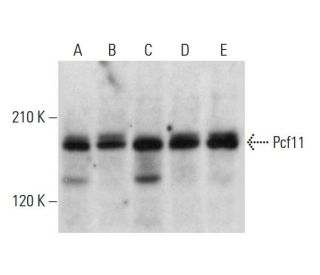

Pcf11 Antibody (C-9): sc-514158
- Pcf11 Antibody (C-9) is a mouse monoclonal IgG3 κ, cited in 1 publications, provided at 200 µg/ml
- specific for an epitope mapping between amino acids 737-767 within an internal region of Pcf11 of human origin
- recommended for detection of Pcf11 of mouse, rat and human origin by WB, IP, IF and ELISA
- At present, we have not yet completed the identification of the preferred secondary detection reagent(s) for Pcf11 Antibody (C-9). This work is in progress.

QUICK LINKS
SEE ALSO...
Pcf11 Antibody (C-9) is a mouse monoclonal IgG3 kappa light chain antibody that detects Pcf11 in mouse, rat, and human samples through applications such as western blotting (WB), immunoprecipitation (IP), immunofluorescence (IF), and enzyme-linked immunosorbent assay (ELISA). Pcf11 (C-9) antibody is available in a non-conjugated form, allowing for versatile experimental use. Pcf11, also known as cleavage and polyadenylation factor subunit homolog (S. cerevisiae), plays a vital role in the regulation of gene expression by facilitating the recruitment of polyadenylation machinery to elongating RNA polymerase II (RNAPII), which is essential for proper transcriptional termination. This 1,555 amino acid nuclear protein is a key component of the pre-mRNA cleavage complex II and promotes the dissociation of RNA polymerase II elongation complexes from DNA, thereby influencing the efficiency of transcription. Pcf11 contains a carboxy-terminal domain (CTD)-interaction domain that binds to the heptad repeats within the RNA polymerase II CTD in a phospho-dependent manner, highlighting its importance in the transcription cycle. The gene encoding Pcf11 is located on human chromosome 11, a region associated with various genetic disorders, including Jervell and Lange-Nielsen syndrome and Jacobsen syndrome, underscoring the significance of Pcf11 in both normal cellular function and disease.
Alexa Fluor® is a trademark of Molecular Probes Inc., OR., USA
LI-COR® and Odyssey® are registered trademarks of LI-COR Biosciences
Pcf11 Antibody (C-9) References:
- Human pre-mRNA cleavage factor II(m) contains homologs of yeast proteins and bridges two other cleavage factors. | de Vries, H., et al. 2000. EMBO J. 19: 5895-904. PMID: 11060040
- Functional interaction of yeast pre-mRNA 3' end processing factors with RNA polymerase II. | Licatalosi, DD., et al. 2002. Mol Cell. 9: 1101-11. PMID: 12049745
- Coupling of termination, 3' processing, and mRNA export. | Hammell, CM., et al. 2002. Mol Cell Biol. 22: 6441-57. PMID: 12192043
- Recognition of RNA polymerase II carboxy-terminal domain by 3'-RNA-processing factors. | Meinhart, A. and Cramer, P. 2004. Nature. 430: 223-6. PMID: 15241417
- Key features of the interaction between Pcf11 CID and RNA polymerase II CTD. | Noble, CG., et al. 2005. Nat Struct Mol Biol. 12: 144-51. PMID: 15665873
- RNA polymerase II CTD phosphopeptides compete with RNA for the interaction with Pcf11. | Hollingworth, D., et al. 2006. RNA. 12: 555-60. PMID: 16497660
- Structure of a nucleotide-bound Clp1-Pcf11 polyadenylation factor. | Noble, CG., et al. 2007. Nucleic Acids Res. 35: 87-99. PMID: 17151076
- Transcription termination factor Pcf11 limits the processivity of Pol II on an HIV provirus to repress gene expression. | Zhang, Z., et al. 2007. Genes Dev. 21: 1609-14. PMID: 17606639
- Human Pcf11 enhances degradation of RNA polymerase II-associated nascent RNA and transcriptional termination. | West, S. and Proudfoot, NJ. 2008. Nucleic Acids Res. 36: 905-14. PMID: 18086705
Ordering Information
| Product Name | Catalog # | UNIT | Price | Qty | FAVORITES | |
Pcf11 Antibody (C-9) | sc-514158 | 200 µg/ml | $322.00 | |||
Pcf11 (C-9) Neutralizing Peptide | sc-514158 P | 100 µg/0.5 ml | $69.00 |