
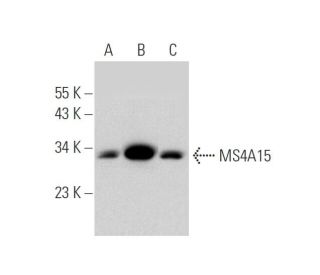

MS4A15 Antibody (C-9): sc-515078
- MS4A15 Antibody (C-9) is a mouse monoclonal IgM κ MS4A15 antibody, cited in 1 publications, provided at 200 µg/ml
- specific for an epitope mapping between amino acids 29-45 near the N-terminus of MS4A15 of human origin
- recommended for detection of MS4A15 of mouse, rat and human origin by WB, IP, IF and ELISA
- m-IgGκ BP-HRP is the preferred secondary detection reagent for MS4A15 Antibody (C-9) for WB applications. This reagent is now offered in a bundle with MS4A15 Antibody (C-9) (see ordering information below). For additional m-IgGκ BP conjugates see our complete list of Mouse IgG Binding Proteins.

QUICK LINKS
MS4A15 Antibody (C-9) is a mouse monoclonal IgM antibody that detects MS4A15 protein of mouse, rat, and human origin by western blotting (WB), immunoprecipitation (IP), immunofluorescence (IF), and enzyme-linked immunosorbent assay (ELISA). Anti-MS4A15 antibody (C-9) is available as the non-conjugated form. MS4A15 protein, a member of the membrane-spanning 4-domain family, subfamily A, is a 240 amino acid multi-pass membrane protein that plays a crucial role in various cellular processes. MS4A15 (C-9) antibody recognizes a protein involved in the regulation of immune responses and has been implicated in the modulation of calcium signaling pathways, which are essential for numerous cellular functions, including cell proliferation and differentiation. The gene encoding MS4A15 is located on human chromosome 11, a region associated with several genetic disorders, highlighting the importance of MS4A15 in maintaining cellular homeostasis and potential implications in disease mechanisms. Through interactions with other proteins in the MS4A family, MS4A15 may also contribute to the complex signaling networks that govern immune cell behavior, making MS4A15 a valuable target for research in immunology and related fields.
Alexa Fluor® is a trademark of Molecular Probes Inc., OR., USA
LI-COR® and Odyssey® are registered trademarks of LI-COR Biosciences
MS4A15 Antibody (C-9) References:
- Identification of a new multigene four-transmembrane family (MS4A) related to CD20, HTm4 and beta subunit of the high-affinity IgE receptor. | Ishibashi, K., et al. 2001. Gene. 264: 87-93. PMID: 11245982
- Hereditary angioedema. Long-term follow-up of 88 patients. Experience of the Argentine Allergy and Immunology Institute. | Fabiani, JE., et al. 2000. Allergol Immunopathol (Madr). 28: 267-71. PMID: 11270087
- Identification of a CD20-, FcepsilonRIbeta-, and HTm4-related gene family: sixteen new MS4A family members expressed in human and mouse. | Liang, Y. and Tedder, TF. 2001. Genomics. 72: 119-27. PMID: 11401424
- Structural organization of the human MS4A gene cluster on Chromosome 11q12. | Liang, Y., et al. 2001. Immunogenetics. 53: 357-68. PMID: 11486273
- Smith-Lemli-Opitz syndrome and the DHCR7 gene. | Jira, PE., et al. 2003. Ann Hum Genet. 67: 269-80. PMID: 12914579
- The pathogenesis and treatment of acid sphingomyelinase-deficient Niemann-Pick disease. | Schuchman, EH. 2007. J Inherit Metab Dis. 30: 654-63. PMID: 17632693
- Jervell and Lange-Nielsen syndrome in Norwegian children: aspects around cochlear implantation, hearing, and balance. | Siem, G., et al. 2008. Ear Hear. 29: 261-9. PMID: 18595190
- Chromosomal microarray mapping suggests a role for BSX and Neurogranin in neurocognitive and behavioral defects in the 11q terminal deletion disorder (Jacobsen syndrome). | Coldren, CD., et al. 2009. Neurogenetics. 10: 89-95. PMID: 18855024
- An intronic mutation leading to incomplete skipping of exon-2 in KCNQ1 rescues hearing in Jervell and Lange-Nielsen syndrome. | Bhuiyan, ZA., et al. 2008. Prog Biophys Mol Biol. 98: 319-27. PMID: 19027783
Ordering Information
| Product Name | Catalog # | UNIT | Price | Qty | FAVORITES | |
MS4A15 Antibody (C-9) | sc-515078 | 200 µg/ml | $322.00 | |||
MS4A15 Antibody (C-9): m-IgGκ BP-HRP Bundle | sc-552710 | 200 µg Ab; 40 µg BP | $361.00 | |||
MS4A15 (C-9) Neutralizing Peptide | sc-515078 P | 100 µg/0.5 ml | $69.00 |