
Plasmide CRISPR d'Activation (h) DNAM-1: sc-402189-ACT
- Espèces cibles: human
- 20 µg d'ADN plasmidique purifié et prêt à transfecter; Jusqu'à 20 transfections
- Le Plasmide CRISPR d'Activation (h) DNAM-1 correspond à un système d'activation de la transcription par un médiateur d'activation synergique du système (SAM) spécifiquement conçu pour réguler positivement l'expression du gène
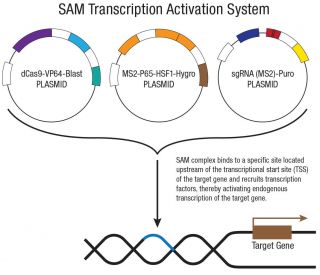
- DNAM-1 Plasmide d'Activation CRISPR (h) est composé de trois plasmides au ratio 1:1:1 : un plasmide codant pour la nucléase Cas9 désactivée (dCas9) (D10A and N863A) fusionnée au domaine de transactivation VP64, et un gène de résistance à la blasticidine; un plasmide codant pour la protéine de fusion MS2-p65-HSF1 et un gène de résistance à l'hygromycine; un plasmide codant pour un ARN guide spécifique de 20 nt fusionné avec deux aptamères ARN MS2, et un gène de résistance à la puromycine.
- Le complexe SAM résultant se lie à une région spécifique d'un site de départ de la transcription du gène cible et fournit un recrutement accru des facteurs de transcription pour une activation hautement efficace du gène cible
- Les gRNA codés par le plasmide d'activation CRISPR DNAM-1 (h) et le plasmide d'activation CRISPR DNAM-1 (h2) ciblent des régions régulatrices distinctes en amont du site de départ de la transcription de CD226. L'un ou les deux modèles peuvent être disponibles
- Après transfection, l'efficacité de knockout de gène peut être évaluée par WB, IF ou IHC en utilisant l'anticorps: DNAM-1 Antibody (D-11): sc-376736

Informations pour la commande
| Nom du produit | Ref. Catalogue | COND. | Prix HT | QTÉ | Favoris | |
Plasmide CRISPR d'Activation (h) DNAM-1 | sc-402189-ACT | 20 µg | $397.00 |
CD226 code pour DNAM‑1, un récepteur d’adhésion et de co‑stimulation de la superfamille des immunoglobulines, exprimé par les cellules NK, les lymphocytes T CD8+ ainsi que par certains sous‑ensembles de lymphocytes T CD4+ et de monocytes. DNAM‑1 se lie aux ligands CD155 (PVR) et CD112 (NECTIN2) afin de favoriser la formation de la synapse immunologique, la polarisation des granules cytotoxiques et la libération de cytokines, en s’intégrant à des réseaux de signalisation qui modèlent l’activation des lymphocytes et la reconnaissance des cellules cibles. Par son rôle dans l’équilibrage des signaux activateurs et inhibiteurs, CD226 influence la surveillance immunitaire antitumorale et les réponses aux infections virales. Des variations génétiques et une expression dérégulée de CD226 ont été associées à une susceptibilité accrue aux maladies à médiation immunitaire, ce qui en fait une cible d’intérêt pour étudier les voies inflammatoires et l’hétérogénéité fonctionnelle des cellules immunitaires.
DNAM-1 Le plasmide d'activation CRISPR (h) offre une approche ciblée et non destructive pour réguler à la hausse l'expression endogène de CD226 sans modifier la séquence d'ADN sous-jacente.
DNAM-1 Le plasmide d'activation CRISPR (h) est un système SAM (synergistic activation mediator) à trois plasmides conçu pour une régulation à la hausse hautement efficace et spécifique du locus CD226 dans des lignées cellulaires humaines. Le système s'articule autour d'une Cas9 catalytiquement inactive (dCas9) portant deux mutations inactivantes (D10A et N863A) qui éliminent l'activité nucléase tout en préservant la liaison à l'ADN. Cette dCas9 est fusionnée à VP64, un puissant activateur transcriptionnel, et est co-exprimée avec un gène de résistance à la blasticidine pour la sélection. Le deuxième plasmide code pour la protéine de fusion MS2-p65-HSF1, un complexe activateur secondaire qui agit de concert avec dCas9-VP64, ainsi qu'un gène de résistance à l'hygromycine. Le troisième plasmide code pour un ARN guide (sgRNA) de 20 nt spécifique de la cible, fusionné à deux aptamères d'ARN MS2 qui recrutent le complexe MS2-p65-HSF1 vers le site d'activation, accompagné d'un gène de résistance à la puromycine. Les trois plasmides sont délivrés dans un rapport massique de 1:1:1 pour une expression équilibrée de tous les composants du système.
Une fois assemblé au locus cible, le complexe SAM se lie à environ 200 pb en amont du site de départ de la transcription CD226, où VP64, p65 et HSF1 agissent de concert pour recruter la machinerie transcriptionnelle et induire une régulation à la hausse de l'expression endogène de DNAM-1. Contrairement à Cas9, qui possède une activité nucléase, dCas9 n'introduit pas de cassures double brin ni ne modifie la séquence génomique, préservant ainsi le locus CD226 natif et permettant l'étude des réponses transcriptionnelles dépendantes de DNAM-1 au niveau du locus endogène, ce qui en fait un outil précieux pour les études fonctionnelles, l'identification de gènes cibles et la modélisation de la restauration de la voie DNAM-1 dans les cellules tumorales présentant une expression de CD226 silencée ou réduite.
Réservé à la recherche. N'est pas destiné à un usage diagnostique ou thérapeutique.