
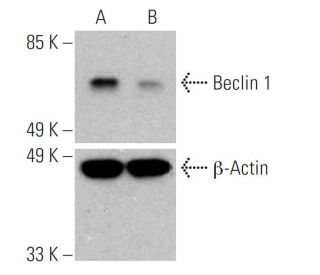
Not CRISPR data: the image illustrates antibody quality for visualizing CRISPR experiment results.
Not CRISPR data: the image illustrates antibody quality for visualizing CRISPR experiment results.
Plasmide Double Nickase (h) BECN1/Beclin-1: sc-400139-NIC
- Espèces cibles: human
- 20 µg d'ADN plasmidique purifié et prêt à transfecter; Jusqu'à 20 transfections
- Le Plasmide Double Nickase (h) BECN1/Beclin-1 correspond à une paire de plasmides chacun codant la nucléase Cas9 mutante D10A et un ARN guide (gARN) cible de 20 nt specifique, élaboré pour le knockout optimal de l'expression d'un gène avec une plus grande spécificité que le plasmide KO CRISPR/Cas9 correspondant.
- Les séquences des paires d'ARNg sont décalées de 20 pb environ pour induire avec la Cas9 une double entaille spécifique de l'ADN génomique, qui imite un DSB
- L'un des plasmides de la paire contient un gène de résistance à la puromycine; l'autre plasmide de la paire contient un marqueur GFP pour confirmer visuellement la transfection
- Le plasmide BECN1/Beclin-1 Double Nickase (h) et le plasmide BECN1/Beclin-1 Double Nickase (h2) codent pour des paires distinctes de gRNA ciblant BECN1. Un ou les deux modèles peuvent être disponibles
- Après transfection, l'efficacité de knockout de gène peut être évaluée par WB, IF ou IHC en utilisant l'anticorps: BECN1/Beclin-1 Antibody (E-8): sc-48341

Informations pour la commande
| Nom du produit | Ref. Catalogue | COND. | Prix HT | QTÉ | Favoris | |
Plasmide Double Nickase (h) BECN1/Beclin-1 | sc-400139-NIC | 20 µg | $410.00 | |||
Plasmide Double Nickase (h2) BECN1/Beclin-1 | sc-400139-NIC-2 | 20 µg | $410.00 |
BECN1 (Beclin-1) est un régulateur central de l'initiation de l'autophagie et de la nucléation des autophagosomes grâce à son rôle dans l'assemblage du complexe PI3K de classe III avec PIK3C3/VPS34, ATG14 et UVRAG. En coordonnant la production de phosphatidylinositol-3-phosphate au niveau des phagophores naissants, Beclin-1 relie la détection des nutriments et les réponses au stress aux voies de dégradation lysosomale, influençant la protéostasie, le contrôle qualité des organites et la signalisation de l'immunité innée. L'activité de BECN1 est modulée par des interactions avec des protéines de la famille BCL2 ainsi que par des événements de phosphorylation qui intègrent des signaux issus de mTOR, d'AMPK et des voies apoptotiques. La dérégulation de l'autophagie dépendante de BECN1 a été associée à la neurodégénérescence, à la biologie des infections et à l'adaptation cellulaire liée au cancer, ce qui en fait un nœud fréquemment étudié dans les réseaux d'homéostasie et de réponse au stress.
BECN1/Beclin-1 Le plasmide double nickase (h) se compose d'une paire de plasmides appariés, conçus pour une édition hautement spécifique du locus BECN1 dans les lignées cellulaires human. Chaque plasmide exprime une nickase Cas9 D10A et un sgRNA distinct ciblant des brins d'ADN opposés au sein de BECN1. Lorsqu'elles sont dirigées vers des sites adjacents sur des brins d'ADN opposés, les deux nickases génèrent des cassures simple brin décalées qui, ensemble, produisent une cassure double brin décalée, nécessitant une activité coordonnée sur la cible de la part des deux guides. La cassure d'ADN qui en résulte est résolue par les voies de réparation cellulaires endogènes, le plus souvent par jonction non homologue (NHEJ), ce qui conduit à des insertions ou des délétions qui perturbent la fonction de BECN1. En nécessitant l'engagement de deux ARNsg au locus cible, l'approche par double nick améliore la spécificité de l'édition et offre une stratégie CRISPR complémentaire pour les applications où un contrôle supplémentaire de la précision du ciblage est souhaité.
Afin de faciliter l'identification efficace des cellules éditées, un plasmide code pour la GFP permettant la visualisation par fluorescence des populations transfectées, tandis que le plasmide compagnon porte un gène de résistance à la puromycine pour la sélection antibiotique. Ensemble, ces caractéristiques favorisent l'enrichissement efficace des populations co-transfectées et simplifient la validation des clones présentant une perturbation de BECN1.
Réservé à la recherche. N'est pas destiné à un usage diagnostique ou thérapeutique.