
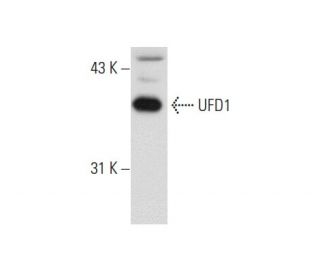


UFD1 Antibody (5e2): sc-81630
- UFD1 Antibody (5e2) is a mouse monoclonal mouse IgM κ κ, cited in 1 publications, provided at 200 µg/ml
- raised against full-length recombinant UFD1 of mouse origin
- recommended for detection of UFD1 of mouse, rat and human origin by WB, IP and IF
- m-IgGκ BP-HRP is the preferred secondary detection reagent for UFD1 Antibody (5e2) for WB applications. This reagent is now offered in a bundle with UFD1 Antibody (5e2) (see ordering information below). For additional m-IgGκ BP conjugates see our complete list of Mouse IgG Binding Proteins.

QUICK LINKS
UFD1 Antibody (5e2) is a mouse monoclonal IgM antibody that detects UFD1 in mouse, rat, and human samples through applications such as western blotting (WB), immunoprecipitation (IP), and immunofluorescence (IF). UFD1 plays a crucial role in the ubiquitin-proteasome system, specifically in the ubiquitin-fusion degradation pathway, which is essential for maintaining cellular homeostasis by regulating protein turnover. UFD1 is primarily located in the cytoplasm and is involved in the selective degradation of misfolded or damaged proteins, thereby preventing the accumulation of potentially toxic protein aggregates. Proper functioning of UFD1 is vital, as dysfunction can lead to various developmental disorders, including CATCH22 syndrome, which is characterized by cardiac defects, cleft palate, and hypocalcemia. Anti-UFD1 antibody (5e2) is designed to facilitate the study of UFD1′s role in these critical cellular processes, providing researchers with a valuable tool for understanding the implications of UFD1 in health and disease.
Alexa Fluor® is a trademark of Molecular Probes Inc., OR., USA
LI-COR® and Odyssey® are registered trademarks of LI-COR Biosciences
UFD1 Antibody (5e2) References:
- Distinct conformations of the protein complex p97-Ufd1-Npl4 revealed by electron cryomicroscopy. | Bebeacua, C., et al. 2012. Proc Natl Acad Sci U S A. 109: 1098-103. PMID: 22232657
- UFD1 contributes to MYC-mediated leukemia aggressiveness through suppression of the proapoptotic unfolded protein response. | Huiting, LN., et al. 2018. Leukemia. 32: 2339-2351. PMID: 29743725
- Involvement of VCP/UFD1/Nucleolin in the viral entry of Enterovirus A species. | Yan, J., et al. 2020. Virus Res. 283: 197974. PMID: 32289342
- Multiple UBX proteins reduce the ubiquitin threshold of the mammalian p97-UFD1-NPL4 unfoldase. | Fujisawa, R., et al. 2022. Elife. 11: PMID: 35920641
- SUMO enhances unfolding of SUMO-polyubiquitin-modified substrates by the Ufd1/Npl4/Cdc48 complex. | Lee, HG., et al. 2023. Proc Natl Acad Sci U S A. 120: e2213703120. PMID: 36574706
- The Ufd1 cofactor determines the linkage specificity of polyubiquitin chain engagement by the AAA+ ATPase Cdc48. | Williams, C., et al. 2023. Mol Cell. 83: 759-769.e7. PMID: 36736315
- The Cdc48 N-terminal domain has a molecular switch that mediates the Npl4-Ufd1-Cdc48 complex formation. | Oppenheim, T., et al. 2023. Structure. 31: 764-779.e8. PMID: 37311459
- VCF1 is a p97/VCP cofactor promoting recognition of ubiquitylated p97-UFD1-NPL4 substrates. | Mirsanaye, AS., et al. 2024. Nat Commun. 15: 2459. PMID: 38503733
- Trim21 modulates endoplasmic reticulum-associated degradation and sensitizes cancer cells to ER stress-induced apoptosis by inhibiting VCP/Npl4/UFD1 assembly. | Yuan, C., et al. 2025. Biochim Biophys Acta Mol Basis Dis. 1871: 167533. PMID: 39368714
- Targeting DTX2/UFD1-mediated FTO degradation to regulate antitumor immunity. | Cui, YH., et al. 2024. Proc Natl Acad Sci U S A. 121: e2407910121. PMID: 39661064
Ordering Information
| Product Name | Catalog # | UNIT | Price | Qty | FAVORITES | |
UFD1 Antibody (5e2) | sc-81630 | 200 µg/ml | $322.00 | |||
UFD1 Antibody (5e2): m-IgGκ BP-HRP Bundle | sc-552828 | 200 µg Ab; 40 µg BP | $361.00 |