
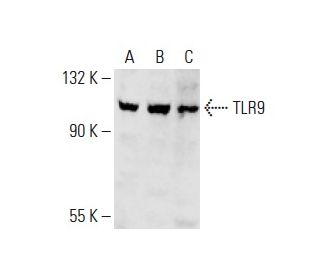

TLR9 Antibody (D-7): sc-518075
- TLR9 Antibody (D-7) is a mouse monoclonal IgM, cited in 1 publications, provided at 200 µg/ml
- specific for an epitope mapping between amino acids 244-268 within an extracellular domain of TLR9 of human origin
- recommended for detection of TLR9 of human origin by WB, IP, IF and ELISA
- At present, we have not yet completed the identification of the preferred secondary detection reagent(s) for TLR9 Antibody (D-7). This work is in progress.

TLR9 Antibody (D-7) is a mouse monoclonal IgM antibody that detects TLR9 in human samples through applications such as western blotting (WB), immunoprecipitation (IP), immunofluorescence (IF), and enzyme-linked immunosorbent assay (ELISA). TLR9 is a crucial component of the immune system, primarily located in endosomal compartments of immune cells, where TLR9 plays a vital role in recognizing unmethylated CpG motifs found in bacterial and viral DNA. This localization is significant because TLR9 effectively detects pathogens and initiates an immune response, thereby contributing to the activation of innate immunity and the subsequent adaptive immune response. The interaction of TLR9 with its ligands leads to the recruitment of adaptor proteins, such as MyD88, which subsequently activates downstream signaling pathways, including the NFκB pathway, resulting in the production of pro-inflammatory cytokines. Anti-TLR9 antibody (D-7) is essential for researchers studying immune responses, pathogen recognition, and the development of immunotherapies, making anti-TLR9 antibody (D-7) a valuable tool in both basic and applied biomedical research.
Alexa Fluor® is a trademark of Molecular Probes Inc., OR., USA
LI-COR® and Odyssey® are registered trademarks of LI-COR Biosciences
TLR9 Antibody (D-7) References:
- Immunotherapeutic applications of CpG oligodeoxynucleotide TLR9 agonists. | Vollmer, J. and Krieg, AM. 2009. Adv Drug Deliv Rev. 61: 195-204. PMID: 19211030
- Targeting the TLR9-MyD88 pathway in the regulation of adaptive immune responses. | Huang, X. and Yang, Y. 2010. Expert Opin Ther Targets. 14: 787-96. PMID: 20560798
- TLR9 and endogenous adjuvants of the whole blood-stage malaria vaccine. | Coban, C., et al. 2010. Expert Rev Vaccines. 9: 775-84. PMID: 20624050
- TLR9 ligation in pancreatic stellate cells promotes tumorigenesis. | Zambirinis, CP., et al. 2015. J Exp Med. 212: 2077-94. PMID: 26481685
- The Role of TLR2, TLR4, and TLR9 in the Pathogenesis of Atherosclerosis. | Roshan, MH., et al. 2016. Int J Inflam. 2016: 1532832. PMID: 27795867
- Kidney Proximal Tubular TLR9 Exacerbates Ischemic Acute Kidney Injury. | Han, SJ., et al. 2018. J Immunol. 201: 1073-1085. PMID: 29898963
- TLR9 and beclin 1 crosstalk regulates muscle AMPK activation in exercise. | Liu, Y., et al. 2020. Nature. 578: 605-609. PMID: 32051584
- TLR9-IL-2 axis exacerbates allergic asthma by preventing IL-17A hyperproduction. | Murakami, Y., et al. 2020. Sci Rep. 10: 18110. PMID: 33093516
- TLR9 deficiency alleviates doxorubicin-induced cardiotoxicity via the regulation of autophagy. | Guo, Z., et al. 2020. J Cell Mol Med. 24: 10913-10923. PMID: 33140921
- Introduction of sugar-modified nucleotides into CpG-containing antisense oligonucleotides inhibits TLR9 activation. | Yoshida, T., et al. 2024. Sci Rep. 14: 11540. PMID: 38773176
Ordering Information
| Product Name | Catalog # | UNIT | Price | Qty | FAVORITES | |
TLR9 Antibody (D-7) | sc-518075 | 200 µg/ml | $322.00 |