
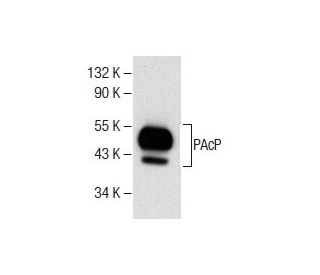
PAcP Antibody (PAP-1): sc-69858
- PAcP Antibody (PAP-1) is a mouse monoclonal IgG1 κ PAcP antibody provided at 200 µg/ml
- raised against purified PAcP from seminal fluid of human origin
- PAcP Antibody (PAP-1) is recommended for detection of PAcP of human origin by WB, IP, IF and IHC(P)
- Anti-PAcP Antibody (PAP-1) is available conjugated to agarose for IP; HRP for WB, IHC(P) and ELISA; and to either phycoerythrin or FITC for IF, IHC(P) and FCM
- also available conjugated to Alexa Fluor® 488, Alexa Fluor® 546, Alexa Fluor® 594 or Alexa Fluor® 647 for WB (RGB), IF, IHC(P) and FCM, and for use with RGB fluorescent imaging systems, such as iBright™ FL1000, FluorChem™, Typhoon, Azure and other comparable systems
- also available conjugated to Alexa Fluor® 680 or Alexa Fluor® 790 for WB (NIR), IF and FCM; for use with Near-Infrared (NIR) detection systems, such as LI-COR®Odyssey®, iBright™ FL1000, FluorChem™, Typhoon, Azure and other comparable systems
- m-IgG Fc BP-HRP, m-IgG1 BP-HRP and m-IgGκ BP-HRP are the preferred secondary detection reagents for PAcP Antibody (PAP-1) for WB and IHC(P) applications. These reagents are now offered in bundles with PAcP Antibody (PAP-1) (see ordering information below).

QUICK LINKS
SEE ALSO...
PAcP Antibody (PAP-1) is a mouse monoclonal IgG1 kappa light chain antibody that detects the PAcP protein of human origin by western blotting (WB), immunoprecipitation (IP), immunofluorescence (IF), and immunohistochemistry with paraffin-embedded sections (IHCP). Anti-PAcP antibody (PAP-1) is available in both non-conjugated and various conjugated forms, including agarose, horseradish peroxidase (HRP), phycoerythrin (PE), fluorescein isothiocyanate (FITC), and multiple Alexa Fluor® conjugates. The prostatic acid phosphatase (PAcP) protein, also known as PAP or PPAP, serves as a critical differentiation antigen specific to prostate epithelium. Functionally, PAcP acts as a neutral protein-tyrosine phosphatase, playing a vital role in regulating prostate cell growth by catalyzing the conversion of orthophosphoric monoester to alcohol and orthophosphate. This enzymatic activity is particularly important as PAcP is stimulated by androgens, making PAcP a key marker for androgen action on human prostate epithelial cells. The secretion of PAcP is a hallmark of prostate tissue atrophy, and cellular expression of PAcP can inhibit prostate cancer cell growth, at least in part by dephosphorylating the c-ErbB-2/neu protein. Consequently, reduced levels of cellular PAcP in cancer cells may contribute to the progression of prostate cancer. PAcP is encoded by the human ACPP gene, located on chromosome 3q21-q23, highlighting PAcP′s significance in both normal prostate function and disease states.
Alexa Fluor® is a trademark of Molecular Probes Inc., OR., USA
LI-COR® and Odyssey® are registered trademarks of LI-COR Biosciences
PAcP Antibody (PAP-1) References:
- Characterization of a prostate-specific tyrosine phosphatase by mutagenesis and expression in human prostate cancer cells. | Zhang, XQ., et al. 2001. J Biol Chem. 276: 2544-50. PMID: 11067847
- Decreased expression of cellular prostatic acid phosphatase increases tumorigenicity of human prostate cancer cells. | Lin, MF., et al. 2001. J Urol. 166: 1943-50. PMID: 11586265
- Atrophy and apoptosis in ventral prostate of rats induced by 5alpha-reductase inhibitor, epristeride. | Qian, LH., et al. 2001. Acta Pharmacol Sin. 22: 399-404. PMID: 11743885
- Protein kinase C pathway is involved in regulating the secretion of prostatic acid phosphatase in human prostate cancer cells. | Lin, MF., et al. 2001. Cell Biol Int. 25: 1139-48. PMID: 11913958
- Identification and characterization of regulatory elements of the human prostatic acid phosphatase promoter. | Zelivianski, S., et al. 2002. Oncogene. 21: 3696-705. PMID: 12032838
- Variation of prostate-specific antigen expression in different tumour growth patterns present in prostatectomy specimens. | Gallee, MP., et al. 1990. Urol Res. 18: 181-7. PMID: 1697709
Ordering Information
| Product Name | Catalog # | UNIT | Price | Qty | FAVORITES | |
PAcP Antibody (PAP-1) | sc-69858 | 200 µg/ml | $322.00 | |||
PAcP Antibody (PAP-1): m-IgG Fc BP-HRP Bundle | sc-528650 | 200 µg Ab; 10 µg BP | $361.00 | |||
PAcP Antibody (PAP-1): m-IgGκ BP-HRP Bundle | sc-521087 | 200 µg Ab, 40 µg BP | $361.00 | |||
PAcP Antibody (PAP-1): m-IgG1 BP-HRP Bundle | sc-543052 | 200 µg Ab; 20 µg BP | $361.00 | |||
PAcP Antibody (PAP-1) AC | sc-69858 AC | 500 µg/ml, 25% agarose | $424.00 | |||
PAcP Antibody (PAP-1) HRP | sc-69858 HRP | 200 µg/ml | $322.00 | |||
PAcP Antibody (PAP-1) FITC | sc-69858 FITC | 200 µg/ml | $336.00 | |||
PAcP Antibody (PAP-1) PE | sc-69858 PE | 200 µg/ml | $349.00 | |||
PAcP Antibody (PAP-1) Alexa Fluor® 488 | sc-69858 AF488 | 200 µg/ml | $364.00 | |||
PAcP Antibody (PAP-1) Alexa Fluor® 546 | sc-69858 AF546 | 200 µg/ml | $364.00 | |||
PAcP Antibody (PAP-1) Alexa Fluor® 594 | sc-69858 AF594 | 200 µg/ml | $364.00 | |||
PAcP Antibody (PAP-1) Alexa Fluor® 647 | sc-69858 AF647 | 200 µg/ml | $364.00 | |||
PAcP Antibody (PAP-1) Alexa Fluor® 680 | sc-69858 AF680 | 200 µg/ml | $364.00 | |||
PAcP Antibody (PAP-1) Alexa Fluor® 790 | sc-69858 AF790 | 200 µg/ml | $364.00 |