
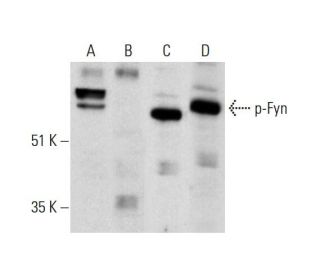

p-Fyn Anticuerpo (D-1): sc-377555
- p-Fyn Anticuerpo (D-1) es un monoclonal de ratón IgM κ, ver las 4 publicaciones, proporcionado como 200 µg/ml
- planteado frente a una secuencia corta de aminoácidos que contiene Thr 12 fosforilado Fyn de human origen
- recomendado para detectarThr 12 phosphorylated Fyn de mouse, rat y human origen, mediante WB, IP, IF y ELISA
- Ver Fyn (15): sc-434 para p-Fyn anticuerpos conjugados, incluyendo AC, HRP, FITC, PE, Alexa Fluor® 488, 594, 647, 680 y 790.
- Actualmente, aún no hemos completado la identificación de los reactivos de detección secundaria preferidos para p-Fyn Anticuerpo (D-1). Este trabajo está en progreso.

ENLACES RÁPIDOS
VER TAMBIÉN ....
El anticuerpo p-Fyn (D-1) es un anticuerpo monoclonal de ratón IgM κ que detecta la Fyn fosforilada en la posición Thr 12 de origen humano, de ratón y de rata mediante las técnicas de WB, IP, IF y ELISA. Este anticuerpo está disponible en su forma no conjugada. Src es el homólogo humano del gen v-Src del virus del sarcoma de Rous, también conocido como virus del sarcoma aviar o ASV. Src fue la primera tirosina quinasa no receptora proto-oncogénica caracterizada en humanos. La familia Src está compuesta por nueve miembros en vertebrados, incluyendo Src, Yes, Fgr, Frk, Fyn, Lyn, Hck, Lck y Blk. Las quinasas de la familia Src transmiten señales que están involucradas en el control de una variedad de procesos celulares, incluyendo la proliferación, diferenciación, motilidad y adhesión. Estas quinasas contienen un anclaje en la membrana celular seguido por un dominio SH3 y un dominio SH2 involucrados en la asociación modular y la activación, respectivamente. Normalmente se mantienen en un estado inactivo y pueden ser activadas transitoriamente durante eventos celulares como la mitosis. Diferentes localizaciones subcelulares de estas quinasas pueden ser importantes para la regulación de procesos celulares específicos como la mitogénesis, la organización del citoesqueleto y el tráfico de membranas. Las quinasas Fyn y Lck desempeñan un papel clave en la señalización del receptor de antígeno de células T (TCR). El gen humano Fyn se localiza en el cromosoma 6q21 y codifica una proteína de 537 aminoácidos.
Alexa Fluor® es una marca registrada de Molecular Probes Inc., OR., USA
REIVEW LI-COR® y Odyssey® son marcas registradas de LI-COR Biosciences.
p-Fyn Anticuerpo (D-1) Referencias:
- Señalización diferencial del receptor de antígeno de células T mediada por las quinasas de la familia Src Lck y Fyn. | Denny, MF., et al. 2000. Mol Cell Biol. 20: 1426-35. PMID: 10648627
- Cinasas de la familia Src: estructura y funciones. | Tatosyan, AG. and Mizenina, OA. 2000. Biochemistry (Mosc). 65: 49-58. PMID: 10702640
- Señalización en leucocitos mediada por la quinasa Src. | Korade-Mirnics, Z. and Corey, SJ. 2000. J Leukoc Biol. 68: 603-13. PMID: 11073097
- Atisbos seleccionados de la activación y función de la quinasa Src. | Bjorge, JD., et al. 2000. Oncogene. 19: 5620-35. PMID: 11114743
- Las quinasas de la familia SRC median la inhibición de los canales de Na+ epiteliales por la endotelina. | Gilmore, ES., et al. 2001. J Biol Chem. 276: 42610-7. PMID: 11560932
- Señalización Nrf2 y supervivencia celular. | Niture, SK., et al. 2010. Toxicol Appl Pharmacol. 244: 37-42. PMID: 19538984
- Significado pronóstico de la fosforilación de Fyn en pacientes con adenocarcinoma de pulmón tras la resección pulmonar. | Nishikawa, S., et al. 2019. Ann Thorac Cardiovasc Surg. 25: 246-252. PMID: 31189776
- El eje Nrf2/p-Fyn/ABCB1 acompañado de la acumulación nuclear de p-Fyn desempeña un papel fundamental en la resistencia a la vinorelbina en el cáncer de pulmón no microcítico. | Tamari, S., et al. 2022. Oncol Rep. 48: PMID: 35959810
- La amplificación de la proteína de choque térmico mejora la mielinización cerebelosa en el modelo de ratón Npc1nih. | Gray, J., et al. 2022. EBioMedicine. 86: 104374. PMID: 36455410
- Comparación estructural de las funciones de las quinasas Src. | Williams, JC., et al. 1998. Trends Biochem Sci. 23: 179-84. PMID: 9612082
Información sobre pedidos
| Nombre del producto | Número de catálogo | UNIDAD | Precio | CANTIDAD | Favoritos | |
p-Fyn Anticuerpo (D-1) | sc-377555 | 200 µg/ml | $322.00 | |||
p-Fyn (D-1) péptido neutralizante | sc-377555 P | 100 µg/0.5 ml | $69.00 |