
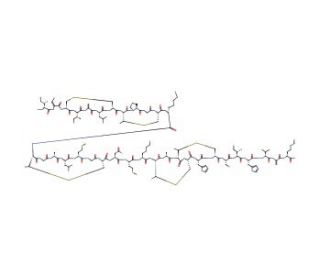

Nisin from Lactococcus lactis (CAS 1414-45-5)
QUICK LINKS
Nisin from Lactococcus lactis is a natural antimicrobial peptide. This lantibiotic peptide, derived from specific bacteria strains like Lactococcus lactis, effectively impedes the growth of various Gram-positive bacteria, including food-borne pathogens. Composed of 34 amino acids, Nisin from Lactococcus lactis is produced through bacterial fermentation. It demonstrates multiple mechanisms of action, including disrupting the cell membrane, inhibiting cell wall synthesis, and impeding protein synthesis. Additionally, Nisin from Lactococcus lactis induces the production of specific enzymes, such as proteases, facilitating the breakdown of bacterial cell walls. Its mode of action involves binding to cell wall precursor lipid components (lipid A portion) of bacteria and disrupts cell wall production. This binding prompts a conformational change known as the "nisin effect," leading to the inhibition of bacterial growth. Moreover, it alters the cell membrane which results in the leakage of cytoplasmic components and destruction of the proton motive force1.
Nisin from Lactococcus lactis (CAS 1414-45-5) References
- Biosynthesis of the lantibiotic nisin: genomic organization and membrane localization of the NisB protein. | Engelke, G., et al. 1992. Appl Environ Microbiol. 58: 3730-43. PMID: 1482192
- Lantibiotics: how do producers become self-protected? | Alkhatib, Z., et al. 2012. J Biotechnol. 159: 145-54. PMID: 22329892
- Synthesis and succinylation of subtilin-like lantibiotics are strongly influenced by glucose and transition state regulator AbrB. | Bochmann, SM., et al. 2015. Appl Environ Microbiol. 81: 614-22. PMID: 25381239
- Adsorption of nisin into layered double hydroxide nanohybrids and in-vitro controlled release. | Bouaziz, Z., et al. 2017. Mater Sci Eng C Mater Biol Appl. 76: 673-683. PMID: 28482578
- Preparation and optimization of self-assembled chondroitin sulfate-nisin nanogel based on quality by design concept. | Mohtashamian, S., et al. 2018. Int J Biol Macromol. 107: 2730-2739. PMID: 29080818
- Antiviral effects of nisin, lysozyme, lactoferrin and their mixtures against bovine viral diarrhoea virus. | Małaczewska, J., et al. 2019. BMC Vet Res. 15: 318. PMID: 31488163
- Monoclonal antibody-based enzyme immunoassay for pediocins of Pediococcus acidilactici. | Bhunia, AK. 1994. Appl Environ Microbiol. 60: 2692-6. PMID: 8085814
- Concentration and recovery of the bacteriocin nisin from Lactococcus lactis subsp. lactis. | Van't Hul, JS. and Gibbons, WR. 1996. Biotechnol Appl Biochem. 24: 251-6. PMID: 8969455
Ordering Information
| Product Name | Catalog # | UNIT | Price | Qty | FAVORITES | |
Nisin from Lactococcus lactis, 1 g | sc-253191 | 1 g | $78.00 | |||
Nisin from Lactococcus lactis, 5 g | sc-253191A | 5 g | $199.00 |