
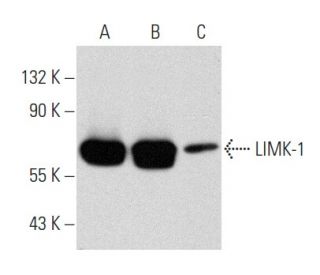
Not CRISPR data: the image illustrates antibody quality for visualizing CRISPR experiment results.
Not CRISPR data: the image illustrates antibody quality for visualizing CRISPR experiment results.
Plásmido Doble Nickase (h) LIMK-1: sc-401057-NIC
- Especies Diana: human
- 20 µg de plásmido de ADN purificado listo para la trasfección; suficiente para 20 transfecciones máximo
- El Plásmido Double Nickase (h)LIMK-1 consisten en un par de plásmidos cada uno codificando una nucleasa Cas9 mutada D10A y una guia de ARN de 20 nucleótidos (gRNA) diseñados para una mayor especificidad que el homologo CRISPR/Cas9 KO
- Las secuencias de gRNA tienen una diferencia de unas 20 pb para permitir un corte doble mediado por Cas9 en el ADN que imita el doble corte
- Uno de los plásmidos contiene el gen de resistencia a puromicina para la selección y el otro el marcado GFP para confirmar visualmente la transfección
- El plásmido de doble nickasa LIMK-1 (h) y el plásmido de doble nickasa LIMK-1 (h2) codifican diseños distintos de pares de gRNA dirigidos a LIMK1. Puede que esté disponible uno o ambos diseños
- Tras la transfección, la eficacia del knockout puede comprobarse mediante WB, IF ó IHC utilzando el anticuerpo: LIMK-1 Anticuerpo (H-12): sc-515585

Información sobre pedidos
| Nombre del producto | Número de catálogo | UNIDAD | Precio | CANTIDAD | Favoritos | |
Plásmido Doble Nickase (h) LIMK-1 | sc-401057-NIC | 20 µg | $410.00 | |||
Plásmido Doble Nickase (h2) LIMK-1 | sc-401057-NIC-2 | 20 µg | $410.00 |
LIMK1 codifica LIMK-1, una quinasa de serina/treonina que regula la dinámica del citoesqueleto de actina al fosforilar e inhibir a cofilina, controlando así el recambio de filamentos, el ensamblaje de fibras de estrés y la motilidad celular. LIMK-1 actúa aguas abajo de la señalización de las GTPasas de la familia Rho a través de las vías ROCK y PAK, integrando señales que modulan la adhesión, la migración y el crecimiento de neuritas. Debido a su papel en la remodelación del citoesqueleto, LIMK1 se estudia en procesos como la plasticidad sináptica y la morfogénesis, y su desregulación se ha implicado en programas de invasión oncogénica y en fenotipos del neurodesarrollo. Estas conexiones de vía hacen de LIMK1 una diana útil para analizar redes de señalización dependientes de actina y comportamientos celulares impulsados por el citoesqueleto.
LIMK-1 El plásmido de doble nicasa (h) consiste en un par de plásmidos emparejados diseñados para la edición de alta especificidad del locus LIMK1 en líneas celulares human. Cada plásmido expresa una nicasa Cas9 D10A y un ARN guía específico (sgRNA) dirigido a cadenas de ADN opuestas dentro de LIMK1. Cuando se dirigen a sitios adyacentes en cadenas de ADN opuestas, las dos nicasas generan cortes en cadena simple desplazados que, juntos, producen una rotura de doble cadena escalonada, lo que requiere una actividad coordinada sobre el objetivo por parte de ambas guías. La rotura de ADN resultante se resuelve mediante vías de reparación celular endógenas, más comúnmente a través de la unión de extremos no homólogos (NHEJ), lo que da lugar a inserciones o deleciones que alteran la función de LIMK1. Al requerir la participación de dos ARN guía en el locus diana, el enfoque de doble corte mejora la especificidad de la edición y proporciona una estrategia CRISPR complementaria para aplicaciones en las que se desea un control adicional sobre la precisión de la orientación.
Para facilitar la identificación eficiente de las células editadas, un plásmido codifica GFP para la visualización fluorescente de las poblaciones transfectadas, mientras que el plásmido complementario lleva un gen de resistencia a la puromicina para la selección con antibióticos. En conjunto, estas características facilitan el enriquecimiento eficiente de las poblaciones cotransfectadas y simplifican la validación de los clones con LIMK1 alterado.
Sólo para uso en investigación. No destinado a uso diagnóstico o terapéutico.