
Partículas Lentivirales de Activación (h) Klotho: sc-400970-LAC
- Especies Diana: human
- 200 µl de Partículas Lentivirales de Activación CRISPR/dCas listas para usar
- Partículas Lentivirales de Acitvación (h) Klotho es un sistema de activación de la trascripción por mediante una activación sinérgica (SAM), diseñado para incrementar la expresión de un gen determinado a través de la tranducción lentiviral de las células
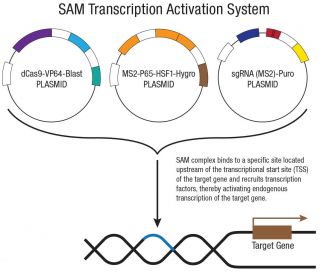
- Partículas Lentivirales de Acitvación (h) Klotho incluyen los siguientes elementos activadores SAM: plásmido codificador de la nucleasa Cas 9 desactivada, (D10A y N863A) fusionadas al dominio de transactivación VP64; plásmido codificador de la proteína de fusión MS2-p65-HSF1 y un plásmido que codifica la secuencia de diana específica de 20 nt de ARN. También contienen genes de resistencia a blasticidina, higromicina y puromicina.
- El complejo SAM resultante se une en un punto específico a unos 200 -250 nt aguas arriba del inicio de la transcripción del gen diana y ofrece un potente punto de reclutamiento de factores de transcripción para un eficiente incremento de la activación génica
- Los gRNA codificados por el Klotho Plásmido de activación lentiviral (h) y el Klotho Plásmido de activación lentiviral (h2) se dirigen a regiones reguladoras distintas del promotor KL. Puede que haya uno o ambos diseños disponibles
- Tras la transfección, la eficacia de la activación génica puede comprobarse mediante WB, IF ó IHC utilzando el anticuerpo: Klotho Anticuerpo (F-5): sc-515939

Información sobre pedidos
| Nombre del producto | Número de catálogo | UNIDAD | Precio | CANTIDAD | Favoritos | |
Partículas Lentivirales de Activación (h) Klotho | sc-400970-LAC | 200 µl | $455.00 |
El gen humano **KL** codifica **Klotho**, una proteína de membrana de tipo I de paso único que también existe como un ectodominio soluble y actúa como un modulador clave de la señalización del factor de crecimiento de fibroblastos y del metabolismo mineral sistémico. Como correceptor obligatorio de **FGF23**, Klotho influye en la homeostasis del fosfato y de la vitamina D y determina las salidas posteriores de las vías **MAPK/ERK** y **PI3K/AKT** en los tejidos sensibles. Además, Klotho se ha relacionado con la regulación de las respuestas al estrés oxidativo, la señalización **Wnt** y programas de senescencia celular que afectan la remodelación tisular y la homeostasis metabólica. La alteración de la expresión de **KL** se ha asociado con fenotipos relevantes para la disfunción renal, la calcificación vascular y procesos cardiometabólicos y neurodegenerativos relacionados con la edad, lo que respalda su uso como un nodo mecanístico en modelos de investigación centrados en vías.
Las partículas de activación lentiviral Klotho (h) responden a esta necesidad al empaquetar el sistema completo de activación transcripcional del mediador de activación sinérgica (SAM) en partículas lentivirales de alto título listas para la transducción, lo que permite una regulación al alza eficiente de KL en una gama más amplia de tipos de células humanas.
Las partículas de activación lentiviral Klotho (h) suministran todos los componentes funcionales del sistema mediador de activación sinérgica (SAM) a través de la transducción lentiviral. El sistema comprende tres preparaciones de partículas cotransducidas en las células diana: una que codifica dCas9 catalíticamente inactivo (mutaciones D10A y N863A) fusionado al dominio de transactivación VP64 con un gen de resistencia a la blasticidina; otra que codifica la proteína de fusión MS2-p65-HSF1 con un gen de resistencia a la higromicina; y otra que codifica un ARN guía (sgRNA) específico del objetivo de 20 nt fusionado a dos aptámeros de ARN MS2 con un gen de resistencia a la puromicina. Tras la transducción lentiviral y la integración genómica de los casetes de expresión, los componentes del SAM se expresan de forma estable y se ensamblan en el locus diana dentro de la región promotora proximal, aguas arriba del sitio de inicio de la transcripción KL, donde VP64, p65 y HSF1 actúan de forma cooperativa para reclutar la maquinaria transcripcional endógena e impulsar la regulación al alza sostenida de la expresión endógena de Klotho. El uso de dCas9 inactivo frente a nucleasas evita la introducción de roturas de ADN de doble cadena y preserva el locus genómico nativo KL y la arquitectura reguladora.
El formato lentiviral ofrece varias ventajas prácticas: la integración genómica estable permite la activación hereditaria a lo largo de las divisiones celulares; las preparaciones de partículas de alto título eliminan la necesidad de producir el virus internamente; y la compatibilidad con tipos de células primarias, no divisibles y resistentes a la transfección amplía la accesibilidad experimental. La transducción exitosa puede confirmarse y enriquecerse mediante selección con triple antibiótico utilizando puromicina, higromicina y blasticidina.
Sólo para uso en investigación. No destinado a uso diagnóstico o terapéutico.