
Keratin 24 Plásmido CRISPR/Cas9 KO (h): sc-414948
- Especies Diana: human
- 20 µg de plásmido de ADN purificado listo para la trasfección; suficiente para 20 transfecciones máximo
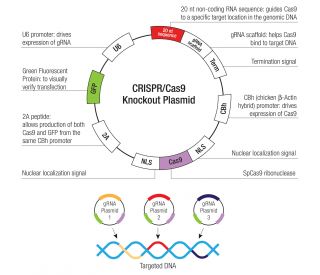
- Keratin 24 El plásmido CRISPR/Cas9 Knockout (KO) (h) es un conjunto de plásmidos, cada uno de los cuales codifica la nucleasa Cas9 y un ARN guía (gRNA) de 20 nt específico para el objetivo, diseñado para lograr la máxima eficiencia de knockout utilizando secuencias derivadas de la biblioteca GeCKO v2
- Las secuencias de gRNA dirigen a Cas9 para que induzca roturas de doble cadena (DSB) específicas en el locus genómico Keratin 24, lo que da lugar a la inactivación del gen mediante unión de extremos no homólogos (NHEJ)
- Los genes de resistencia a la puromicina y RFP están flanqueados por sitios LoxP, lo que permite la eliminación de los marcadores de selección mediante la recombinasa Cre (Vector Cre: sc-418923) tras el establecimiento de líneas celulares knockout estables

Información sobre pedidos
| Nombre del producto | Número de catálogo | UNIDAD | Precio | CANTIDAD | Favoritos | |
Keratin 24 Plásmido CRISPR/Cas9 KO (h) | sc-414948 | 20 µg | $397.00 |
Descripción general
KRT24 codifica la queratina 24, una proteína de filamentos intermedios de tipo I que contribuye a la red del citoesqueleto en células epiteliales y sostiene la integridad estructural y la resiliencia mecánica específicas de cada tejido. Como parte del ensamblaje y la remodelación de los filamentos de queratina, KRT24 se integra con procesos más amplios vinculados al citoesqueleto y a la adhesión que influyen en la forma celular, la polaridad y la función de barrera. Los patrones alterados de expresión de queratinas se asocian comúnmente con respuestas epiteliales al estrés y con cambios en el estado de diferenciación, lo que convierte a KRT24 en un marcador útil y en un punto de entrada mecanístico para estudiar la remodelación epitelial en contextos relevantes para la enfermedad. La organización desregulada de los filamentos intermedios puede afectar el diálogo cruzado de señalización y la homeostasis celular, lo que justifica investigar KRT24 en modelos de disfunción epitelial.
El plásmido CRISPR/Cas9 KO Keratin 24 (h) es un conjunto de plásmidos diseñado para la interrupción dirigida del gen KRT24 en líneas celulares human. Cada plásmido coexpresa un ARN guía único (sgRNA) dirigido a un sitio distinto dentro del KRT24 junto con la nucleasa Cas9 de Streptococcus pyogenes. Los plásmidos también codifican GFP, lo que permite la identificación fluorescente y el enriquecimiento de las células transfectadas con éxito mediante microscopía de fluorescencia o citometría de flujo.
El diseño multiguía aumenta la probabilidad de generar inserciones o deleciones (indeles) que interrumpan el marco de lectura abierto de KRT24 tras la formación de roturas de doble cadena mediadas por Cas9. Las roturas de ADN introducidas por el sistema CRISPR/Cas9 se reparan a través de vías endógenas de unión de extremos no homólogos (NHEJ), lo que con frecuencia da lugar a mutaciones de desplazamiento del marco de lectura que anulan la expresión de la proteína Keratin 24.
Este sistema de knockout CRISPR permite la generación eficiente de modelos celulares deficientes en KRT24 para la investigación de la señalización de Keratin 24, estudios de genómica funcional, investigación en biología del cáncer y evaluación de respuestas terapéuticas en líneas celulares humanas.
Características principales
- sgRNA dirigidos a los exones de KRT24 críticos para la función de Keratin 24
Coexpresión de SpCas9 y sgRNA a partir de un único plásmido para simplificar la administración
Reportero GFP para la identificación de células transfectadas
Conjunto de plásmidos dirigidos a múltiples sitios genómicos de KRT24 para mejorar la eficiencia del knockout
Compatible con la administración mediante transfección
Variantes de diseño
CRISPRs +/- HDRs
- Los gRNA codificados por el plásmido Keratin 24 CRISPR/Cas9 KO (h) y el plásmido Keratin 24 CRISPR/Cas9 KO (h2) se dirigen a sitios distintos dentro del locus KRT24. Puede estar disponible uno o ambos diseños de orientación. Consulte «Productos relacionados» para conocer la disponibilidad.
Las construcciones donantes HDR codificadas por el plásmido HDR Keratin 24 (h) y el plásmido HDR Keratin 24 (h2) contienen un casete de resistencia a la puromicina y un reportero RFP flanqueado por brazos de homología KRT24 para facilitar la reparación dirigida por homología en sitios diana KRT24 definidos que se corresponden con los diseños de KO de CRISPR/Cas9. La disponibilidad de los donantes HDR puede variar. Consulte «Productos relacionados» para conocer la disponibilidad.
Sólo para uso en investigación. No destinado a uso diagnóstico o terapéutico.