
HLA-DOβ CRISPR/Cas9 KO Plasmid (m): sc-420773
- Target species: mouse
- 20 µg of transfection-ready, purified plasmid DNA; Suitable for up to 20 transfections
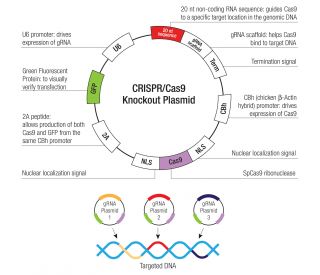
- HLA-DOβ CRISPR/Cas9 Knockout (KO) Plasmid (m) is a pool of plasmids, each encoding Cas9 nuclease and a target-specific 20 nt guide RNA (gRNA) designed for maximum knockout efficiency using sequences derived from the GeCKO v2 library
- gRNA sequences direct Cas9 to induce site-specific double-strand breaks (DSBs) in the HLA-DOβ genomic locus, resulting in gene knockout through non-homologous end joining (NHEJ)
- The puromycin resistance and RFP genes are flanked by LoxP sites, enabling removal of selection markers via Cre recombinase (Cre Vector: sc-418923) after establishing stable knockout cell lines

Ordering Information
| Product Name | Catalog # | UNIT | Price | Qty | FAVORITES | |
HLA-DOβ CRISPR/Cas9 KO Plasmid (m) | sc-420773 | 20 µg | $397.00 |
Overview
H2-Ob encodes the mouse ortholog of HLA-DOβ, a nonclassical MHC class II–associated protein that forms a heterodimer with DOα in antigen-presenting cells. This complex localizes to late endosomal/lysosomal compartments and modulates peptide loading on MHC class II by regulating HLA-DM/H2-DM activity, thereby shaping the repertoire of peptides presented to CD4+ T cells. Through its influence on endosomal antigen processing and MHC II trafficking, H2-Ob contributes to immune tolerance, adaptive immune activation, and the quality of humoral responses. Dysregulated DO/DM balance and altered MHC II antigen presentation are relevant to studies of autoimmunity, infection, and inflammatory disease mechanisms in mouse models.
HLA-DOβ CRISPR/Cas9 KO Plasmid (m) is a pool of plasmids designed for targeted disruption of the H2-Ob gene in mouse cell lines. Each plasmid co-expresses a unique single guide RNA (sgRNA) targeting a distinct site within the H2-Ob together with the Streptococcus pyogenes Cas9 nuclease. The plasmids also encode GFP, allowing fluorescent identification and enrichment of successfully transfected cells by fluorescence microscopy or flow cytometry.
The multi-guide design increases the likelihood of generating insertions or deletions (indels) that disrupt the H2-Ob open reading frame following Cas9-mediated double-strand break formation. DNA breaks introduced by the CRISPR/Cas9 system are repaired through endogenous non-homologous end joining (NHEJ) pathways, frequently resulting in frameshift mutations that abolish HLA-DOβ protein expression.
This CRISPR knockout system enables efficient generation of H2-Ob-deficient cell models for investigation of HLA-DOβ signaling, functional genomics studies, cancer biology research, and evaluation of therapeutic responses in human cell lines.
Key Features
- sgRNAs targeting H2-Ob exon(s) critical for HLA-DOβ function
- Co-expression of SpCas9 and sgRNA from a single plasmid for simplified delivery
- GFP reporter for identification of transfected cells
- Pool of plasmids targeting multiple H2-Ob genomic sites to improve knockout efficiency
- Compatible with delivery by transfection
Design Variants
CRISPRs +/- HDRs
- gRNAs encoded by HLA-DOβ CRISPR/Cas9 KO Plasmid (m) and HLA-DOβ CRISPR/Cas9 KO Plasmid (m2) target distinct sites within the H2-Ob locus. One or both targeting designs may be available. See Related Products for availability.
- HDR donor constructs encoded by HLA-DOβ HDR Plasmid (m) and HLA-DOβ HDR Plasmid (m2) contain a puromycin resistance cassette and an RFP reporter flanked by H2-Ob homology arms to support homology-directed repair at defined H2-Ob target sites corresponding to the CRISPR/Cas9 KO designs. HDR donor availability may vary. See Related Products for availability.
For Research Use Only. Not Intended for Diagnostic or Therapeutic Use.