
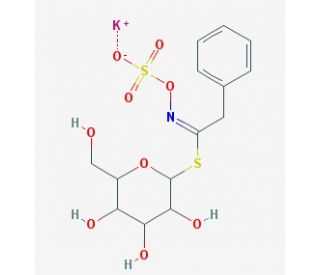

Glucotropaeolin (CAS 5115-71-9)
See product citations (3)
QUICK LINKS
Glucotropaeolin is a glucosinolate found in several plants, including Tropaeolum majus, known as garden nasturtium. It is frequently used in agricultural and plant biology research due to its role in plant defense mechanisms. Research involving Glucotropaeolin often focuses on its capacity to deter herbivores and pathogens when hydrolyzed by the enzyme myrosinase, releasing isothiocyanates, which are biologically active compounds. Studies also investigate its potential impact on soil health and its interactions with other plants and microorganisms in the rhizosphere. In addition, Glucotropaeolin is used in investigations on plant allelopathy, where it may influence the growth and development of surrounding vegetation through chemical release into the environment.
Glucotropaeolin (CAS 5115-71-9) References
- In vitro antiproliferative activity of isothiocyanates and nitriles generated by myrosinase-mediated hydrolysis of glucosinolates from seeds of cruciferous vegetables. | Nastruzzi, C., et al. 2000. J Agric Food Chem. 48: 3572-5. PMID: 10956152
- Purification and characterization of myrosinase from the cabbage aphid (Brevicoryne brassicae), a brassica herbivore. | Pontoppidan, B., et al. 2001. Eur J Biochem. 268: 1041-8. PMID: 11179970
- Identification of new derivatives of sinigrin and glucotropaeolin produced by the human digestive microflora using 1H NMR spectroscopy analysis of in vitro incubations. | Combourieu, B., et al. 2001. Drug Metab Dispos. 29: 1440-5. PMID: 11602519
- Investigation of the tuber constituents of maca (Lepidium meyenii Walp.). | Piacente, S., et al. 2002. J Agric Food Chem. 50: 5621-5. PMID: 12236688
- In vitro digestion of sinigrin and glucotropaeolin by single strains of Bifidobacterium and identification of the digestive products. | Cheng, DL., et al. 2004. Food Chem Toxicol. 42: 351-7. PMID: 14871576
- Inhibition of carcinogenesis by minor dietary constituents. | Wattenberg, LW. 1992. Cancer Res. 52: 2085s-2091s. PMID: 1544145
- Production of glucosinolate hydrolysis products in Farsetia aegyptia suspension cultures following elicitation. | Al-Gendy, AA. and Lockwood, GB. 2005. Fitoterapia. 76: 288-95. PMID: 15885925
- Quantitative determination of intact glucosinolates in broccoli, broccoli sprouts, Brussels sprouts, and cauliflower by high-performance liquid chromatography-electrospray ionization-tandem mass spectrometry. | Tian, Q., et al. 2005. Anal Biochem. 343: 93-9. PMID: 15963940
- Uptake and turn-over of glucosinolates sequestered in the sawfly Athalia rosae. | Müller, C. and Wittstock, U. 2005. Insect Biochem Mol Biol. 35: 1189-98. PMID: 16102424
- The glucosinolate-myrosinase system in nasturtium (Tropaeolum majus L.): variability of biochemical parameters and screening for clones feasible for pharmaceutical utilization. | Kleinwächter, M., et al. 2008. J Agric Food Chem. 56: 11165-70. PMID: 18986152
- Transformation of Nasturtium officinale, Barbarea verna and Arabis caucasica for hairy roots and glucosinolate-myrosinase system production. | Wielanek, M., et al. 2009. Biotechnol Lett. 31: 917-21. PMID: 19229477
- Pitfalls in the desulphation of glucosinolates in a high-throughput assay. | Hennig, K., et al. 2012. Food Chem. 134: 2355-61. PMID: 23442696
- Bioavailability and metabolism of benzyl glucosinolate in humans consuming Indian cress (Tropaeolum majus L.). | Platz, S., et al. 2016. Mol Nutr Food Res. 60: 652-60. PMID: 26610401
- Glucotropaeolin Promotes Apoptosis by Calcium Dysregulation and Attenuates Cell Migration with FOXM1 Suppression in Pancreatic Cancer Cells. | Lee, W., et al. 2023. Antioxidants (Basel). 12: PMID: 36829815
- Biosynthesis of mustard oil glucosides: conversion of phenylacetaldehyde oxime and 3-phenylpropionaldehyde oxime to glucotropaeolin and gluconasturtiin. | Underhill, EW. 1967. Eur J Biochem. 2: 61-3. PMID: 6082608
Ordering Information
| Product Name | Catalog # | UNIT | Price | Qty | FAVORITES | |
Glucotropaeolin, 20 mg | sc-285861 | 20 mg | $1248.00 | |||
Glucotropaeolin, 50 mg | sc-285861A | 50 mg | $2497.00 |