
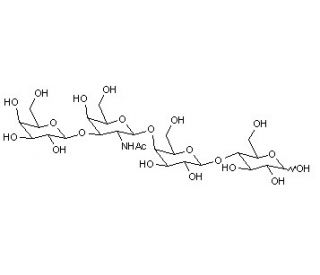

Gangliotetraose (CAS 75645-24-8)
QUICK LINKS
Gangliotetraose is a tetrasaccharide component primarily found as a structural element within gangliosides, which are sialic acid-containing glycosphingolipids crucial to cellular membranes in the nervous system. Structurally, gangliotetraose consists of a sequence of four sugar molecules, including glucose, galactose, and N-acetylgalactosamine, often capped with sialic acid in its complete ganglioside form. In biochemical research, gangliotetraose has been utilized to study the mechanisms of cellular recognition and signal transduction in neural cells. As a simplified model of the more complex gangliosides, it helps in understanding how specific carbohydrate sequences within gangliosides interact with cellular receptors, contribute to neurodevelopment, and influence neural plasticity and repair. This oligosaccharide has also been pivotal in exploring the molecular basis of cell-to-cell communication in the brain and how disruptions in these interactions can contribute to neurological disorders. Additionally, gangliotetraose serves as an important tool in glycobiology for the synthesis of complex glycolipids and in studying the enzymatic processes involved in glycosphingolipid metabolism. Through such research, insights into the specific glycan interactions that occur in various biological processes are expanded, enhancing the understanding of cellular dynamics and pathogenesis in neurobiological conditions.
Gangliotetraose (CAS 75645-24-8) References
- Enhanced susceptibility to kainate-induced seizures, neuronal apoptosis, and death in mice lacking gangliotetraose gangliosides: protection with LIGA 20, a membrane-permeant analog of GM1. | Wu, G., et al. 2005. J Neurosci. 25: 11014-22. PMID: 16306414
- Sphingolipids of the nucleus and their role in nuclear signaling. | Ledeen, RW. and Wu, G. 2006. Biochim Biophys Acta. 1761: 588-98. PMID: 16814200
- Correlation of gangliotetraose gangliosides with neurite forming potential of neuroblastoma cells. | Wu, GS., et al. 1991. Brain Res Dev Brain Res. 61: 217-28. PMID: 1721562
- Nuclear sphingolipids: metabolism and signaling. | Ledeen, RW. and Wu, G. 2008. J Lipid Res. 49: 1176-86. PMID: 18326892
- Gangliosides of cultured astroglia. | Sbaschnig-Agler, M., et al. 1988. Brain Res. 461: 98-106. PMID: 3147125
- Quantification of gangliotetraose gangliosides with cholera toxin. | Wu, GS. and Ledeen, R. 1988. Anal Biochem. 173: 368-75. PMID: 3189815
- Low levels of CSF gangliotetraose-series gangliosides in West syndrome: implication of brain maturation disturbance. | Izumi, T., et al. 1993. Pediatr Neurol. 9: 293-6. PMID: 8216542
- Normal developmental profiles of CSF gangliotetraose-series gangliosides from neonatal period to adolescence. | Izumi, T., et al. 1993. Pediatr Neurol. 9: 297-300. PMID: 8216543
- IgM natural antibody against an asialo-oligosaccharide, gangliotetraose (Gg4), sensitizes HIV-I infected cells for cytolysis by homologous complement. | Wu, X., et al. 1996. Int Immunol. 8: 153-8. PMID: 8671599
- The role of GM1 and other gangliosides in neuronal differentiation. Overview and new finding. | Ledeen, RW., et al. 1998. Ann N Y Acad Sci. 845: 161-75. PMID: 9668350
Ordering Information
| Product Name | Catalog # | UNIT | Price | Qty | FAVORITES | |
Gangliotetraose, 250 µg | sc-285855 | 250 µg | $350.00 | |||
Gangliotetraose, 500 µg | sc-285855A | 500 µg | $600.00 |