
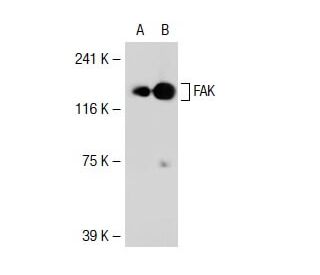
FAK (h): 293T Lysate: sc-114600
- human FAK transfected 293T lysate
- 100 µg protein in 200 µl SDS-PAGE buffer; suitable as Western Blotting control for FAK antibodies
- Suitable control antibody: FAK Antibody (D-1): sc-271126 is recommended as control antibody for monitoring of FAK expression knockdown by Western blotting or immunofluorescence
- should be stored at -20° C and repeated freezing and thawing should be minimized
- sample vial should be boiled once prior to use
- non-transfected control 293T lysate (sc-117752)

QUICK LINKS
The FAK (h): 293T Lysate is derived from the HEK293T cell line, a human embryonic kidney cell line known for its high transfection efficiency, making it a staple in molecular and cellular biology research. This lysate contains Focal Adhesion Kinase (FAK), a non-receptor protein tyrosine kinase that is a critical regulator of integrin-mediated signal transduction pathways. FAK is activated by integrin clustering and engagement with the extracellular matrix, leading to autophosphorylation at Tyr397. This event creates a high-affinity binding site for Src family kinases, resulting in the phosphorylation of additional tyrosine residues on FAK and the recruitment of various signaling proteins. These interactions initiate multiple downstream signaling cascades, including those involving the PI3K-Akt and MAPK pathways, which are essential for cellular processes such as migration, proliferation, and survival. In research, the FAK (h): 293T Lysate is used to study the mechanisms of focal adhesion dynamics and integrin signaling. Researchers employ this lysate in in vitro assays to investigate protein-protein interactions, phosphorylation events, and the assembly of focal adhesion complexes. It is also valuable in analyzing the role of FAK in mechanotransduction, exploring how mechanical signals are converted into biochemical responses. Additionally, this lysate aids in screening for potential modulators of FAK activity, facilitating the understanding of how FAK regulates cell adhesion, motility, and signaling networks. By leveraging this lysate, scientists can gain insights into the signaling pathways governed by FAK and their broader implications in cell biology.
Ordering Information
| Product Name | Catalog # | UNIT | Price | Qty | FAVORITES | |
FAK (h): 293T Lysate | sc-114600 | 100 µg/200 µl | $236.00 |