
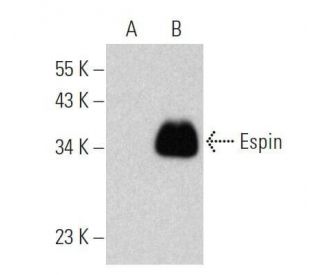


Espin Antibody (E-1): sc-515657
- Espin Antibody (E-1) is a mouse monoclonal IgG1 κ, cited in 2 publications, provided at 200 µg/ml
- specific for an epitope mapping between amino acids 640-657 within an internal region of Espin of human origin
- recommended for detection of Espin of mouse, rat and human origin by WB, IP, IF and ELISA
- m-IgG Fc BP-HRP and m-IgG1 BP-HRP are the preferred secondary detection reagents for Espin Antibody (E-1) for WB applications. These reagents are now offered in bundles with Espin Antibody (E-1) (see ordering information below).

QUICK LINKS
SEE ALSO...
Espin Antibody (E-1) is a mouse monoclonal IgG1 antibody that detects Espin in mouse, rat, and human samples through western blotting (WB), immunoprecipitation (IP), immunofluorescence (IF), and enzyme-linked immunosorbent assay (ELISA). Espin is a crucial cytoplasmic protein consisting of 854 amino acids, characterized by nine ankyrin repeats and a WH2 domain, which plays a significant role in actin dynamics. The WH2 domain facilitates the binding of actin monomers, thereby promoting the assembly of actin bundles that are essential for the structural integrity and signaling functions of sensory cells. This is particularly important in the context of sensory transduction, where the organization of actin filaments influences the responsiveness of sensory receptors. Mutations or defects in Espin are linked to non-syndromic sensorineural deafness autosomal recessive type 36 (DFNB36), highlighting Espin′s vital role in auditory function. In humans, Espin is expressed in two isoforms due to alternative splicing, while in rodents, four major isoforms ranging from approximately 110 to 25 kDa have been identified, along with potential additional splice variants. Furthermore, Espin interacts with proteins such as IRSp53 and Profilin-2, which are involved in actin regulation and cellular signaling pathways, underscoring Espin′s importance in maintaining cellular architecture and function. Anti-Espin antibody (E-1) is an invaluable tool for researchers studying the molecular mechanisms underlying sensory transduction and related pathologies.
Alexa Fluor® is a trademark of Molecular Probes Inc., OR., USA
LI-COR® and Odyssey® are registered trademarks of LI-COR Biosciences
Espin Antibody (E-1) References:
- The deaf jerker mouse has a mutation in the gene encoding the espin actin-bundling proteins of hair cell stereocilia and lacks espins. | Zheng, L., et al. 2000. Cell. 102: 377-85. PMID: 10975527
- Novel espin actin-bundling proteins are localized to Purkinje cell dendritic spines and bind the Src homology 3 adapter protein insulin receptor substrate p53. | Sekerková, G., et al. 2003. J Neurosci. 23: 1310-9. PMID: 12598619
- Correlation of expression of the actin filament-bundling protein espin with stereociliary bundle formation in the developing inner ear. | Li, H., et al. 2004. J Comp Neurol. 468: 125-34. PMID: 14648695
- A novel mutation in the Espin gene causes autosomal recessive nonsyndromic hearing loss but no apparent vestibular dysfunction in a Moroccan family. | Boulouiz, R., et al. 2008. Am J Med Genet A. 146A: 3086-9. PMID: 18973245
- Myosin IIIa boosts elongation of stereocilia by transporting espin 1 to the plus ends of actin filaments. | Salles, FT., et al. 2009. Nat Cell Biol. 11: 443-50. PMID: 19287378
- Structural and viscoelastic properties of actin networks formed by espin or pathologically relevant espin mutants. | Lieleg, O., et al. 2009. Chemphyschem. 10: 2813-7. PMID: 19780097
- Characterization and regulation of an additional actin-filament-binding site in large isoforms of the stereocilia actin-bundling protein espin. | Zheng, L., et al. 2014. J Cell Sci. 127: 1306-17. PMID: 24424026
- Myosin III-mediated cross-linking and stimulation of actin bundling activity of Espin. | Liu, H., et al. 2016. Elife. 5: PMID: 26785147
- Stereocilia-staircase spacing is influenced by myosin III motors and their cargos espin-1 and espin-like. | Ebrahim, S., et al. 2016. Nat Commun. 7: 10833. PMID: 26926603
- Identification of whirlin domains interacting with espin: A study of the mechanism of Usher syndrome type II. | Wang, L., et al. 2019. Mol Med Rep. 20: 5111-5117. PMID: 31638198
Ordering Information
| Product Name | Catalog # | UNIT | Price | Qty | FAVORITES | |
Espin Antibody (E-1) | sc-515657 | 200 µg/ml | $322.00 | |||
Espin Antibody (E-1): m-IgG Fc BP-HRP Bundle | sc-541074 | 200 µg Ab; 10 µg BP | $361.00 | |||
Espin Antibody (E-1): m-IgG1 BP-HRP Bundle | sc-542565 | 200 µg Ab; 20 µg BP | $361.00 | |||
Espin (E-1) Neutralizing Peptide | sc-515657 P | 100 µg/0.5 ml | $69.00 |