
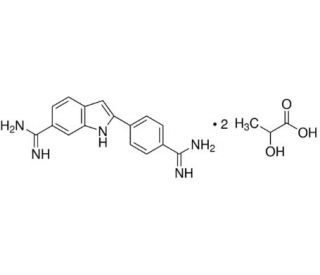

DAPI, dilactate
See product citations (7)
QUICK LINKS
DAPI, dilactate, commonly referred to as 4′,6-diamidino-2-phenylindole dilactate, is a water-soluble derivative of the well-known fluorescent stain DAPI. This compound is particularly favored in biological research for its strong affinity to DNA, where it selectively binds to adenine-thymine rich regions in the minor groove of double-stranded DNA. Upon binding, DAPI fluoresces brightly with a blue emission when excited by ultraviolet light, making it an excellent tool for nuclear staining in fluorescence microscopy and flow cytometry. The mechanism of action of DAPI, dilactate involves the intercalation of its planar structure between the bases of DNA, a process facilitated by its positive charge which attracts the negatively charged phosphate groups of DNA. This binding enhances the quantum yield of the dye, resulting in increased fluorescence intensity that is easily detectable and quantifiable. Researchers utilize DAPI, dilactate extensively in cell cycle studies, apoptosis detection, and chromosome visualization, as it provides a clear and distinct demarcation of nuclei against a less intensely stained cytoplasm. Moreover, its ability to cross the cell membrane when in the dilactate form adds to its utility in live-cell imaging, enabling researchers to perform dynamic studies of cellular processes in real time. This specific characteristic makes DAPI, dilactate an indispensable reagent in the field of cytogenetics, developmental biology, and various other disciplines where precise DNA visualization is crucial.
DAPI, dilactate References
- Multianalyte microphysiometry reveals changes in cellular bioenergetics upon exposure to fluorescent dyes. | Shinawi, TF., et al. 2013. Anal Chem. 85: 11677-80. PMID: 24228839
- Nuclear DNA content variation in life history phases of the Bonnemasoniaceae (Rhodophyta). | Salvador Soler, N., et al. 2014. PLoS One. 9: e86006. PMID: 24465835
- Osteocyte differentiation and the formation of an interconnected cellular network in vitro. | Mc Garrigle, MJ., et al. 2016. Eur Cell Mater. 31: 323-40. PMID: 27215740
- Autophagy drives fibroblast senescence through MTORC2 regulation. | Bernard, M., et al. 2020. Autophagy. 16: 2004-2016. PMID: 31931659
- Adeno-associated virus-9 reverses delayed gastric emptying of solids in diabetic mice. | Li, X., et al. 2023. Neurogastroenterol Motil. 35: e14669. PMID: 37702100
- A Simple and Versatile Strategy for Oriented Immobilization of His-Tagged Proteins on Magnetic Nanoparticles. | Castro-Hinojosa, C., et al. 2023. Bioconjug Chem. 34: 2275-2292. PMID: 37882455
- Switching the polarity of mouse enteroids affects the epithelial interplay with prenylated phenolics from licorice (Glycyrrhiza) roots. | Dinteren, SV., et al. 2024. Food Funct. 15: 1852-1866. PMID: 38086658
- A Bioinspired Astrocyte-Derived Coating Promotes the In Vitro Proliferation of Human Neural Stem Cells While Maintaining Their Stemness. | Jimenez-Vergara, AC., et al. 2023. Biomimetics (Basel). 8: PMID: 38132528
- A xenotransplantation mouse model to study physiology of the mammary gland from large mammals. | Miller, JL., et al. 2024. PLoS One. 19: e0298390. PMID: 38416747
- Fabrication and Characterization of Quad-Component Bioinspired Hydrogels to Model Elevated Fibrin Levels in Central Nervous Tissue Scaffolds. | Diaz-Lasprilla, AM., et al. 2024. Gels. 10: PMID: 38534621
Ordering Information
| Product Name | Catalog # | UNIT | Price | Qty | FAVORITES | |
DAPI, dilactate, 10 mg | sc-300415 | 10 mg | $194.00 |