
D54 Plasmídeo CRISPR/Cas9 KO (m): sc-425948
- alvos específicos: mouse
- 20 µg de plasmídeo de DNA pronto para transfecção; Suficiente para até 20 transfecções
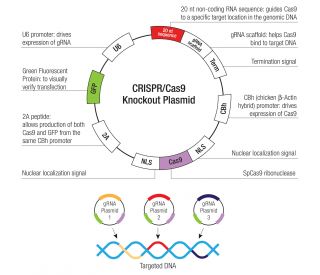
- D54 O Plasmídeo CRISPR/Cas9 Knockout (KO) (m) é um conjunto de plasmídeos, cada um codificando a nuclease Cas9 e um RNA guia (gRNA) de 20 nt específico para o alvo, concebido para uma eficiência máxima de knockout utilizando sequências derivadas da biblioteca GeCKO v2
- As sequências de gRNA direcionam a Cas9 para induzir quebras de cadeia dupla (DSBs) específicas do local no locus genómico D54, resultando no knockout do gene através da junção de extremidades não homólogas (NHEJ)
- Os genes de resistência à puromicina e RFP são flanqueados por sítios LoxP, permitindo a remoção de marcadores de seleção através da recombinase Cre (Cre Vector: sc-418923) após o estabelecimento de linhas celulares knockout estáveis

Informacoes sobre ordens
| Nome do Produto | Numero de Catalogo | UNID | Preco | Qde | FAVORITOS | |
D54 Plasmídeo CRISPR/Cas9 KO (m) | sc-425948 | 20 µg | $397.00 |
Visão geral
Tpd52l2 codifica a D54, um membro da família de proteínas tumorais D52 implicada na regulação do tráfego vesicular, da dinâmica de membranas e de processos secretórios que influenciam o crescimento e a diferenciação celular. A D54 tem sido associada a vias que controlam o transporte intracelular e a organização do citoesqueleto, favorecendo a entrega coordenada de componentes de sinalização e de proteínas de membrana. A expressão alterada de proteínas da família D52 é frequentemente observada em contextos proliferativos e metabólicos, tornando Tpd52l2 um ponto útil para estudar o descontrolo do ciclo celular e a remodelação adaptativa ao stress. Em sistemas murinos, Tpd52l2 constitui um alvo acessível para dissecar como proteínas associadas ao tráfego modulam a saída de sinalização e a homeostase tecidular em modelos relevantes para doença.
O Plasmídeo CRISPR/Cas9 KO D54 (m) é um conjunto de plasmídeos concebido para a interrupção direcionada do gene Tpd52l2 em linhas celulares mouse. Cada plasmídeo coexpressa um RNA guia único (sgRNA) direcionado a um local distinto dentro do Tpd52l2, juntamente com a nuclease Cas9 de Streptococcus pyogenes. Os plasmídeos também codificam GFP, permitindo a identificação fluorescente e o enriquecimento de células transfectadas com sucesso por microscopia de fluorescência ou citometria de fluxo.
O design multiguia aumenta a probabilidade de gerar inserções ou deleções (indels) que interrompem o quadro de leitura aberto do Tpd52l2 na sequência da formação de quebras de cadeia dupla mediadas por Cas9. As quebras de ADN introduzidas pelo sistema CRISPR/Cas9 são reparadas através de vias endógenas de junção de extremidades não homólogas (NHEJ), resultando frequentemente em mutações de deslocamento de quadro que abolir a expressão da proteína D54.
Este sistema de knockout CRISPR permite a geração eficiente de modelos celulares com deficiência de Tpd52l2 para a investigação da sinalização de D54, estudos de genómica funcional, investigação em biologia do cancro e avaliação de respostas terapêuticas em linhas celulares humanas.
Características principais
- sgRNAs direcionados para o(s) exão(ões) Tpd52l2 críticos para a função D54
Coexpressão de SpCas9 e sgRNA a partir de um único plasmídeo para simplificar a administração
Repórter GFP para identificação de células transfectadas
Conjunto de plasmídeos direcionados para múltiplos locais genómicos Tpd52l2 para melhorar a eficiência do knockout
Compatível com administração por transfecção
Variantes de Design
CRISPRs +/- HDRs
- Os gRNAs codificados pelo D54 Plasmídeo CRISPR/Cas9 KO (m) e pelo D54 Plasmídeo CRISPR/Cas9 KO (m2) têm como alvo locais distintos dentro do locus Tpd52l2. Pode estar disponível um ou ambos os designs de alvo. Consulte Produtos Relacionados para verificar a disponibilidade.
As construções doadoras HDR codificadas pelo D54 Plasmídeo HDR (m) e o Plasmídeo HDR D54 (m2) contêm uma cassete de resistência à puromicina e um repórter RFP flanqueado por braços de homologia Tpd52l2 para suportar a reparação dirigida por homologia em locais-alvo Tpd52l2 definidos, correspondentes aos desenhos de KO CRISPR/Cas9. A disponibilidade do doador HDR pode variar. Consulte Produtos Relacionados para verificar a disponibilidade.
Apenas para uso em investigação. Não se destina a uso diagnóstico ou terapêutico.