
CTNNBL1 Plasmídeo CRISPR/Cas9 KO (h): sc-409293
- alvos específicos: human
- 20 µg de plasmídeo de DNA pronto para transfecção; Suficiente para até 20 transfecções
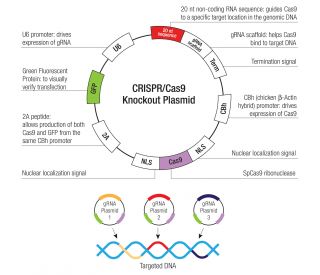
- CTNNBL1 O Plasmídeo CRISPR/Cas9 Knockout (KO) (h) é um conjunto de plasmídeos, cada um codificando a nuclease Cas9 e um RNA guia (gRNA) de 20 nt específico para o alvo, concebido para uma eficiência máxima de knockout utilizando sequências derivadas da biblioteca GeCKO v2
- As sequências de gRNA direcionam a Cas9 para induzir quebras de cadeia dupla (DSBs) específicas do local no locus genómico CTNNBL1, resultando no knockout do gene através da junção de extremidades não homólogas (NHEJ)
- O Plasmídeo HDR CTNNBL1 (h) (sc-409293-HDR) é recomendado para co-transfecção com o Plasmídeo CRISPR/Cas9 KO CTNNBL1 (h) para permitir a seleção de células editadas com sucesso através da integração mediada por HDR de uma cassete de resistência à puromicina e do gene repórter RFP
- O Plasmídeo HDR CTNNBL1 (h) é um conjunto de plasmídeos, cada um contendo um molde de reparação dirigida por homologia (HDR) correspondente aos locais-alvo do gRNA no Plasmídeo CRISPR/Cas9 KO CTNNBL1 (h)
- Cada plasmídeo HDR contém dois braços de homologia de ~800 pb que flanqueiam as cassetes de resistência à puromicina e RFP, concebidos para se ligarem a sequências de ADN genómico que rodeiam o local da quebra de cadeia dupla induzida por Cas9 e facilitarem a integração precisa mediada por HDR
- Os genes de resistência à puromicina e RFP são flanqueados por sítios LoxP, permitindo a remoção de marcadores de seleção através da recombinase Cre (Cre Vector: sc-418923) após o estabelecimento de linhas celulares knockout estáveis
- Após a transfecção, a eficácia do processo de nocaute genético por ser testada WB, IF ou IHC usando o anticorpo:CTNNBL1 Anticorpo (A-5): sc-376847

Informacoes sobre ordens
| Nome do Produto | Numero de Catalogo | UNID | Preco | Qde | FAVORITOS | |
CTNNBL1 Plasmídeo CRISPR/Cas9 KO (h) | sc-409293 | 20 µg | $397.00 | |||
CTNNBL1Plasmídeo HDR (h) | sc-409293-HDR | 20 µg | $445.00 |
Visão geral
CTNNBL1 codifica uma proteína semelhante à beta-catenina implicada em processos nucleares que coordenam o splicing do pré-mRNA e a regulação transcricional. Ela tem sido associada a complexos do spliceossoma e a montagens de processamento de RNA, contribuindo para programas de expressão gênica precisos que governam o crescimento e a diferenciação celular. Por meio de suas funções no metabolismo de RNA e na organização nuclear, CTNNBL1 é estudada no contexto da proteostase e da comunicação cruzada entre vias de sinalização que podem influenciar respostas celulares ao estresse. A desregulação de vias de processamento de RNA e de controle transcricional envolvendo CTNNBL1 tem sido associada a fenótipos celulares alterados relevantes para a biologia do câncer e outros distúrbios em que a fidelidade da expressão gênica é comprometida.
O CTNNBL1 CRISPR/Cas9 KO Plasmid (h) é um conjunto de plasmídeos concebido para a interrupção direcionada do gene CTNNBL1 em human linhas celulares. Cada plasmídeo do conjunto coexpressa um sgRNA único, direcionado a um local distinto dentro do locus CTNNBL1, juntamente com a nuclease Cas9 de Streptococcus pyogenes, e codifica GFP para permitir a identificação fluorescente e o enriquecimento das células transfectadas com sucesso. Esta estratégia multiguia aumenta a probabilidade de induzir deslocamentos de quadro de leitura ou deleções que produzam um knockout funcional, oferecendo uma alternativa mais robusta às abordagens de guia único. As DSBs induzidas em múltiplos locais são resolvidas através da junção de extremidades não homólogas (NHEJ) ou, quando utilizadas com o modelo doador HDR incluído, através da reparação dirigida por homologia (HDR) num local-alvo definido dentro do locus.
Quando utilizado em conjunto com o doador HDR que expressa RFP, a fluorescência de GFP e RFP pode ser utilizada em conjunto para distinguir populações de células transfectadas das editadas, simplificando os fluxos de trabalho de triagem e seleção de clones baseados em citometria de fluxo.
Doador de Reparação Dirigida por Homologia (HDR) — Cassete de Puromicina com Repórter RFP
Para aplicações que requerem clones knockout confirmados e selecionáveis, o CTNNBL1 Plasmídeo HDR (h) inclui uma construção doadora HDR contendo uma cassete de resistência à puromicina (PuroR) e um repórter de proteína fluorescente vermelha (RFP), flanqueados por braços de homologia específicos para um local-alvo definido CTNNBL1.
Quando co-transfectado com o CTNNBL1 Plasmídeo CRISPR/Cas9 KO (h):
- A cassete PuroR-RFP integra-se no local de corte da Cas9 através de HDR, interrompendo o quadro de leitura aberto CTNNBL1.
A fluorescência da RFP fornece um indicador visual imediato do sucesso da integração, permitindo a identificação ou triagem baseada na fluorescência das células editadas antes ou em paralelo com a seleção por puromicina.
As células editadas com sucesso são confirmadas através da resistência à puromicina, reduzindo substancialmente a carga de triagem de clones.
Esta estratégia de seleção é ideal para gerar linhas celulares KO clonais estáveis para estudos funcionais a jusante, triagem de fármacos ou desenvolvimento de modelos.
Sistema de remoção de cassete Cre-lox
A construção doadora HDR apresenta sítios loxP flanqueando a cassete de seleção PuroR-RFP para permitir a remoção limpa do marcador após a confirmação do clone. A expressão transitória da recombinase Cre através do Vetor Cre: sc-418923 incluído excisa a cassete, deixando um local loxP residual mínimo dentro do locus CTNNBL1 e eliminando potenciais efeitos de confusão em ensaios a jusante.
Esta abordagem em duas etapas:
- Minimiza a perturbação da arquitetura local da cromatina e dos elementos reguladores vizinhos
Restaura um contexto genómico quase nativo no locus editado
Permite a reutilização da estratégia de seleção com puromicina na mesma linha celular para edições adicionais
Características principais
- gRNA direcionado para o(s) exão(ões) CTNNBL1 crítico(s) para a função CTNNBL1
Coexpressão de SpCas9 e sgRNA a partir de um único plasmídeo para uma entrega simplificada
Doador HDR com resistência à puromicina para seleção positiva de clones
Cassete PuroR flanqueada por loxP com vetor de recombinase Cre para remoção contínua do marcador
Fornecido pronto a usar para entrega por transfecção
Apenas para uso em investigação. Não se destina a uso diagnóstico ou terapêutico.