


Plásmido Doble Nickase (h) COL8A1: sc-405174-NIC
- Especies Diana: human
- 20 µg de plásmido de ADN purificado listo para la trasfección; suficiente para 20 transfecciones máximo
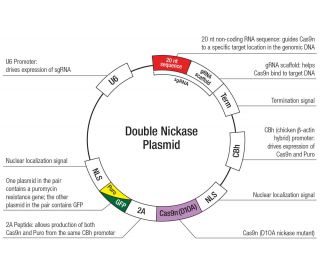
- El Plásmido Double Nickase (h)COL8A1 consisten en un par de plásmidos cada uno codificando una nucleasa Cas9 mutada D10A y una guia de ARN de 20 nucleótidos (gRNA) diseñados para una mayor especificidad que el homologo CRISPR/Cas9 KO
- Las secuencias de gRNA tienen una diferencia de unas 20 pb para permitir un corte doble mediado por Cas9 en el ADN que imita el doble corte
- Uno de los plásmidos contiene el gen de resistencia a puromicina para la selección y el otro el marcado GFP para confirmar visualmente la transfección
- El plásmido de doble nickasa COL8A1 (h) y el plásmido de doble nickasa COL8A1 (h2) codifican diseños distintos de pares de gRNA dirigidos a COL8A1. Puede que esté disponible uno o ambos diseños

Información sobre pedidos
| Nombre del producto | Número de catálogo | UNIDAD | Precio | CANTIDAD | Favoritos | |
Plásmido Doble Nickase (h) COL8A1 | sc-405174-NIC | 20 µg | $410.00 | |||
Plásmido Doble Nickase (h2) COL8A1 | sc-405174-NIC-2 | 20 µg | $410.00 |
COL8A1 codifica la cadena alfa 1 del colágeno tipo VIII, un colágeno de cadena corta no fibrilar, enriquecido en matrices extracelulares especializadas como el endotelio corneal y regiones asociadas a la membrana basal vascular. COL8A1 contribuye al ensamblaje de la matriz, a la adhesión célula–matriz y a la biomecánica tisular, influyendo en la comunicación de señales entre la matriz extracelular y las vías intracelulares que regulan la migración, la proliferación y la diferenciación. La expresión alterada de COL8A1 o su deposición en la matriz se ha vinculado a disfunción endotelial y a procesos de remodelación relevantes para la fisiología ocular y la patología vascular, lo que lo convierte en un objetivo útil para estudiar la homeostasis de la matriz extracelular y la mecanotransducción. Los modelos in vitro e in vivo que modifican COL8A1 ayudan a investigar cambios en el comportamiento celular impulsados por la matriz, así como propiedades de barrera y respuestas al estrés.
COL8A1 El plásmido de doble nicasa (h) consiste en un par de plásmidos emparejados diseñados para la edición de alta especificidad del locus COL8A1 en líneas celulares human. Cada plásmido expresa una nicasa Cas9 D10A y un ARN guía específico (sgRNA) dirigido a cadenas de ADN opuestas dentro de COL8A1. Cuando se dirigen a sitios adyacentes en cadenas de ADN opuestas, las dos nicasas generan cortes en cadena simple desplazados que, juntos, producen una rotura de doble cadena escalonada, lo que requiere una actividad coordinada sobre el objetivo por parte de ambas guías. La rotura de ADN resultante se resuelve mediante vías de reparación celular endógenas, más comúnmente a través de la unión de extremos no homólogos (NHEJ), lo que da lugar a inserciones o deleciones que alteran la función de COL8A1. Al requerir la participación de dos ARN guía en el locus diana, el enfoque de doble corte mejora la especificidad de la edición y proporciona una estrategia CRISPR complementaria para aplicaciones en las que se desea un control adicional sobre la precisión de la orientación.
Para facilitar la identificación eficiente de las células editadas, un plásmido codifica GFP para la visualización fluorescente de las poblaciones transfectadas, mientras que el plásmido complementario lleva un gen de resistencia a la puromicina para la selección con antibióticos. En conjunto, estas características facilitan el enriquecimiento eficiente de las poblaciones cotransfectadas y simplifican la validación de los clones con COL8A1 alterado.
Sólo para uso en investigación. No destinado a uso diagnóstico o terapéutico.