
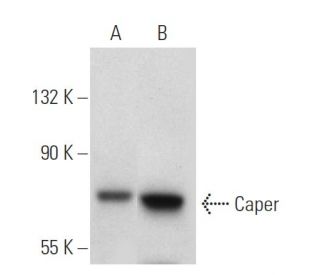
Caper Antikörper (P14): sc-101103
- Caper Antikörper (P14) ist ein Maus monoklonales IgG2a κ, verwendet in 2 wissenschaftlichen Veröffentlichungen, in einer Menge von 100 µg/ml
- gezogen gegen rekombinantes Caper aus der Spezies human
- Empfohlen für die Detektion von Caper aus der Spezies mouse, rat und human per WB, IP, IF, IHC(P) und ELISA
- Aktuell testen wir noch unsere Sekundärantikörper um das beste Bindeprotein für diesen Primärantikörper Caper (P14) zu finden. Kontaktieren Sie uns bitte, wenn Sie Fragen hierzu haben sollten.

Direktverknüpfungen
Siehe auch...
Caper, auch bekannt als Splicing-Faktor HCC1 oder Hepatozelluläres Karzinom-Protein 1 und RNA-bindendes Regionen-enthaltendes Protein 2 (RNPC2), fungiert als Transkriptions-Koaktivator für Steroid-Nukleinsäure-Rezeptoren c-Jun, ERalpha und ER-beta. Caper, ein nukleäres Protein mit den höchsten Konzentrationen in nukleären Speckles, spielt eine Rolle im pre-mRNA-Splicing-Prozess. Zwei Isoformen von Caper, HCC1.3 und HCC1.4, kolokalisieren mit pre-mRNA-Splicing-Faktor SC35 und uridinreichen kleinen nukleären RNAs. Caper ist ein weit verbreitetes Protein mit den höchsten Niveaus, die in Skelettmuskel, Lunge, Gehirn und Pankreas detektiert werden.
Alexa Fluor® ist ein Markenzeichen von Molecular Probes Inc., OR., USA
LI-COR® und Odyssey® sind Markenzeichen von LI-COR Biosciences
Caper Antikörper (P14) Literaturhinweise:
- HCC1, das Arabidopsis-Homolog des mitochondrialen Kupfer-Chaperons SCO1 der Hefe, ist für die Embryonalentwicklung unerlässlich. | Steinebrunner, I., et al. 2011. J Exp Bot. 62: 319-30. PMID: 21041373
- CAPER-α-alternatives Spleißen reguliert die Expression des vaskulären endothelialen Wachstumsfaktors 165 in Ewing-Sarkomzellen. | Huang, G., et al. 2012. Cancer. 118: 2106-16. PMID: 22009261
- CAPER: ein Chromosom-assemblierter menschlicher Proteom-BrowsER. | Guo, F., et al. 2013. J Proteome Res. 12: 179-86. PMID: 23256906
- CAPER, ein neuer Regulator für das Fortschreiten von Brustkrebs beim Menschen. | Mercier, I., et al. 2014. Cell Cycle. 13: 1256-64. PMID: 24621503
- Die Überexpression von HCC1/CAPERα kann bei der Entstehung von Lungenkrebs eine Rolle spielen. | Chai, Y., et al. 2014. Tumour Biol. 35: 6311-7. PMID: 24643682
- CAPER ist von entscheidender Bedeutung für die Energie- und Redox-Homöostase, indem es glukosebedingte mitochondriale Funktionen über ERR-α-Gabpa und stressinduzierte adaptive Reaktionen über NF-κB-cMYC integriert. | Kang, YK., et al. 2015. PLoS Genet. 11: e1005116. PMID: 25830341
- CAPER als therapeutisches Ziel für dreifach negativen Brustkrebs. | Campbell, MC., et al. 2018. Oncotarget. 9: 30340-30354. PMID: 30100993
- Entwicklung von CAPER-Peptiden zur Behandlung von dreifach negativem Brustkrebs. | Chilewski, SD., et al. 2020. Cell Cycle. 19: 432-447. PMID: 31931653
- Der konservierte alternative Spleißfaktor CAPER reguliert neuromuskuläre Phänotypen während der Entwicklung und des Alterns. | Titus, MB., et al. 2021. Dev Biol. 473: 15-32. PMID: 33508255
- HCC1, eine Polygalacturonase, reguliert den Chlorophyllabbau über den Ethylensyntheseweg. | Liao, Y., et al. 2023. Rice (N Y). 16: 57. PMID: 38071259
Bestellinformation
| Produkt | Katalog # | EINHEIT | Preis | ANZAHL | Favoriten | |
Caper Antikörper (P14) | sc-101103 | 100 µg/ml | $339.00 |