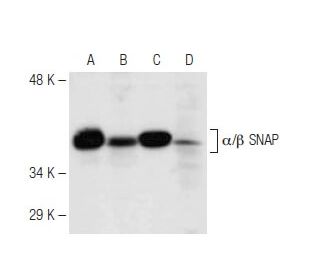


alpha / beta-SNAP Antibody (16D1): sc-65386
- α/β-SNAP Antibody (16D1) is a mouse monoclonal IgG2b provided at 100 µg/ml
- raised against recombinant α-SNAP of human origin
- recommended for detection of α-SNAP and β-SNAP of mouse, rat and human origin by WB and IP
- At present, we have not yet completed the identification of the preferred secondary detection reagent(s) for α/β-SNAP Antibody (16D1). This work is in progress.

α/β-SNAP Antibody (16D1) is a mouse monoclonal IgG2b antibody that detects α/β-SNAP in mouse, rat, and human samples through western blotting (WB) and immunoprecipitation (IP) applications. α/β-SNAP plays a crucial role in regulating synaptic transmission by facilitating SNARE complex assembly, which is essential for synaptic vesicle fusion with presynaptic membrane during neurotransmitter release. This process is vital for proper neuronal communication and is implicated in various neurological functions and disorders. α/β-SNAP interacts with other key proteins involved in exocytosis, such as syntaxins and VAMPs, to mediate N-ethylmaleimide-sensitive factor membrane binding, which is necessary for SNARE complex disassembly after vesicle fusion. By understanding α/β-SNAP interactions and functions, researchers can gain insights into synaptic plasticity mechanisms and potential therapeutic targets for conditions like Alzheimer′s disease and other synaptic dysfunctions. Anti-α/β-SNAP antibody (16D1) serves as an invaluable tool for studying synaptic transmission dynamics and molecular pathways involved in neurotransmitter release.
Alexa Fluor® is a trademark of Molecular Probes Inc., OR., USA
LI-COR® and Odyssey® are registered trademarks of LI-COR Biosciences
alpha / beta-SNAP Antibody (16D1) References:
- Putative fusogenic activity of NSF is restricted to a lipid mixture whose coalescence is also triggered by other factors. | Brügger, B., et al. 2000. EMBO J. 19: 1272-8. PMID: 10716927
- Sequential SNARE disassembly and GATE-16-GOS-28 complex assembly mediated by distinct NSF activities drives Golgi membrane fusion. | Muller, JM., et al. 2002. J Cell Biol. 157: 1161-73. PMID: 12070132
- A ubiquitous membrane fusion protein alpha SNAP: a potential therapeutic target for cancer, diabetes and neurological disorders? | Andreeva, AV., et al. 2006. Expert Opin Ther Targets. 10: 723-33. PMID: 16981829
- A Qa-SNARE complex contributes to soybean cyst nematode resistance via regulation of mitochondria-mediated cell death. | Wang, R., et al. 2021. J Exp Bot. 72: 7145-7162. PMID: 34165531
- Soybean Cyst Nematode Resistance Quantitative Trait Locus cqSCN-006 Alters the Expression of a γ-SNAP Protein. | Butler, KJ., et al. 2021. Mol Plant Microbe Interact. 34: 1433-1445. PMID: 34343024
- A protein assembly-disassembly pathway in vitro that may correspond to sequential steps of synaptic vesicle docking, activation, and fusion. | Söllner, T., et al. 1993. Cell. 75: 409-18. PMID: 8221884
- SNAP family of NSF attachment proteins includes a brain-specific isoform. | Whiteheart, SW., et al. 1993. Nature. 362: 353-5. PMID: 8455721
- A v-SNARE implicated in intra-Golgi transport. | Nagahama, M., et al. 1996. J Cell Biol. 133: 507-16. PMID: 8636227
- Syntaxin 5 is a common component of the NSF- and p97-mediated reassembly pathways of Golgi cisternae from mitotic Golgi fragments in vitro. | Rabouille, C., et al. 1998. Cell. 92: 603-10. PMID: 9506515
- Arrangement of subunits in 20 S particles consisting of NSF, SNAPs, and SNARE complexes. | Hohl, TM., et al. 1998. Mol Cell. 2: 539-48. PMID: 9844627
Ordering Information
| Product Name | Catalog # | UNIT | Price | Qty | FAVORITES | |
α/β-SNAP Antibody (16D1) | sc-65386 | 100 µg/ml | $322.00 |