
Trx CRISPR Activation Plasmid (h): sc-400746-ACT
- Zielspezies: human
- 20 µg transfektionsfertige, aufgereinigte Plasmid DNA; geeignet für 20 Transfektionen
- Trx CRISPR Activation Plasmid (h) ist ein Transkriptionsaktivierungs System (SAM) welches für die gezielte Verstärkung der Genexpression bestimmt ist
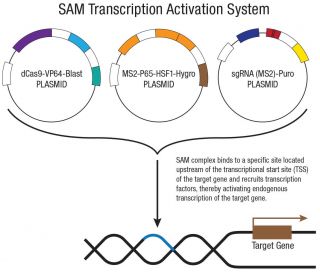
- Trx CRISPR Aktivierungsplasmide (h) bestehen aus 3 Plasmiden im Massenverhältnis 1:1:1: ein Plasmid kodiert für die deaktivierte Cas9 (dCas9) Nuklease (D10A und N863A) fusioniert an die Transaktivierungsdomaine VP64 sowie ein Gen für die Blasticidin Resistenz; ein zweites Plasmid kodierend für das MS2-p65-HSF1 Fusionsprotein sowie ein Gen für die Hygromycin Resistenz; ein drittes Plasmid kodierd für die Ziel-spezifische 20 nt guide RNA fusioniert an zwei MS2 RNA Aptamere sowie ein Gen für die Puromycin Resistenz.
- Der entstehende SAM-Komplex (Mediator-Komplex zur synergistischen Gen-Aktivierung) bindet eine sequenzspezifische Region 200-250 nt upstream (in 5'-Richtung) des Transkriptionsstartsignals und rekrutiert dort ständig Transkriptionsfaktoren für eine verstärkte Gen-Aktivierung und Gen-Expression.
- Die vom Trx CRISPR-Aktivierungsplasmid (h) und vom Trx CRISPR-Aktivierungsplasmid (h2) kodierten gRNAs zielen auf unterschiedliche regulatorische Regionen stromaufwärts der TXN-Transkriptionsstartstelle ab. Eines oder beide Designs sind möglicherweise verfügbar
- Nach der Transfektion kann die Effizienz des Gen-Knockouts per Western Blot oder histologisch mit folgendem Antikörper überprüft werden: Trx: sc-166393

Bestellinformation
| Produkt | Katalog # | EINHEIT | Preis | ANZAHL | Favoriten | |
Trx CRISPR Activation Plasmid (h) | sc-400746-ACT | 20 µg | $397.00 |
Das humane Gen **TXN** kodiert Thioredoxin (Trx), eine ubiquitär exprimierte Oxidoreduktase, die die zelluläre Redoxhomöostase aufrechterhält, indem sie Dithiol-Disulfid-Austauschreaktionen katalysiert und antioxidative Abwehrsysteme unterstützt. Trx ist in die Thioredoxin-Reduktase/NADPH-Achse eingebunden und moduliert redoxsensitive Signalknoten, die die transkriptionelle Regulation, die Proteinfaltung und die Apoptose beeinflussen, einschließlich der Regulation der ASK1-vermittelten Stresssignalgebung. Durch die Kontrolle intrazellulärer reaktiver Sauerstoffspezies und des Redoxzustands trägt TXN zu Prozessen wie Proliferation, inflammatorischer Signalgebung und zellulären Antworten auf Hypoxie und DNA-Schäden bei. Eine dysregulierte TXN/Trx-Aktivität wurde mit einer veränderten Bewältigung von oxidativem Stress und mit Signalgebungsphänotypen in Verbindung gebracht, wie sie in der Krebsbiologie, bei metabolischen Funktionsstörungen und in neuroinflammatorischen Kontexten beobachtet werden.
Trx Das CRISPR-Aktivierungsplasmid (h) bietet einen gezielten, nicht-destruktiven Ansatz zur Hochregulierung der endogenen TXN-Expression, ohne die zugrunde liegende DNA-Sequenz zu verändern.
Trx Das CRISPR-Aktivierungsplasmid (h) ist ein aus drei Plasmiden bestehendes synergistisches Aktivierungsmediator-System (SAM), das für eine hocheffiziente, ortsspezifische transkriptionelle Hochregulation des TXN-Lokus in menschlichen Zelllinien entwickelt wurde. Das System basiert auf einem katalytisch inaktiven Cas9 (dCas9), das zwei inaktivierende Mutationen (D10A und N863A) trägt, welche die Nukleaseaktivität eliminieren, während die DNA-Bindung erhalten bleibt. Dieses dCas9 ist mit VP64, einem potenten Transkriptionsaktivator, fusioniert und wird zusammen mit einem Blasticidin-Resistenzgen zur Selektion koexprimiert. Das zweite Plasmid kodiert das MS2-p65-HSF1-Fusionsprotein, einen sekundären Aktivatorkomplex, der zusammen mit dCas9-VP64 wirkt, sowie ein Hygromycin-Resistenzgen. Das dritte Plasmid kodiert für eine zielspezifische 20-nt-sgRNA, die an zwei MS2-RNA-Aptamere fusioniert ist, welche den MS2-p65-HSF1-Komplex an die Aktivierungsstelle rekrutieren, begleitet von einem Puromycin-Resistenzgen. Die drei Plasmide werden im Massenverhältnis 1:1:1 verabreicht, um eine ausgewogene Expression aller Systemkomponenten zu gewährleisten.
Nach der Assemblierung am Zielort bindet der SAM-Komplex etwa 200 bp stromaufwärts der TXN-Transkriptionsstartstelle, wo VP64, p65 und HSF1 gemeinsam die Transkriptionsmaschinerie rekrutieren und die Hochregulation der endogenen Trx-Expression vorantreiben. Im Gegensatz zu nukleaseaktivem Cas9 verursacht dCas9 keine Doppelstrangbrüche und verändert die genomische Sequenz nicht, wodurch der native TXN-Locus erhalten bleibt und die Untersuchung von Trx-abhängigen Transkriptionsreaktionen am endogenen Locus ermöglicht wird. Dies macht es zu einem wertvollen Werkzeug für Funktionsstudien, die Identifizierung von Zielgenen und die Modellierung der Wiederherstellung des Trx-Signalwegs in Tumorzellen mit stillgelegtem oder reduziertem TXN-Ausdruck.
Nur für Forschungszwecke. Nicht für diagnostische oder therapeutische Zwecke bestimmt.