
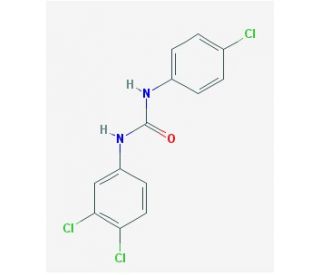

Triclocarban (CAS 101-20-2)
See product citations (1)
QUICK LINKS
Tilmicosin, a semi-synthetic macrolide antibiotic, has garnered significant interest in scientific research due to its potent antimicrobial activity against various bacterial pathogens, particularly those causing respiratory diseases in livestock. Its mechanism of action involves binding to the 50S ribosomal subunit of susceptible bacteria, inhibiting protein synthesis and ultimately leading to bacterial cell death. Recent research has focused on elucidating the molecular basis of tilmicosin′s antimicrobial efficacy and its potential applications in veterinary medicine and agriculture. Studies have investigated its activity against specific bacterial strains, including Mycoplasma species and certain Gram-positive bacteria like Staphylococcus aureus and Streptococcus species. Furthermore, researchers have explored novel formulations and delivery systems to enhance the pharmacokinetic properties and efficacy of tilmicosin, aiming to mitigate antimicrobial resistance and improve animal health outcomes. Additionally, investigations into the safety profile, environmental impact, and potential for cross-resistance with other antibiotics have provided valuable insights into the rational use of tilmicosin in animal production systems. Overall, tilmicosin represents a valuable tool for research aimed at combating bacterial infections in veterinary medicine and advancing animal health and welfare.
Triclocarban (CAS 101-20-2) References
- Potential Developmental and Reproductive Impacts of Triclocarban: A Scoping Review. | Rochester, JR., et al. 2017. J Toxicol. 2017: 9679738. PMID: 29333157
- Triclocarban and Triclosan Inhibit Human Aromatase via Different Mechanisms. | Li, H., et al. 2017. Biomed Res Int. 2017: 8284097. PMID: 29376079
- Triclocarban Disrupts the Epigenetic Status of Neuronal Cells and Induces AHR/CAR-Mediated Apoptosis. | Kajta, M., et al. 2019. Mol Neurobiol. 56: 3113-3131. PMID: 30097849
- Fate of Triclocarban (TCC) in aquatic and terrestrial systems and human exposure. | Vimalkumar, K., et al. 2019. Chemosphere. 230: 201-209. PMID: 31103866
- Fate, risk and removal of triclocarban: A critical review. | Yun, H., et al. 2020. J Hazard Mater. 387: 121944. PMID: 31901847
- Understanding the interaction between triclocarban and denitrifiers. | Wang, D., et al. 2021. J Hazard Mater. 401: 123343. PMID: 32763677
- The Different Facets of Triclocarban: A Review. | Iacopetta, D., et al. 2021. Molecules. 26: PMID: 34068616
- Triclosan and triclocarban as potential risk factors of colitis and colon cancer: Roles of gut microbiota involved. | Sanidad, KZ., et al. 2022. Sci Total Environ. 842: 156776. PMID: 35724794
- Genetic bioaugmentation with triclocarban-catabolic plasmid effectively removes triclocarban from wastewater. | Ke, Z., et al. 2022. Environ Res. 214: 113921. PMID: 35863452
Ordering Information
| Product Name | Catalog # | UNIT | Price | Qty | FAVORITES | |
Triclocarban, 100 mg | sc-213106 | 100 mg | $260.00 |