
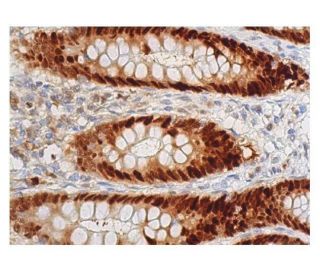
PCNA Anticuerpo (6D645): sc-71858
- PCNA Anticuerpo (6D645) es un monoclonal de ratón IgG2a κ, ver las 12 publicaciones, proporcionado como 200 µg/ml
- criado contra rata PCNA fabricada en el vector de expresión de proteína A pR1T2T
- recomendado para detectarPCNA p36 protein expressed at high levels in proliferating cells de mouse, rat, human, insect y S. pombe origen, mediante WB, IP, IF, IHC(P) y FCM
- Ver PCNA (PC10): sc-56 para PCNA anticuerpos conjugados, incluyendo AC, HRP, FITC, PE, Alexa Fluor® 488, 594, 647, 680 y 790.
- m-IgG Fc BP-HRP es el reactivo de detección secundario preferido para PCNA Anticuerpo (6D645) para aplicaciones WB and IHC(P). Este reactivo se ofrece ahora en un paquete con PCNA Anticuerpo (6D645) (ver información de pedido más abajo).

ENLACES RÁPIDOS
VER TAMBIÉN ....
El antígeno nuclear de células proliferantes (PCNA) es una proteína nuclear crítica en las células eucariotas que desempeña un papel central en la replicación y reparación del ADN. Estructuralmente, el PCNA forma un anillo homotrimérico que rodea el ADN, funcionando como una pinza deslizante para mejorar la procesividad de las ADN polimerasas delta (δ) y épsilon (ε) durante la síntesis de las cadenas principal y retardada. Esta arquitectura en forma de anillo permite al PCNA servir de plataforma para reclutar diversas proteínas implicadas en el metabolismo del ADN, incluidas las responsables de la reparación del ADN, la remodelación de la cromatina y la regulación del ciclo celular. La expresión del PCNA está estrechamente regulada y alcanza su máximo durante la fase S del ciclo celular, lo que lo convierte en un marcador fiable de la proliferación celular en los estudios de investigación. El estudio del PCNA es crucial para comprender los mecanismos fundamentales de la proliferación celular, el mantenimiento del genoma y las respuestas celulares al daño del ADN. El PCNA es esencial para la replicación del ADN de alta fidelidad al anclar las ADN polimerasas a la plantilla de ADN, lo que garantiza una síntesis de ADN rápida y precisa, vital para la proliferación celular y la estabilidad del genoma. El PCNA también participa en múltiples vías de reparación del ADN, como la reparación por escisión de nucleótidos, la reparación por escisión de bases y la reparación de desajustes, al interactuar con factores que eliminan las lesiones del ADN y ayudan a corregir los desajustes de pares de bases tras la replicación. El PCNA interactúa con factores de ensamblaje de la cromatina y modificadores de las histonas, influyendo en el ensamblaje de los nucleosomas durante la replicación y la reparación del ADN. Las modificaciones postraduccionales como la ubiquitinación y la sumoilación del PCNA regulan su papel en las vías de tolerancia al daño del ADN, incluida la síntesis de translesiones y el cambio de molde. La desregulación de la función o la expresión del PCNA está implicada en varias enfermedades, especialmente en el cáncer, donde a menudo se sobreexpresa debido a la elevada tasa de proliferación de las células tumorales. Esto convierte al PCNA no sólo en un biomarcador importante para el diagnóstico y el pronóstico del cáncer, sino también en una diana potencial para la intervención terapéutica. El anticuerpo PCNA (6D645) es un anticuerpo monoclonal IgG2a kappa de ratón desarrollado contra el PCNA de rata utilizando el vector de expresión de proteína A pR1T2T. Está diseñado para la detección de la proteína PCNA p36, que se expresa abundantemente en células proliferantes de diversas especies, como el ratón, la rata, el ser humano, los insectos y Schizosaccharomyces pombe (levadura de fisión). El anticuerpo monoclonal PCNA (6D645) es muy útil en diversas aplicaciones, como la inmunotransferencia (Western Blotting), la inmunoprecipitación, la inmunofluorescencia, la inmunohistoquímica en secciones incluidas en parafina y la citometría de flujo. Comprender las multifacéticas funciones del PCNA, utilizando el anticuerpo monoclonal PCNA (6D645), es esencial para comprender cómo las células mantienen la integridad del genoma y responden al daño del ADN, contribuyendo en última instancia al desarrollo de estrategias terapéuticas contra enfermedades proliferativas como el cáncer. El uso del anticuerpo monoclonal PCNA (6D645) ayuda a los investigadores a explorar estos mecanismos, lo que es importante para avanzar en las terapias dirigidas a tratar enfermedades proliferativas como el cáncer.
Información sobre pedidos
| Nombre del producto | Número de catálogo | UNIDAD | Precio | CANTIDAD | Favoritos | |
PCNA Anticuerpo (6D645) | sc-71858 | 200 µg/ml | $322.00 | |||
Paquete de PCNA (6D645): m-IgG Fc BP-HRP | sc-539417 | 200 µg Ab; 10 µg BP | $361.00 |