
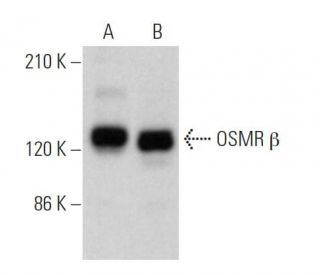
Not CRISPR data: the image illustrates antibody quality for visualizing CRISPR experiment results.
Not CRISPR data: the image illustrates antibody quality for visualizing CRISPR experiment results.
OSMR β CRISPR/Cas9 KO Plasmid (h): sc-402700
- Zielspezies: human
- 20 µg transfektionsfertige, aufgereinigte Plasmid DNA; geeignet für 20 Transfektionen
- OSMR β Das CRISPR/Cas9-Knockout (KO)-Plasmid (h) ist ein Pool von Plasmiden, von denen jedes für die Cas9-Nuklease und eine zielspezifische 20-nt-Guide-RNA (gRNA) kodiert, die für maximale Knockout-Effizienz unter Verwendung von Sequenzen aus der GeCKO v2-Bibliothek entwickelt wurde
- gRNA-Sequenzen lenken Cas9 so, dass es ortsspezifische Doppelstrangbrüche (DSBs) im OSMR β-Genomlokus induziert, was zu einem Gen-Knockout durch nicht-homologe Endverknüpfung (NHEJ) führt
- OSMR β HDR-Plasmid (h) (sc-402700-HDR) wird für die Co-Transfektion mit dem OSMR β CRISPR/Cas9-KO-Plasmid (h) empfohlen, um die Selektion erfolgreich editierter Zellen durch HDR-vermittelte Integration einer Puromycin-Resistenzkassette und eines RFP-Reportergens zu ermöglichen
- Das OSMR β HDR-Plasmid (h) ist ein Pool von Plasmiden, von denen jedes eine HDR-Matrize (Homology-Directed Repair) enthält, die den gRNA-Zielstellen im OSMR β CRISPR/Cas9-KO-Plasmid (h) entspricht
- Jedes HDR-Plasmid enthält zwei ~800 bp lange Homologiearme, die die Puromycin-Resistenz- und RFP-Kassetten flankieren und so konzipiert sind, dass sie an genomische DNA-Sequenzen binden, die die durch Cas9 induzierte Doppelstrangbruchstelle umgeben, und eine präzise HDR-vermittelte Integration ermöglichen
- Die Puromycin-Resistenz- und RFP-Gene werden von LoxP-Stellen flankiert, was die Entfernung der Selektionsmarker mittels Cre-Rekombinase (Cre-Vektor: sc-418923) nach der Etablierung stabiler Knockout-Zelllinien ermöglicht
- Nach der Transfektion kann die Effizienz des Gen-Knockouts per Western Blot oder histologisch mit folgendem Antikörper überprüft werden: OSMR β: sc-271695

Bestellinformation
| Produkt | Katalog # | EINHEIT | Preis | ANZAHL | Favoriten | |
OSMR β CRISPR/Cas9 KO Plasmid (h) | sc-402700 | 20 µg | $397.00 | |||
OSMR β HDR Plasmid (h) | sc-402700-HDR | 20 µg | $445.00 |
Übersicht
Oncostatin‑M‑Rezeptor beta (OSMRβ), kodiert durch das humane OSMR-Gen, ist eine Untereinheit eines Typ‑I‑Zytokinrezeptors, die mit gp130 zusammenwirkt, um die Oncostatin‑M‑Signalübertragung zu vermitteln. Die Ligandenbindung fördert die Aktivierung der JAK/STAT‑, MAPK/ERK‑ und PI3K/AKT‑Signalwege und koordiniert Transkriptionsprogramme, die Entzündung, Umbau der extrazellulären Matrix, Zellüberleben und Differenzierung regulieren. Die OSMRβ‑Signalgebung wurde mit fibrotischen Reaktionen sowie mit Crosstalk im tumorassoziierten Mikromilieu in Verbindung gebracht und wird häufig in Kontexten untersucht, in denen zytokingetriebene epithel‑stromale Kommunikation die Gewebehomöostase prägt. Eine veränderte OSMR‑Aktivität ist daher relevant für mechanistische Studien zu chronischer inflammatorischer Signalgebung, fibroseassoziiertem Remodeling und der Integration onkogener Signalwege.
OSMR β CRISPR/Cas9-KO-Plasmid (h) ist ein Pool von Plasmiden, die für die gezielte Disruption des OSMR-Gens in human-Zelllinien entwickelt wurden. Jedes Plasmid im Pool koexprimiert eine einzigartige sgRNA, die auf eine bestimmte Stelle innerhalb des OSMR-Lokus abzielt, zusammen mit der Streptococcus pyogenes Cas9-Nuklease, und kodiert für GFP, um die fluoreszente Identifizierung und Anreicherung erfolgreich transfizierter Zellen zu ermöglichen. Diese Multi-Guide-Strategie erhöht die Wahrscheinlichkeit, Frameshifts oder Deletionen zu induzieren, die zu einem funktionellen Knockout führen, und bietet damit eine robustere Alternative zu Single-Guide-Ansätzen. An mehreren Stellen induzierte DSBs werden durch nicht-homologe Endverknüpfung (NHEJ) oder, bei Verwendung mit der enthaltenen HDR-Donor-Matrize, durch homologe Reparatur (HDR) an einer definierten Zielstelle innerhalb des Lokus repariert.
Bei Verwendung in Verbindung mit dem RFP-exprimierenden HDR-Donor können GFP- und RFP-Fluoreszenz gemeinsam genutzt werden, um transfizierte von editierten Zellpopulationen zu unterscheiden, was die auf Durchflusszytometrie basierenden Sortier- und Klonauswahl-Workflows optimiert.
Homology-Directed Repair (HDR)-Donor — Puromycin-Kassette mit RFP-Reporter
Für Anwendungen, die bestätigte, selektierbare Knockout-Klone erfordern, enthält das OSMR β HDR-Plasmid (h) ein HDR-Donorkonstrukt mit einer Puromycin-Resistenzkassette (PuroR) und einem Reporter für rotes fluoreszierendes Protein (RFP), flankiert von Homologiearmen, die für eine definierte OSMR Zielstelle spezifisch sind.
Bei Co-Transfektion mit dem OSMR β CRISPR/Cas9-KO-Plasmid (h):
- Die PuroR-RFP-Kassette integriert sich über HDR an der Cas9-Schnittstelle und unterbricht dabei das OSMR offene Lesegerüst.
Die RFP-Fluoreszenz liefert einen unmittelbaren visuellen Hinweis auf eine erfolgreiche Integration und ermöglicht die fluoreszenzbasierte Identifizierung oder Sortierung editierter Zellen vor oder parallel zur Puromycin-Selektion.
Erfolgreich editierte Zellen werden durch Puromycin-Resistenz bestätigt, was den Aufwand für das Klon-Screening erheblich reduziert.
Diese Selektionsstrategie eignet sich ideal zur Erzeugung stabiler, klonaler KO-Zelllinien für nachgelagerte Funktionsstudien, Wirkstoffscreenings oder die Modellentwicklung.
Cre-lox-Kassetten-Entfernungssystem
Das HDR-Donorkonstrukt verfügt über loxP-Stellen, die die PuroR-RFP-Selektionskassette flankieren, um eine saubere Markerentfernung nach der Klonbestätigung zu ermöglichen. Die transiente Expression der Cre-Rekombinase über das enthaltene Cre-Vektor: sc-418923 schneidet die Kassette heraus, wobei eine minimale Rest-loxP-Stelle innerhalb des OSMR-Lokus verbleibt und potenzielle Störeffekte auf nachgeschaltete Assays eliminiert werden.
Dieser zweistufige Ansatz:
- Minimiert Störungen der lokalen Chromatinarchitektur und benachbarter regulatorischer Elemente
Stellt einen nahezu nativen genomischen Kontext am editierten Locus wieder her
Ermöglicht die Wiederverwendung der Puromycin-Selektionsstrategie in derselben Zelllinie für weitere Editierungen
Hauptmerkmale
- gRNA, die auf OSMR Exon(e) abzielt, die für die OSMR β Funktion entscheidend sind
Koexpression von SpCas9 und sgRNA aus einem einzigen Plasmid für eine vereinfachte Verabreichung
HDR-Donor mit Puromycin-Resistenz für die positive Klonselektion
loxP-flankierte PuroR-Kassette mit Cre-Rekombinase-Vektor für die nahtlose Markerentfernung
Wird gebrauchsfertig für die Verabreichung durch Transfektion geliefert
Nur für Forschungszwecke. Nicht für diagnostische oder therapeutische Zwecke bestimmt.