
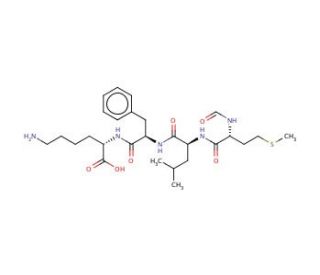

N-Formyl-Met-Leu-Phe-Lys (CAS 104180-18-9)
QUICK LINKS
N-Formyl-Met-Leu-Phe-Lys (fMLFK) is a synthetic peptide derived from the N-terminus of bacterial proteins, particularly those released during infection or inflammation. This chemical has been extensively studied in research settings due to its role as a potent chemoattractant for leukocytes, particularly neutrophils, in the immune response. The mechanism of action of fMLFK involves its interaction with specific cell surface receptors, known as formyl peptide receptors (FPRs), expressed on the surface of leukocytes. Upon binding to FPRs, fMLFK triggers a series of intracellular signaling cascades that result in the activation of leukocytes and their subsequent migration towards sites of infection or tissue damage. In research, fMLFK has been employed as a valuable tool to investigate the mechanisms underlying leukocyte chemotaxis and inflammation. It has been used in various in vitro and in vivo studies to explain the signaling pathways involved in FPR activation, the regulation of leukocyte migration, and the interplay between immune cells and microbial pathogens. Additionally, fMLFK has been utilized in the development and optimization of assays for studying immune cell function, screening potential agents targeting leukocyte recruitment, and evaluating the efficacy of anti-inflammatory drugs.
N-Formyl-Met-Leu-Phe-Lys (CAS 104180-18-9) References
- Multiple activation steps of the N-formyl peptide receptor. | Prossnitz, ER., et al. 1999. Biochemistry. 38: 2240-7. PMID: 10029516
- The synthetic chemoattractant Trp-Lys-Tyr-Met-Val-DMet activates neutrophils preferentially through the lipoxin A(4) receptor. | Dahlgren, C., et al. 2000. Blood. 95: 1810-8. PMID: 10688842
- H-2M3 presents a Listeria monocytogenes peptide to cytotoxic T lymphocytes. | Pamer, EG., et al. 1992. Cell. 70: 215-23. PMID: 1353418
- Preparation and properties of an improved photoaffinity ligand for the N-formyl peptide receptor. | Allen, RA., et al. 1986. Biochim Biophys Acta. 882: 271-80. PMID: 3015224
- Insights into the Activation Mechanism of the ALX/FPR2 Receptor. | Schmitz Nunes, V., et al. 2020. J Phys Chem Lett. 11: 8952-8957. PMID: 33030905
- Berbamine Hydrochloride inhibits lysosomal acidification by activating Nox2 to potentiate chemotherapy-induced apoptosis via the ROS-MAPK pathway in human lung carcinoma cells. | Zhan, Y., et al. 2023. Cell Biol Toxicol. 39: 1297-1317. PMID: 36070022
- Formyl peptide receptor 2 is an emerging modulator of inflammation in the liver. | Lee, C., et al. 2023. Exp Mol Med. 55: 325-332. PMID: 36750693
- Binding of low affinity N-formyl peptide receptors to G protein. Characterization of a novel inactive receptor intermediate. | Prossnitz, ER., et al. 1995. J Biol Chem. 270: 10686-94. PMID: 7738006
- Isolation and characterization of a variant HL60 cell line defective in the activation of the NADPH oxidase by phorbol myristate acetate. | Tardif, M., et al. 1998. J Immunol. 161: 6885-95. PMID: 9862721
- Phagocyte Activation by Trp–Lys–Tyr–Met–Val–Met, Acting through FPRL1/LXA4R, is not Affected by Lipoxin A4 | Christophe, T., et al. 2002. Scandinavian journal of immunology. 56(5): 470-476.
Ordering Information
| Product Name | Catalog # | UNIT | Price | Qty | FAVORITES | |
N-Formyl-Met-Leu-Phe-Lys, 1 mg | sc-391160 | 1 mg | $60.00 | |||
N-Formyl-Met-Leu-Phe-Lys, 10 mg | sc-391160A | 10 mg | $278.00 |