
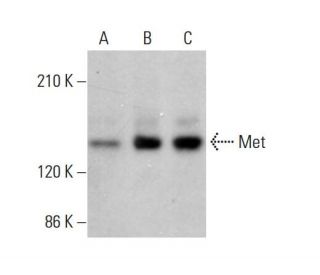
Met Antikörper (B-2): sc-8057
- Met Antikörper B-2 ist ein Maus monoklonales IgG1 κ Met Antikörper, verwendet in 125 wissenschaftlichen Veröffentlichungen, in einer Menge von 200 µg/ml
- spezifisch für ein Epitop, welches zwischen den Aminosäuren 1359-1379 am C-terminus von c-Met p140 aus der Spezies mouse liegt
- Met Antikörper (B-2) ist empfohlen für die Detektion von Met aus der Spezies mouse und rat per WB, IP, IF, IHC(P) und ELISA
- Anti-Met Antikörper (B-2) ist erhältlich als Konjugat mit Agarose für IP; HRP für WB, IHC(P) und ELISA; und entweder mit Phycoerythrin oder FITC für IF, IHC(P) und FCM
- auch erhältlich als Konjugat mit Alexa Fluor® 488, Alexa Fluor® 546, Alexa Fluor® 594 oder Alexa Fluor® 647 für IF, IHC(P) und FCM
- auch erhältlich als Konjugat mit Alexa Fluor® 680 oder Alexa Fluor® 790 für WB (NIR), IF und FCM
- m-IgG Fc BP-HRP und m-IgG1 BP-HRP sind die bevorzugten sekundären Nachweisreagenzien für Met Antikörper (B-2) for WB and IHC(P) applications. Diese Reagenzien werden jetzt in Bündeln mit Met Antikörper (B-2) angeboten(siehe Bestellinformationen unten).

Direktverknüpfungen
Siehe auch...
Der Met-Antikörper (B-2) ist ein monoklonaler IgG1-Kappa-Leichtketten-Antikörper der Maus, der Met von Mäusen und Ratten durch Western Blot (WB), Immunopräzipitation (IP), Immunfluoreszenz (IF), Immunhistochemie und Enzyme-linked Immunosorbent Assay (ELISA) nachweist. Der monoklonale Antikörper Met (B-2) ist sowohl in nicht konjugierter als auch in verschiedenen konjugierten Formen erhältlich, darunter Agarose, Meerrettichperoxidase (HRP), Phycoerythrin (PE), Fluoresceinisothiocyanat (FITC) und mehrere Alexa Fluor®-Konjugate, die eine vielseitige Verwendung für unterschiedliche experimentelle Anforderungen ermöglichen. Met, auch bekannt als c-Met, ist ein Transmembranrezeptor mit intrinsischer Tyrosinkinaseaktivität, der eine entscheidende Rolle bei zellulären Prozessen wie Proliferation, Motilität und Morphogenese spielt. Die Met-Funktion ist besonders wichtig im Zusammenhang mit der Geweberegeneration und -reparatur, da Met als Rezeptor für den Hepatozyten-Wachstumsfaktor dient, der eine Schlüsselrolle bei der Leberregeneration spielt. Eine Fehlregulation der c-Met-Signalübertragung wurde mit verschiedenen Krebsarten in Verbindung gebracht, was Met zu einem wichtigen Ziel für therapeutische Interventionen macht. Das c-Met-Onkogen wurde erstmals durch Transfektionsanalyse in NIH/3T3-Zellen identifiziert, die aus einem chemisch induzierten humanen osteogenen Sarkom gewonnen wurden, was die Bedeutung von Met in der Onkogenese unterstreicht. Darüber hinaus unterstreicht das Vorhandensein einer Tyrosinphosphorylierung von Met in bestimmten menschlichen Magenkarzinom-Zelllinien die potenzielle Rolle von Met bei der Tumorprogression und Metastasierung.
Alexa Fluor® ist ein Markenzeichen von Molecular Probes Inc., OR., USA
LI-COR® und Odyssey® sind Markenzeichen von LI-COR Biosciences
Met Antikörper (B-2) Literaturhinweise:
- c-Met und Hepatozyten-Wachstumsfaktor: Potenzial als neue Ziele in der Krebstherapie. | Sattler, M. and Salgia, R. 2007. Curr Oncol Rep. 9: 102-8. PMID: 17288874
- In-vivo-Nachweis der c-MET-Expression in einem Hepatokarzinogenesemodell der Ratte mittels molekularer Magnetresonanztomographie. | Towner, RA., et al. 2007. Mol Imaging. 6: 18-29. PMID: 17311762
- Identifizierung des Hepatozyten-Wachstumsfaktor-Rezeptors als Produkt des c-met-Proto-Onkogens. | Bottaro, DP., et al. 1991. Science. 251: 802-4. PMID: 1846706
- Mechanismus der Aktivierung des Met-Onkogens. | Park, M., et al. 1986. Cell. 45: 895-904. PMID: 2423252
- Charakterisierung des Met-Proto-Onkogens der Maus. | Chan, AM., et al. 1988. Oncogene. 2: 593-9. PMID: 2838789
- Amplifikation und Überexpression des met-Gens in spontan transformierten NIH3T3-Mausfibroblasten. | Cooper, CS., et al. 1986. EMBO J. 5: 2623-8. PMID: 3023053
- p145, ein Protein mit assoziierter Tyrosinkinase-Aktivität in einer menschlichen Magenkarzinom-Zelllinie. | Giordano, S., et al. 1988. Mol Cell Biol. 8: 3510-7. PMID: 3211149
- MET-Dysregulation bei Krebs ins Visier nehmen. | Recondo, G., et al. 2020. Cancer Discov. 10: 922-934. PMID: 32532746
- Die Rolle von MET bei der Chemotherapieresistenz. | Wood, GE., et al. 2021. Oncogene. 40: 1927-1941. PMID: 33526881
- MET-aktivierende Ubiquitin-Multimere. | Kawakami, N., et al. 2023. Angew Chem Int Ed Engl. 62: e202307157. PMID: 37450419
- Molekulare Klonierung eines neuen transformierenden Gens aus einer chemisch transformierten menschlichen Zelllinie. | Cooper, CS., et al. Nature. 311: 29-33. PMID: 6590967
- Die Phosphorylierung von Serin 985 reguliert die Hepatozyten-Wachstumsfaktor-Rezeptor-Kinase negativ. | Gandino, L., et al. 1994. J Biol Chem. 269: 1815-20. PMID: 8294430
Bestellinformation
| Produkt | Katalog # | EINHEIT | Preis | ANZAHL | Favoriten | |
Met Antikörper (B-2) | sc-8057 | 200 µg/ml | $322.00 | |||
Met (B-2): m-IgG Fc BP-HRP Bundle | sc-526513 | 200 µg Ab; 10 µg BP | $361.00 | |||
Met (B-2): m-IgG1 BP-HRP Bundle | sc-531886 | 200 µg Ab; 20 µg BP | $361.00 | |||
Met Antikörper (B-2) AC | sc-8057 AC | 500 µg/ml, 25% agarose | $424.00 | |||
Met Antikörper (B-2) HRP | sc-8057 HRP | 200 µg/ml | $322.00 | |||
Met Antikörper (B-2) FITC | sc-8057 FITC | 200 µg/ml | $336.00 | |||
Met Antikörper (B-2) PE | sc-8057 PE | 200 µg/ml | $349.00 | |||
Met Antikörper (B-2) Alexa Fluor® 488 | sc-8057 AF488 | 200 µg/ml | $364.00 | |||
Met Antikörper (B-2) Alexa Fluor® 546 | sc-8057 AF546 | 200 µg/ml | $364.00 | |||
Met Antikörper (B-2) Alexa Fluor® 594 | sc-8057 AF594 | 200 µg/ml | $364.00 | |||
Met Antikörper (B-2) Alexa Fluor® 647 | sc-8057 AF647 | 200 µg/ml | $364.00 | |||
Met Antikörper (B-2) Alexa Fluor® 680 | sc-8057 AF680 | 200 µg/ml | $364.00 | |||
Met Antikörper (B-2) Alexa Fluor® 790 | sc-8057 AF790 | 200 µg/ml | $364.00 | |||
Met (B-2) Neutralizing Peptid | sc-8057 P | 100 µg/0.5 ml | $69.00 |